

After our piece on the “DC Seventeen,” some readers asked: why revisit the removal of Inspectors General a year later? So, forgive us as we dive further into how it benefits the quislings.
A year after the removal of Inspectors General, the most important consequence is not what was allowed, but what was learned.
The lesson absorbed by those closest to power was simple: accountability is no longer the price of authority. And privilege is the reward for loyalty.
When oversight disappears, discretion expands - but more importantly, it becomes exploitable.
Fewer questions. Fewer records. Greater autonomy. Access without friction.
For those willing to enable the concentration of power, the benefits are not abstract or ideological. They are concrete, repeatable, and cumulative. And once experienced, they explain why being a quisling is not a sacrifice, but a bargain.
Privilege, in this context, is not abstract.
It is not merely status or favor.
It is authority exercised with fewer constraints, fewer questions, and fewer consequences.
And it expresses itself most clearly not in rhetoric, but in decisions - how resources are allocated, how rules are interpreted, and which transactions proceed without scrutiny.
To see what the erosion of accountability actually enables, it is useful to look at how discretion functions once oversight is no longer assumed.
Privilege in Practice
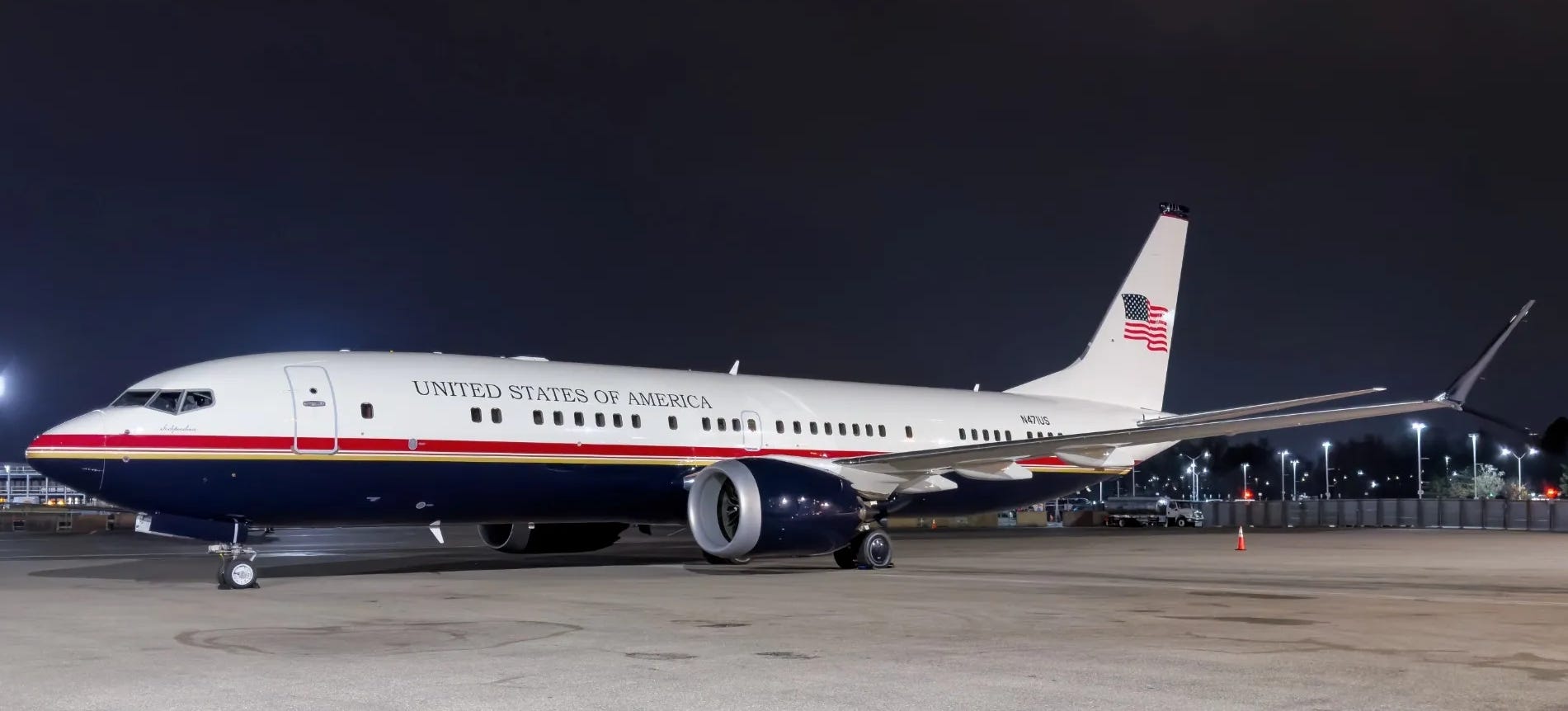
In late 2025 and early 2026, public reporting detailed major aircraft acquisitions by the Department of Homeland Security, including Gulfstream G700 contracts and efforts to bring a Boeing 737 MAX 8 into DHS service.
Reported costs reached into the hundreds of millions with limited or no competitive bidding, drawing criticism amid broader budget pressures.
Aviation records show that one apparent luxury Boeing 737 MAX 8 now associated with DHS operations - civil registration N471US - had previously been registered to Fertitta Enterprises. Tilman Fertitta is a business executive, a public supporter of President Trump, and the new U.S. Ambassador to Italy.
There has been no public finding of wrongdoing.
But transactions of this scale - particularly when they involve politically connected sellers - are precisely the kinds of matters that traditionally draw sustained Inspector General scrutiny.
Procurement justifications are examined.
Valuations are questioned.
Decision chains are documented.
That scrutiny is not incidental. It is the mechanism by which discretion is constrained.
When it is weakened or removed, the question is no longer whether decisions are defensible, but whether anyone will ask.
What Weak Oversight Changes
Inspectors General do not run agencies.
They do not set policy or make decisions.
They impose friction.
They ask for procurement justifications.
They examine travel records.
They document decision chains and publish findings that force discretion into daylight.
Their function is not to prevent authority from being exercised, but to ensure that it must be explained.
When that expectation fades, the change is rarely dramatic.
It is procedural.
From review to rubber stamp.
From documentation to discretion.
From defensibility to entitlement.
Over time, authority exercised without sustained scrutiny stops feeling provisional and begins to feel earned.
Decisions no longer require justification so much as affirmation. And privilege - authority with fewer constraints - becomes not an exception, but a norm.
Privilege as Currency
Privilege functions as currency when accountability weakens.
It can be accumulated, exchanged, and protected.
It confers advantages that are practical rather than symbolic: autonomy over resources, freedom from documentation, access without friction, and insulation from consequence.
For those positioned closest to power, these benefits are neither theoretical nor evenly distributed.
They are experienced through travel approved without question, contracts advanced without delay, and decisions made without the habitual expectation of review.
Over time, privilege becomes less a favor than a condition of service.
This is why loyalty persists even when public scrutiny intensifies.
Some enable power out of ideology.
Some out of ambition.
Some out of fear.But many remain because privilege - authority exercised with fewer constraints - is real.
It is felt.
It is useful.
And it is difficult to surrender once normalized.
In such an environment, being a quisling is not understood internally as betrayal.
It is understood as prudence.
The rewards are immediate.
The risks deferred.
And the costs of dissent made unmistakably clear - not through punishment alone, but through exclusion from privilege others continue to enjoy.
Conclusion
The lasting consequence of erasing accountability is not any single decision made in its absence.
It is the culture that follows: one in which power no longer expects to explain itself, and privilege no longer feels borrowed.
A year on, the lesson has been absorbed.
Authority without oversight does not merely endure - it teaches.
And what it teaches is that loyalty pays.
Notes:
The photo is of “N471US” - a Boeing 737 MAX 8. More info here.
The DHS spokesperson, Tricia McLaughlin, is reported to have called the plane's luxury features "part of Secretary Noem’s broader efforts to clamp down on inefficiencies." Hmm…