

Empires don’t fall because they lose battles. They fall because their allies stop answering the phone.
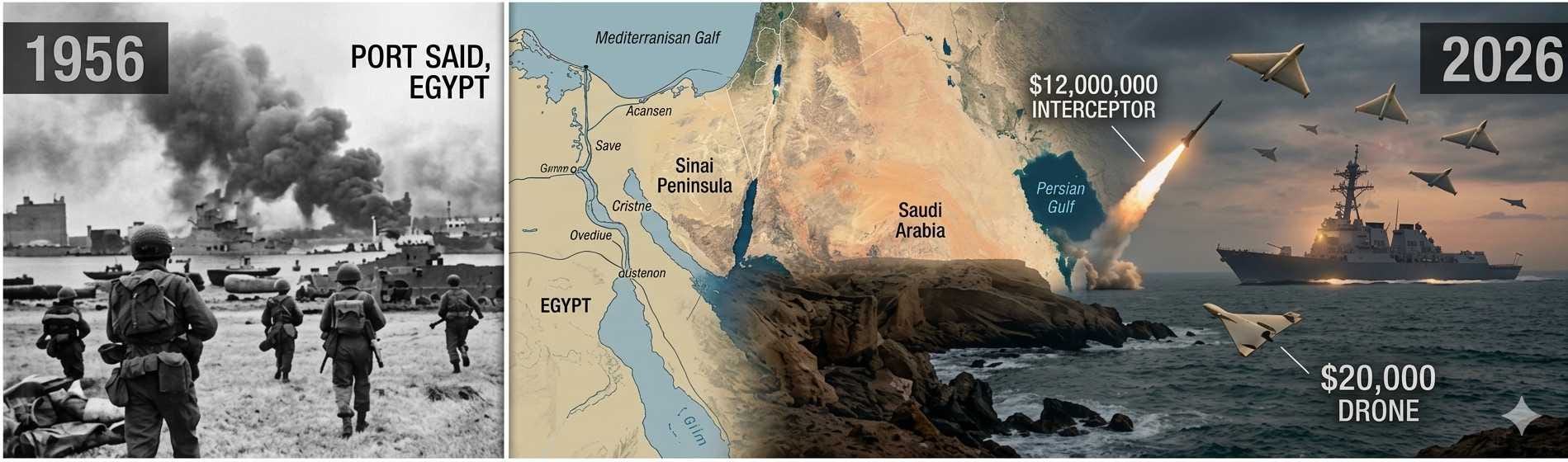
The parallels are no longer academic. They’re becoming visceral.
If the 1956 Suez Crisis marked the final breath of the British Empire, the recent intervention in Iran may be shaping up as America’s Suez moment - the point where ambition collides with alliance, and the empire discovers it can no longer count on the support that made its power possible.
The Precedent
In July 1956, Egyptian President Gamal Abdel Nasser nationalized the Suez Canal. For British Prime Minister Anthony Eden, this wasn’t merely a policy challenge - it was a personal affront and an existential threat to what remained of British imperial prestige.
Eden - driven by wounded pride and an obsession with Nasser he compared to appeasing Hitler - led Britain into a tactical victory that became a strategic funeral. Britain seized the canal. Britain lost the world.
They weren’t undone by Egyptian bullets. They were undone by a phone call from Washington and a run on the pound sterling. President Eisenhower refused to support the British economy until they withdrew. The illusion of British dominance didn’t fade gradually. It vanished overnight.
The mechanics of imperial overreach don’t change. A superpower attempts to solve a 21st-century asymmetric problem with 20th-century kinetic force - and discovers too late that the real asymmetry is diplomatic.
The Chokepoint
Where Eden feared losing control of the Suez Canal, we face the potential closure or tolling of the Strait of Hormuz. The vulnerability is identical: global energy flowing through a narrow artery that cannot be held by force alone.
It remains the Achilles’ heel of Western power. Geography is undefeated.
The Arithmetic
Britain was brought to heel not by battlefield losses, but by the withdrawal of American support. Today the arithmetic is more complex - and the isolation more complete.
We fired million-dollar interceptors at swarm drones that cost less than a used car. Operation Epic Fury has cost an estimated $1 billion per day until the ceasefire. Pentagon projections suggested that sustaining that tempo would drain critical munitions stockpiles within months.
But the unsustainable equation isn’t purely financial. It’s the mismatch between American action and allied consent. Britain learned in 1956 that military capability means nothing without allied backing. We’re learning it again.
The Enablers
Eden was surrounded by men who believed the postwar world still revolved around London - men who mistook the memory of power for power itself.
We know their American counterparts.
“This is the best money we’ve ever spent... When this regime falls in Iran, we’re gonna make a ton of money.” - Senator Lindsey Graham, February 2026
Lindsey Graham: The most visible cheerleader. After repeated pre-war trips to Israel and public advocacy for strikes, Graham hailed the conflict as “the best money ever spent,” adding that when Iran’s regime falls, “we’re gonna make a ton of money.” The troops he simultaneously praised in prayerful social media posts might be forgiven for wondering whether their lives had been priced into that ROI calculation.
John Thune: The institutional stamp. After strikes launched without congressional authorization, the Senate majority leader commended the president’s “decisive action.” He did not call the Senate back into session. He did not demand a legal basis under the War Powers Resolution. He did not ask about strategy, timeline, or exit criteria. He offered cover. Nothing more. That is the job he chose.
JD Vance: The man who knew better. Reporting indicates Vance privately warned that war with Iran risked regional chaos and mass U.S. casualties. Once the decision was made, he defended the strikes publicly and became the administration’s face for ceasefire diplomacy. History will record both halves of that sentence: the private warning and the public alignment. It always does.
The Vacuum
The most profound difference between 1956 and now is the absence of a successor.
When Britain stumbled at Suez, the United States stepped in to stabilize the global system. Eisenhower’s phone call wasn’t just financial pressure - it was the explicit withdrawal of allied support. Britain discovered that imperial adventures require allied consent, and that consent had expired.
In 2026, the script has flipped. As America launched strikes without consulting NATO allies whose economies depend on stable energy markets, European patience with American unilateralism reached its limit. The same administration that floated annexing Greenland and publicly humiliated longstanding partners now expects those partners to absorb economic shocks from a war they didn’t authorize and can’t afford.
The asymmetry isn’t just military - million-dollar interceptors versus cheap drones. It’s geopolitical. We bear a fraction of the economic pain while European industries face energy price spikes and supply disruptions. They’re tired of American inconstancy. They resent footing the bill for decisions made in Washington.
No benign hegemon waits in the wings to stabilize what we’ve destabilized. Just a fragmented, multi-polar horizon where former allies pursue their own accommodations and global institutions erode.
The Choice
The men who led Britain into Suez were not cartoon villains. They were serious people who mistook momentum for strength. They believed one more show of force would restore what time and treasure had already spent.
Military and diplomatic warnings at the time cautioned that force would not achieve Eden’s strategic objectives. He proceeded anyway.
The men who enabled this intervention in Iran made the same calculation. Intelligence assessments warned that even large-scale military action was unlikely to dislodge Iran’s entrenched system. The senators who offered institutional cover had access to these assessments.
They proceeded anyway.
That is not a footnote. That is the chapter.
And when the historians write it, the names will be listed in full.
What are you seeing in your district? Are your representatives explaining why they supported - or stayed silent on - strikes launched without congressional authorization? The historical pattern is clear. The question is whether enough Americans are paying attention this time.
Interesting perspective. There is no-one to replace the U.S.. Is this the end of the American century and the start of the Chinese century - and what does that entail for democracies. These Quisling posts are always thought provoking.