

One of the most surprising realizations in recent years is that, in America, the impulses and schemes of just one man and his minions can result in things like these:
A Middle East war that has no end in sight
The near elimination of successful soft-power initiatives like USAID, Voice of America, Radio Free Europe/Radio Liberty, and the National Endowment for Democracy
A war of words and trade with Canada, alienating the country that was formerly our closest ally
Trade wars and tariffs erratic enough to fracture long-time alliances and dent confidence in the dollar itself, nudging partners toward alternatives
A reorientation of foreign policy to distance former friends and cozy up to dictators
As we pointed out in “Putin’s Wishlist,” America has made a U-turn of catastrophic proportions while Congress has been silent and the Supreme Court has been busy enabling it.
We used to think that the Constitution created a “ship of state” that made slow turns and could be depended on by allies. But that’s no longer true - and there’s a quisling explanation.
The framers put Congress first for a reason.
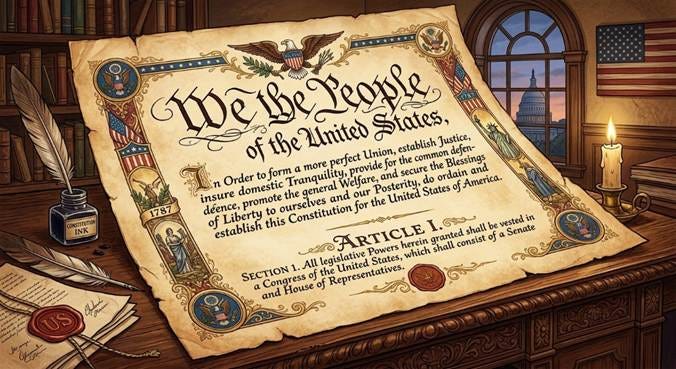
Article I is the legislature. Article II is the presidency. That is not an accidental sequence. It is the founding generation telling us, in the very structure of the document, who they trusted least with power and who was supposed to answer to whom. A people who had just fought a war against a king wrote the first article about the branch closest to them - where most have to face voters every two years; and the second article about the man who would sit alone in an office they feared most.
We have that backward now. In practice, Article II acts and Article I complies.
Start with the numbers
Article I, Section 8 hands Congress an actual list: tax and spend, regulate commerce, declare war, raise armies - and, after seventeen specific grants, the power to make all laws “necessary and proper” for carrying the rest out.
Article II, by comparison, is thin. Strip out the parts the president shares with the Senate - treaties, appointments, both requiring consent - and what is left is short: commander in chief, pardons, receiving ambassadors, reporting to Congress on the state of the union, and a closing instruction to “take care that the laws be faithfully executed.” That is the whole of it. One office was built with a list. The other was built with a sentence and a promise to behave.
The “unitary executive” is a theory about that one sentence. It reads the vesting clause - “the executive power shall be vested in a President” - as a grant of total, personal command over everyone who works for the federal government, immune from the limits Congress writes into the laws that created their jobs. So...
Congress builds an independent commission with fixed terms and for-cause removal protections; the theory says the president may fire its members anyway, because the Constitution recognizes no such thing as an independent officer.
Congress appropriates money for a purpose; the theory says the president may decline to spend it, because faithful execution is his judgment to make.
The theory is not new - conservative lawyers inside the Reagan Justice Department sketched it out in the 1980s, and for forty years it lived mainly in law review articles and dissenting opinions. What changed is that it now has five votes.
This is not a fringe argument anymore. It is settled law.
The FTC Commissioner
On June 29, 2026, the Supreme Court decided Trump v. Slaughter, 6–3, and let the president remove a sitting FTC commissioner without the cause Congress had written into the statute. In doing so it overturned Humphrey’s Executor v. United States, a decision that had stood for ninety-one years.
Chief Justice Roberts wrote that the old precedent was “tethered to a highly circumscribed” view of agency power that no longer holds, since a modern regulator like the FTC “unquestionably exercises executive power.”
Justice Sotomayor, dissenting, warned that the ruling “reshapes our Government,” converting roughly two dozen commissions Congress designed to be insulated from the White House - over energy, consumer safety, nuclear oversight - into ordinary executive agencies answering to one man.
The same term, the administration withheld close to $4 billion in foreign aid that Congress had already appropriated - impoundment, the practice Congress outlawed by statute in 1974 after Nixon tried it, and which the administration now argues the president may simply do again.
Scholars call the power of the purse Congress’s single most fundamental lever, the one the framers gave it precisely because a Congress that cannot control spending cannot control anything else.
Meanwhile, DOGE, an office built to shrink the federal workforce, moved to dissolve or fold together entire agencies that only Congress had the authority to create in the first place - not by asking Congress to repeal the statutes that established them, but by treating those statutes as suggestions.
None of this required a constitutional amendment. It required only a legal theory patient enough to wait for a friendly court.
Here’s the mockery in it
Article I comes before Article II because the legislature was supposed to come first - first in trust, first in accountability, first in the sequence of government the framers imagined, back when a standing army and a permanent bureaucracy were things Americans worried about, not things they’d stopped noticing. Unitary executive theory does not amend that order. It just ignores it, quietly, one removal power and one impounded appropriation at a time, until the numbering in the document is the only thing left that still says Congress goes first.
We are not here to tell you what to conclude from that. We are only pointing out that the Constitution, read as written, put a check on presidential power in Article I before it got around to describing the presidency in Article II - and that the office built on the shorter article has spent this last year and a half arguing, with real success, that the shorter article is the only one that matters.
The Quislings
Before we close, let’s name the quislings at the Supreme Court (which, incidentally, was established even later in the Constitution - in Article III):
● Justice Roberts - check our index at https://quislings.info/quislings-substack/ to see an extensive list.
● Justice Alito - Whose home flew an inverted flag associated with the “Stop the Steal” movement in the days after January 6th.
● Justice Thomas - The poster child for undisclosed gifts, whose wife exchanged text messages with the White House chief of staff urging that the 2020 election be overturned.
● Justice Gorsuch - Who occupies the seat Senate Republicans held open for more than a year rather than let a sitting president fill it, and wrote separately in Trump v. Slaughter to warn about concentrated presidential power - while arguing courts, not Congress, should be the ones reining it in.
● Justice Kavanaugh - Who argued, as a federal appeals judge a decade before this case reached him, that this same kind of independent-agency structure was already unconstitutional.
● Justice Barrett - Confirmed just eight days before the 2020 election, thirty days after her nomination - one of the fastest confirmations in the Court’s modern history.
Plus, of course, nearly an entire Republican Congress that has sat silent, somehow thinking that this unitary executive idea wouldn’t come back to bite them when the next Democrat is in the Oval Office.
Sources
● What Is Unitary Executive Theory? How Is Trump Using It to Push His Agenda? - Democracy Docket
● Trump v. Slaughter - vote breakdown - Wikipedia
● Justice Gorsuch’s Slaughter Opinion Is a Direct Threat to Congress - Just Security
● Supreme Court term weakens Congress and expands Trump power - Axios
● ArtI.S8.1 Overview of Congress’s Enumerated Powers - Constitution Annotated, Library of Congress
● Why the Legislative Branch Is Listed First in Article I - Constituting America
● Justice Alito’s home flew a U.S. flag upside down after Jan. 6, a report says - PBS News
● Text messages reveal Ginni Thomas urged Mark Meadows toward overturning election results - NPR
● Judge Kavanaugh on Separation of Powers - American Constitution Society
● Senate confirms Amy Coney Barrett to the Supreme Court - NPR
● Trump’s Ukraine-Russia peace plan, in the full 28 points - Axios
● Democracy-promoting organization sues the Trump administration over withheld funds - NPR
● Judge freezes Trump plan to dismantle Radio Free Europe/Radio Liberty - NPR
Does this mean that we have to wait for a change in the Supreme Court justices for the Constitution to prevail as implied?