

In Ian Fleming's story, both sides - Russia and Britain - are working an angle. In this one, only one side appears to be. Russia is getting the love. America is getting the bill. And somewhere between those two facts lies a question that keeps getting harder to dismiss.
This week, U.S. Special Envoy Steve Witkoff publicly relayed a denial from Vladimir Putin: Russia, he said, is not sharing intelligence with Iran. This despite U.S. intelligence reports - confirmed by The Washington Post - that Moscow has provided Tehran with targeting data on American ships and aircraft.
Witkoff’s response to the contradiction:
“We can take them at their word. Let’s hope they’re not sharing.”
Hope. As policy.
It is a familiar posture. The reflexive benefit of the doubt extended to the Kremlin dates to the 2018 Helsinki Summit, when the President stood beside Putin and publicly rejected the unanimous findings of his own intelligence community on Russian election interference, describing Putin’s denial as “strong and powerful.”
“President Putin says it’s not Russia. I don’t see any reason why it would be.”
That was the opening move. What followed is a ledger.
The Concessions, in Order
Each decision below was explained at the time as pragmatic, tactical, or temporary. Taken together, they tell a different story. The names attached to these decisions are not anonymous bureaucrats. They are Cabinet officers who swore an oath to the Constitution.
Pam Bondi, on her first day as Attorney General, dismantled the Justice Department’s KleptoCapture task force - the unit created to seize assets from sanctioned Russian oligarchs - and also shut down the federal programs designed to detect and counter Russian influence operations inside the United States.
Pete Hegseth, as Secretary of Defense, ordered U.S. Cyber Command to halt offensive cyber operations and planning against Russia. While Russian hackers continued probing Western infrastructure, America’s cyber deterrent was stood down.
Marco Rubio, as Secretary of State, traveled to Saudi Arabia to begin “peace negotiations” with Russia over the future of Ukraine. Ukraine was not invited to the table.
The administration also withdrew the United States from the International Center for the Prosecution of the Crime of Aggression against Ukraine - the multinational body investigating Putin and Russian leadership for war crimes - and terminated U.S. funding for programs documenting Russian atrocities, including a database tracking the forced deportation of Ukrainian children to Russia. No named official claimed credit. The Justice Department cited only a need to “redeploy resources.”
JD Vance traveled uninvited to Greenland in March 2025 to publicly berate Denmark - a NATO ally - for “underinvesting” in the territory’s security. The administration has repeatedly declined to rule out military force to acquire it. Denmark’s prime minister said such action would mean “the end of NATO.” Russia’s president called Trump’s intentions serious and historically rooted.
Scott Bessent, as Treasury Secretary, has been the public face of a tariff policy that has strained relations with every major democratic trading partner simultaneously - Canada, the European Union, Japan, South Korea. In a private investor meeting, Bessent himself called the tariff situation “unsustainable.” In public, he called it “strategic uncertainty.” The result is the same: allies estranged, relationships fractured, and Moscow’s longstanding goal of a divided West advancing without Russia having to do a thing.
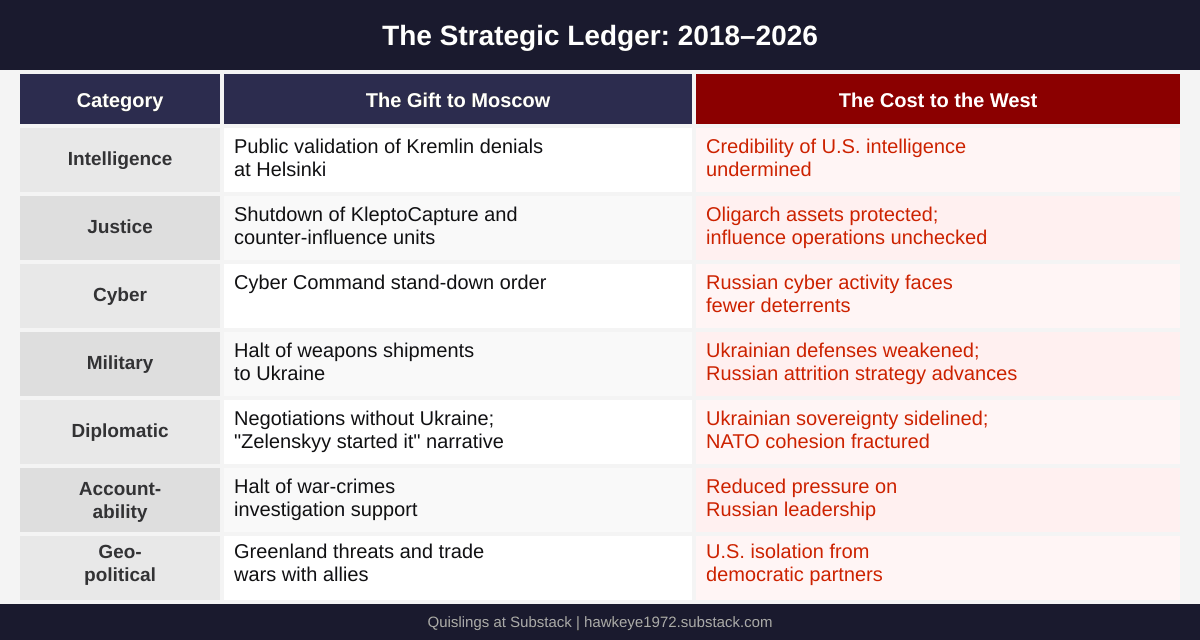
The ledger of what these decisions delivered - and what they cost - is consistent across every category:
The Question of the Return
Taken individually, each item on that ledger can be explained away. An isolated choice. A tactical pause. A diplomatic experiment.
Taken together, across nearly a decade, the cumulative effect is a strategic windfall for Moscow: intelligence sidelined, accountability dismantled, alliances strained, and Ukraine negotiated over rather than with.
The pattern is visible. The ledger is documented. The beneficiary is consistent.
The ledger is what it is. Russia is getting the love. America is getting the bill. The only question left is who’s getting the rest.
If this landed, share it with someone still looking for innocent explanations.
Last night, Trump removed sanctions on Russian oil shipments for the next 30 days. An estimated 120+ million barrels of oil presently stranded on tankers can now be sold. At $100 a barrel... Putin loves it.
Trump has a Putin envy complex.