

Soon after his inauguration, Donald Trump amplified one of Napoleon’s most dangerous ideas: “He who saves his country does not violate any law.”
It is a seductive doctrine - simple, absolute, and infinitely elastic. And it has always attracted leaders who believe themselves to be the exception to every rule they invoke.
The parallels are real. But perhaps not the ones intended.
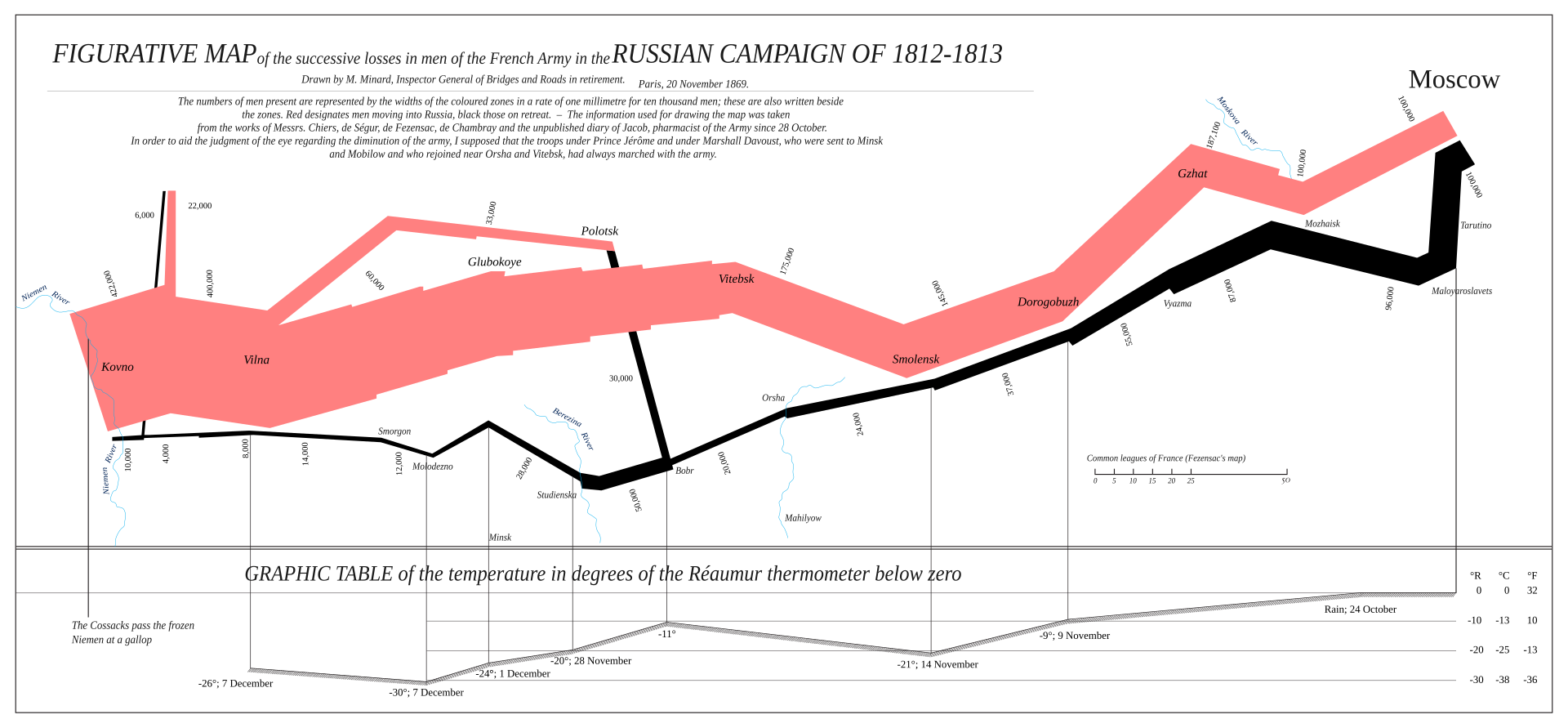
The image above redraws Charles Joseph Minard’s legendary map of Napoleon‘s invasion of Russia in 1812 - a visual epitaph for an army of 422,000 that returned with only 10,000. Its power lies in its restraint: a single, thinning line charting the slow erasure of an empire’s ambition against distance and cold.
The width of the line represents the size of the army and tells the story of a catastrophe disguised as strategy:
250,000 dead from cold, starvation, and exhaustion
100,000 lost to disease, mostly typhus
Only 40,000 killed in battle
War did not destroy Napoleon’s army. Overconfidence did.
But Quislings at Substack isn’t a history blog. It’s a warning.
Napoleon’s failure was not merely logistical. It was psychological - a fatal confidence in a “short campaign,” a belief that momentum could substitute for planning, and that willpower could bend reality to its timeline.
That same delusion echoes today in the rhetoric surrounding conflict in the Persian Gulf: promises of swift victory giving way to something slower, costlier, and far less defined. What begins as certainty gradually narrows - resources, options, credibility - until the shape of the outcome starts to resemble Minard’s line.
While Defense Secretary Pete Hegseth frames the conflict in sweeping, almost crusading terms, the reality looks less like triumph than attrition. Not the catastrophic human losses of 1812, but a steady hemorrhaging all the same - of money, of weapons stockpiles, of alliances, of strategic clarity.
The assumption persists:
that force alone can resolve what has no clear endpoint,
that an ideology can be bombed into submission,
that a war without a defined conclusion will somehow conclude itself.
The People Who Keep Marching
Like Napoleon, the architects of such campaigns tend to dismiss constraint as weakness. Advisors become obstacles. Limits become inconveniences. Law becomes optional - so long as the outcome is framed as salvation.
One difference is that Napoleon did have advisors who warned against the invasion of Russia. One of the clearest voices was the former ambassador to Russia, who understood the geography, the climate, and the political realities.
Napoleon ignored those warnings.
But where were the warnings for this Iran war?
There was no meaningful consultation with Congress, and key military leadership had already been reshaped in ways that limited internal dissent.
And then, afterwards, we have the enablers.
In early March, the Republicans in the Senate moved to block a war powers resolution that would have required explicit congressional authorization for continued military action against Iran. The margin was narrow, but decisive - a reminder that even as the line narrows, the machinery keeps moving.
Oversight has not kept pace. Key committee leadership, including Jim Risch, chairman of the Senate Foreign Relations Committee, has resisted calls for public hearings into the conflict, arguing they would be “counterproductive.” Counterproductive to what is left unsaid - but the effect is clear: less scrutiny, less accountability, and less public understanding of what is being done in its name.
Other defenders of the status quo have gone further. Lindsey Graham has dismissed congressional efforts to assert authority over war-making in blunt terms, framing such efforts as an overreach rather than a responsibility. It is an inversion of the constitutional design - one that treats oversight not as duty, but as interference.
Meanwhile, the material commitments continue to expand. The Pentagon has requested more than $200 billion in supplemental funding tied to the conflict - a war launched without clear authorization and now seeking sustained financial backing. Some senators, including Susan Collins and Todd Young, have expressed concerns about mission clarity even as they voted against measures that would have forced a fuller debate.
The war is now entering its second month. Estimates of the cost range between $15 billion and $25 billion. Thirteen American service members are dead. Cheap Iranian drones are steadily depleting stockpiles of far more sophisticated - and far more expensive - defensive weapons (for more on that subject, visit our post “When No One Says No”).

And there has been no public hearing. No testimony from Pete Hegseth or Marco Rubio. No floor debate over objectives, timelines, or exit strategy.
Just votes. Blocking oversight. Keeping the line moving.
Quislings in Congress.
Napoleon’s law-breaking patriotism did not secure his legacy. It delivered him to a damp house on the island of Saint Helena, where he spent his final years arguing with his doctor and staring out at the Atlantic - his empire reduced to memory.
Of course, Napoleon didn’t have a diversified real estate portfolio.
Our modern-day Bonaparte has options the Frenchman never had. He could seek “political asylum” in Moscow - or retire to one of the Trump Towers rising in Dubai or Riyadh, far from the consequences.
There, he can look out over the region he helped set on fire, while the rest of the world deals with the bill.
Please keep these going. They are frighteningly insightful and educational, but like a train wreck, we cannot afford to look away.
Your posts are all so well thought out and important. Are you considering ways to significantly increase the distribution?