

“Neither snow nor rain nor heat nor gloom of night stays these couriers from the swift completion of their appointed rounds” is a phrase and informal motto of the US Postal Service. Maybe that’s changing.
Postmaster General David Steiner spent sixteen years running Waste Management, then sat on FedEx’s board as its lead independent director. In May 2025, the Postal Service’s Board of Governors narrowed its search for a new Postmaster General to three names - and Trump personally intervened, dismissing one finalist and telling the board he wanted Steiner.
Steiner was sworn in that July as the 76th Postmaster General. He is the second consecutive Trump-era Postmaster General with no Postal Service background - a reversal of the twenty-two years of career postal officials who ran USPS before Louis DeJoy in Trump 45.
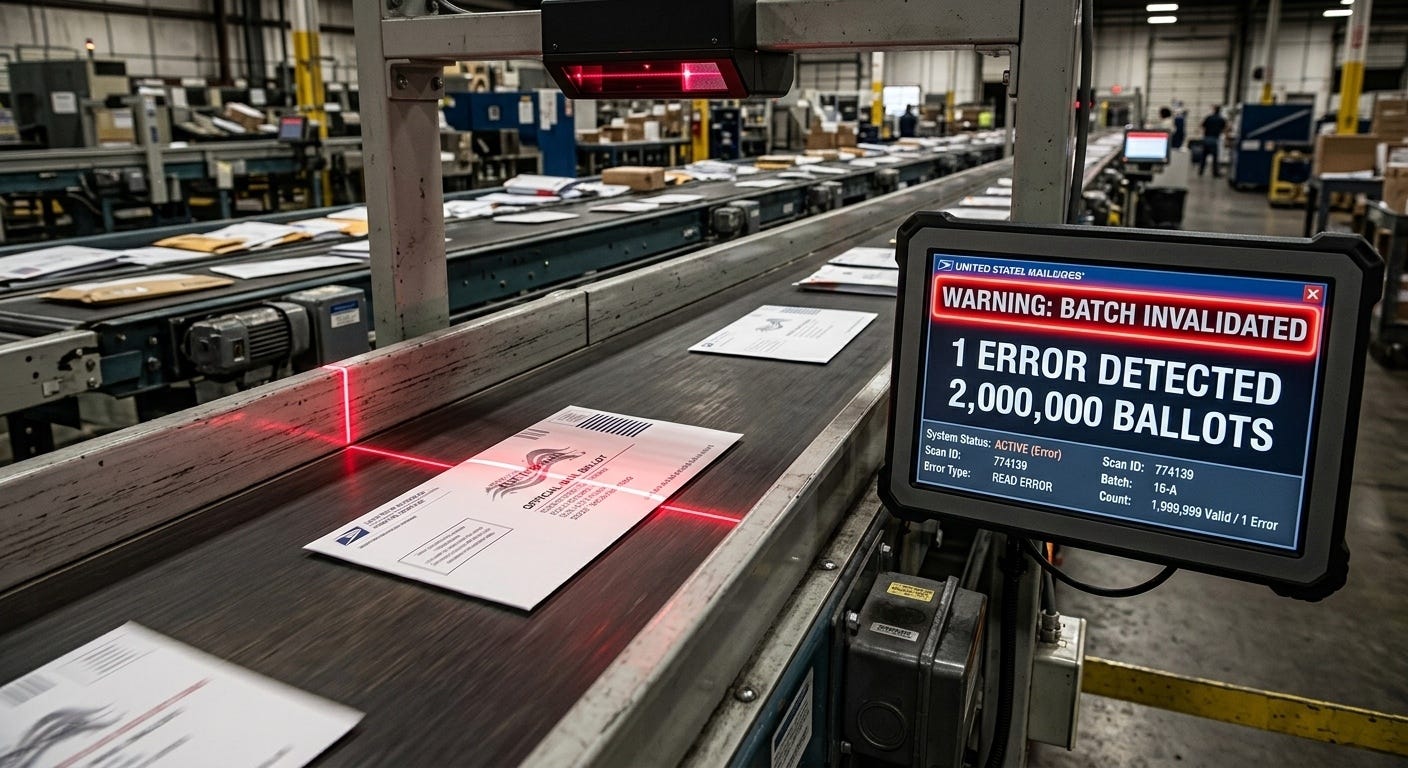
Nine months later, Trump signed an executive order telling USPS to stop treating every mail voter the same. States would have to hand over lists of who requested a mail ballot at least thirty days before ballots go out; anyone missing from a state’s list would not get one. Steiner’s agency built a system to enforce it - and, according to a Postal Service whistleblower, built it so that a single unreadable barcode on a single ballot could void an entire batch.
As an example, in Maricopa County AZ, that batch might be a mailing of more than two million ballots riding on one scan.
Asked directly by senators on June 24 whether ballots would go out to voters missing from a state’s list, Steiner answered, “Under our proposed regulation, no.”
Is Voting by Mail Really A Problem?
The problem Trump and Steiner are addressing does not exist in the numbers:
Brookings puts mail-ballot fraud at roughly four in ten million ballots cast.
A 2020 American Statistical Association study found no elevated fraud risk from mail voting at all.
A twelve-year News21 review, covering hundreds of millions of ballots, turned up 491 alleged cases nationwide.
What mail ballots reliably produce instead is turnout: 46% of 2020 voters used one, in the highest-turnout election in over a century.
A Consequential Quisling
Steiner has other options available that would have the same effect, without issuing another headline-grabbing rule:
Thin the staff. Already underway - 35,000 jobs cut in four years, a $9.5 billion annual loss, and Steiner telling Congress in March that reduced delivery days and involuntary layoffs are “on the table.” Louis DeJoy tried a version of this in 2020: pulled sorting machines, cut overtime, mail slowed nationwide weeks before the election, and it took a federal court order to reverse it. So Steiner wouldn’t need to write a new playbook - the 2020 one already exists.
Call a mail holiday. Nothing stops a Postmaster General from declaring a service “exigency” and slowing processing in the name of a cash crisis he has already testified, under oath, is real. A financial emergency and a voting-rights emergency would be almost impossible for outsiders to tell apart on paper.
Write another rule. The March executive order has already produced a 95-page draft, built and waiting so it can take effect “immediately” the moment a court stops blocking it. There’s no reason to expect it’s the last one.
So far, courts have said no - and USPS kept building anyway. A federal judge in Massachusetts blocked the rule in June, calling it an unconstitutional attempt to insert the executive branch into election administration, and blocked it again in August. In between, according to a Postal Service whistleblower, USPS quietly resumed building the ballot-verification system in July, weeks after telling the court it was complying. The judge agreed: on August 25, she found USPS had in fact violated her order, writing that officials “cannot contend that they misunderstood the scope of the court’s order.”
The Trump administration has gone to the Supreme Court three times since to get the block lifted before ballots go out in North Carolina and Alabama.
Each trip resets the clock. File, get blocked, appeal, wait - and let the emergency docket decide, quietly and without full briefing, right as the deadline arrives. By the time anyone rules on the merits, the ballots will already be mailed, or they won’t have been. November doesn’t wait for the Supreme Court, and the Court has shown no urgency about making sure it doesn’t have to.
The Court has already tipped its hand once. On August 25, a 6-3 majority let three other pieces of the order take effect - the citizenship-list sharing, the prosecution priority for state officials, and USPS’s ballot-design rulemaking - ruling that the challenging states “have not yet been harmed” and adding only, “On that score, time will tell.” That is a Supreme Court willing to let the rule run first and weigh the damage later. Delay works just as well as a win - by the time any ruling comes, the executive order will already have done what it was designed to do.
The Limits of Immunity
None of this makes Steiner untouchable. A federal officer’s immunity from prosecution covers only conduct that’s lawful and necessary to the job - and a judge has already found USPS crossed that line once, defying her order outright. Several states already criminalize knowingly delaying a ballot’s delivery, and unlike a federal case, a presidential pardon can’t reach a state conviction. No state has tested this against a sitting Postmaster General. That doesn’t mean none will.
Neither snow, nor rain, nor heat, nor gloom of night has ever stopped the mail. A quiet postmaster and a slow election might.
Sources
● CNN - “FedEx board member David Steiner to be next US postmaster general”: https://www.cnn.com/2025/05/09/politics/usps-postmaster-general-david-steiner
● Washington Post - “At Trump’s urging, USPS board to name David Steiner as postmaster general”: https://www.washingtonpost.com/business/2025/05/06/usps-trump-david-steiner/
● ProPublica - “New Mail Voting Rules Moved Forward Despite USPS Officials’ Concerns About Mass Disenfranchisement” (the executive order, the batch-rejection design, and the whistleblower’s allegation that USPS kept building the system during the injunctions): https://www.propublica.org/article/mail-voting-usps-officials-concerns-disenfranchisement
● Democracy Docket - “USPS repeatedly defied courts to advance Trump’s mail voting attack, whistleblower alleges” (the July 29 resumption and the timeline of injunctions): https://www.democracydocket.com/news-alerts/whistleblower-usps-violated-court-orders-advance-trump-mail-voting-attack/
● Axios - “Trump administration violated court order on mail-voting rules, judge says” (Judge Talwani’s August 25 finding and quote): https://www.axios.com/2026/08/25/usps-mail-voting-rule-injunction
● Democracy Docket - “Postmaster general says USPS won’t deliver mail ballots if states don’t give Trump admin voter rolls” (the June 24 Senate testimony): https://www.democracydocket.com/news-alerts/postmaster-general-steiner-postal-service-will-not-deliver-mail-ballots-state-voter-rolls/
● TIME - “The Facts About Mail-In Voting Fraud” (Brookings, ASA, News21, and turnout figures): https://time.com/article/2026/03/20/mail-voting-absentee-voter-fraud-trump-claims-research/
● Federal News Network - “USPS cutting delivery days ‘on the table,’ as agency runs out of cash, postmaster general tells lawmakers”: https://federalnewsnetwork.com/agency-oversight/2026/03/usps-cutting-delivery-days-on-the-table-as-agency-runs-out-of-cash-postmaster-general-tells-lawmakers/
● The Hill - “Federal judge says DeJoy changes to postal service before 2020 election harmed delivery”: https://thehill.com/regulation/court-battles/3678315-federal-judge-says-dejoy-changes-to-postal-service-before-2020-election-harmed-delivery/
● Votebeat - “2026 election: What’s the latest on Trump’s mail-voting executive order?” (the 95-page draft rule and Judge Talwani’s ruling that it was an unconstitutional attempt to usurp states’ election powers): https://www.votebeat.org/national/2026/08/28/trump-mail-voting-executive-order-2026-midterms-court-updates/
● SCOTUSblog - “Trump administration asks Supreme Court to clear the way for it to implement new mail-in voting rule”: https://www.scotusblog.com/2026/09/trump-administration-asks-supreme-court-to-clear-the-way-for-it-to-implement-new-mail-in-voting-/
● ABC News - coverage of the Supreme Court’s August 25, 2026 order, including the per curiam opinion’s “time will tell” language: https://abcnews.com/US/usps-makes-new-rules-mail-ballots/story?id=135879673
● State Court Report - “When Can States Prosecute Federal Agents?” (the scope and limits of a federal officer’s immunity from state prosecution): https://statecourtreport.org/our-work/analysis-opinion/when-can-states-prosecute-federal-agents
● University of Wisconsin State Democracy Research Initiative - “Can State Prohibitions on Election Interference Constrain Federal Actors?”: https://statedemocracy.law.wisc.edu/our-work/can-state-prohibitions-on-election-interference-constrain-federal-actors