

Hegseth is at it again.
At Quantico on September 30, in his “State of the Force” address, he told the assembled officers what the new military would look like: “No fatties, no trannies, no beardos, no weirdos. No wimps, no radicals. Just warriors.” Then he added that testosterone testing would come “on top.”
He wasn’t just attempting to poetize.
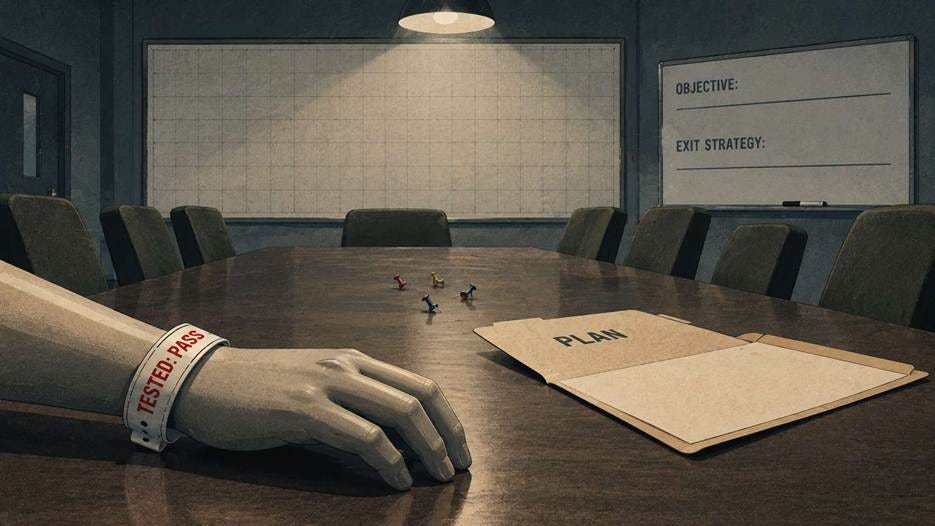
Since July the Pentagon has been moving toward mandatory testosterone screening for male troops age 30 and older, with treatment for anyone whose levels come up “suboptimal.”
The Pentagon clinical guidance released in late September concedes that the evidence “does not support its use to improve energy, vitality, physical function, or cognition.”
So the department is testing for a hormone that its own doctors say will not improve the thing it is after.
Toughness Was Never the Question
As we covered in “Iron Ladies,” testosterone is not required for toughness. History is full of women who ran armies and kingdoms through famine, siege and betrayal, and who would have pushed Hegseth’s face into the dirt, taken his lunch money and laughed at him.
The real question is thinking, and the same speech put it on the table. Hegseth also announced AutoWarCom, a four-star Autonomous Warfare Command meant to put drones and robots at the center of American fighting, which he called “the fastest peacetime shift in modern military history.” He added a futures study, Project Meridian, with Elon Musk, Newt Gingrich and Palmer Luckey helping lead it. The man who created chaos with DOGE, the first Speaker the House ever punished for ethics violations, and the man who sells the weapons. We couldn’t find evidence that any of them has served in the American military. They will still tell the Pentagon what the next war looks like. The generals who might have an opinion are being cut by 20 percent.
Consider the two announcements side by side. One says the next war will be fought by machines. The other says the humans still in the room should be screened for hormone levels. Are these compatible?
What the Science Says
The research does not say testosterone makes men stupid. It says something more useful. Restoring a genuine deficiency helps. Pushing normal levels higher buys no extra cognitive benefit. And elevated testosterone shifts the mind toward rapid, intuitive, reward-seeking choices and away from slow, deliberate calculation. It makes people hungrier for status and dominance, which is not the same thing as making them better strategists.
Two studies from the world of securities trading show what that looks like. In “The Bull of Wall Street,” published in Management Science in 2018, researchers gave 140 male traders either testosterone gel or a placebo and set them loose in simulated asset markets. The testosterone group produced larger, longer-lasting price bubbles. They bid higher, overestimated what assets were worth, and were slower to correct when the true value became plain.
The real-world version is a 2008 Cambridge study that tracked 17 London floor traders for eight days. Higher morning testosterone predicted higher profits, and also heightened risk-taking. The authors suspected a feedback loop: confidence breeds gains, gains breed more confidence, and left unchecked the loop ends in overconfidence, overleveraging and bubbles. That pattern should sound familiar to anyone who remembers how bubbles end.
The upside of the hormone is nerve. The downside is a man who will not stop to ask whether he is wrong. Wars have a way of sorting it out.
The Record So Far
Judge the strategist by the record. At a July 21 Senate hearing, Sen. Gary Peters told Hegseth: “You, sir, are the failure, not the men and women who are on that front line.” The Strait of Hormuz was still closed. The strikes on Iran were in their tenth straight night. Hegseth put the war’s cost at $37.5 billion, allowed that it may be low, and asked for another $87.6 billion. Peters wanted a plan to win. Hegseth wanted money.
The senator’s complaint was strategy, not funding. On September 30 at Quantico, Hegseth’s answer was to double his cut in generals and admirals to 20 percent, the people who are supposed to supply it.
Watch the Quantico speech itself. The list of exclusions is read haltingly, a string of rhymes that sounds practiced and lands on silence. One idea, delivered the one way he knows how, again and again.
Who Built the Machines
There is a quieter irony in the AI announcement. The people who built modern artificial intelligence did not do it whipped up on hormones. They did it over decades of patient, unglamorous, doubted work. Alan Turing asked whether machines could think in 1950. Geoffrey Hinton kept working on neural networks through the years when the field had written them off, and won a Nobel Prize in Physics in 2024. Many of those closest to the technology are now the loudest voices urging caution about handing it lethal decisions.
Amnesty International put it plainly: “the replacement of troops with machines makes the decision to go to war easier.”
Nobody ever won a Nobel by being quicker to trust a first impulse.
Strategy is what you do when impulse says otherwise. It is the discipline of the second thought, and no blood test measures it.
Sources
Hegseth State of the Force speech, full quote (Mediaite)
Video of the speech excerpt (YouTube)
AutoWarCom announcement (Democracy Now)
Pentagon testosterone testing policy (PBS NewsHour)
Nadler et al., 2018, “The Bull of Wall Street” (Management Science)
Coates and Herbert, 2008, London trading floor (PNAS)
Sen. Peters and Hegseth, July 21 hearing (PBS NewsHour)
House reprimands and penalizes Gingrich, 1997 (Washington Post)
Hegseth State of the Force address, 20% cut in generals and admirals (PBS NewsHour)
brains over brawn! great article.