

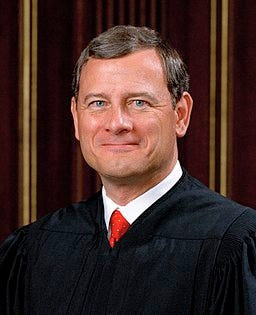
John Roberts is often portrayed as the Court’s institutionalist - a reasonable conservative who saved Obamacare and occasionally restrains his court’s right flank. That reputation has proven durable. It is also deeply misleading.
Roberts’ most consequential decisions follow a consistent pattern: expanding the political power of concentrated wealth, weakening structural protections for voters, and insulating executive authority from accountability. Each move is presented as narrow or institutional. Together, they shift the balance of power away from voters and toward those with money and access.
These are the mechanics of oligarchy - not the abolition of democracy, but the steady elevation of wealth over broad participation.
Three decisions define the arc: money without limits, voting without guardrails, and a presidency with sweeping immunity.
Money Without Limits: Citizens United
The transformation begins with Citizens United v. FEC. The case initially concerned whether a nonprofit could distribute a film critical of Hillary Clinton near an election. The Court could have resolved the dispute narrowly: “Yes, you can show the film.”
But Roberts saw an opening. According to reporting from Jeffrey Toobin in The New Yorker, Roberts scrapped an initial narrow opinion and ordered a rare re-argument. He didn’t just ask the lawyers to argue the case at hand; he directed them to argue for overturning decades of campaign finance precedent. Justice Souter’s dissent was scathing, accusing Roberts of manipulating the Court’s own procedures to reach a pre-ordained conclusion.
The resulting majority opinion contained a series of assertions detached from reality. Justice Kennedy (another “moderate”) wrote:
“[W]e now conclude that independent expenditures, including those made by corporations, do not give rise to corruption or the appearance of corruption. …
The fact that speakers [i.e., donors] may have influence over or access to elected officials does not mean that these officials are corrupt. …
The appearance of influence or access, furthermore, will not cause the electorate to lose faith in our democracy.”
As Robert Weissman of Public Citizen noted, “perhaps five people in Washington, D.C." believe this: "Justice Kennedy and the four justices who joined him."
The result was not simply more speech. It was the removal of meaningful limits on how wealth can shape elections.
The asymmetry became stark:
Individual voters remain capped in direct contributions to candidates.
Billionaires can spend unlimited sums through entities legally required to be independent of campaigns.
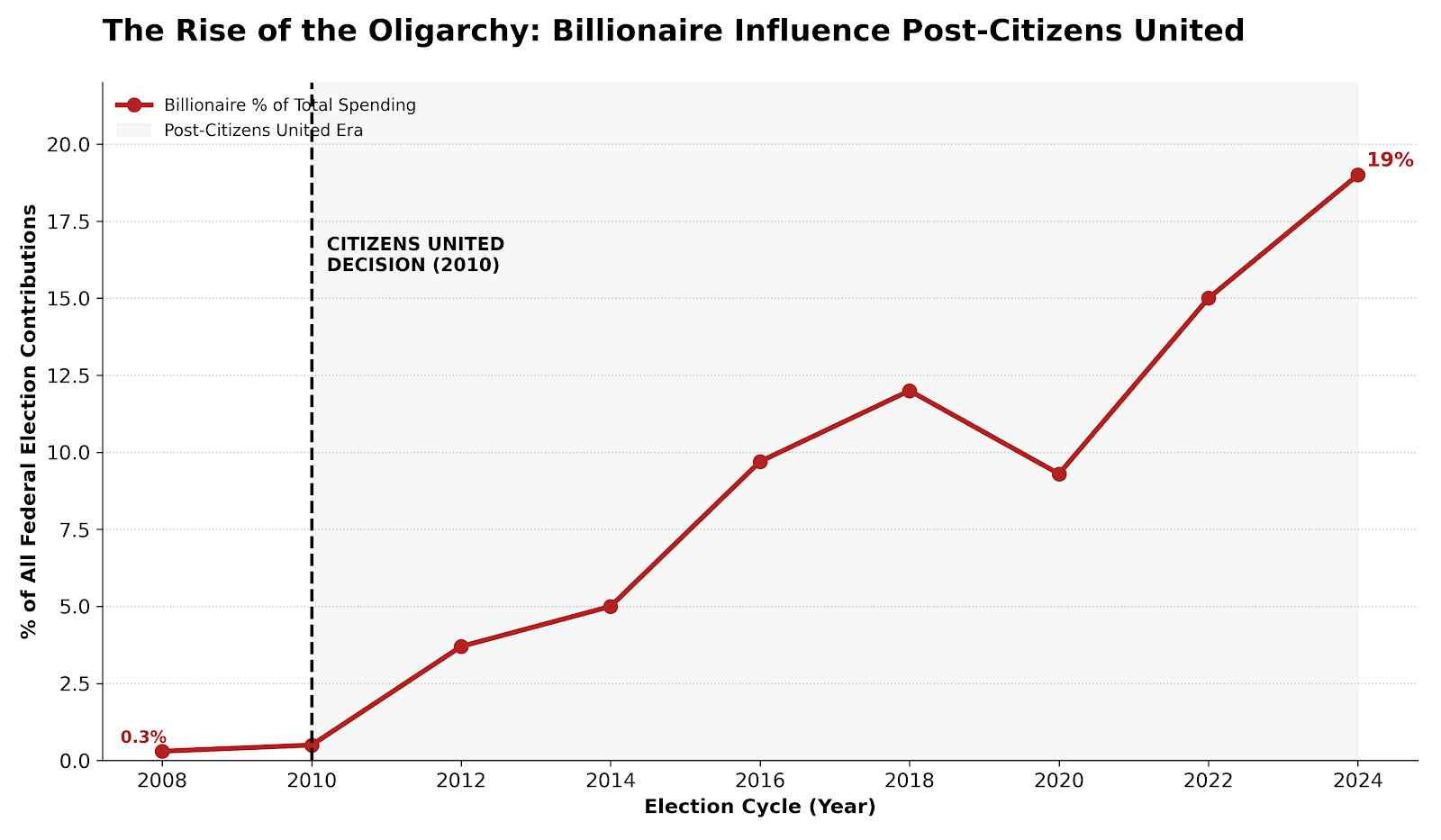
Before this ruling, billionaires accounted for 0.3% of federal election spending. By 2024, just 300 families contributed over $3 billion - nearly 20% of all federal donations.
This does not eliminate voting. It changes what voting competes against: a political marketplace increasingly dominated by concentrated capital. And clever people don’t spend money in these amounts without expectations.
Eliminating Guardrails and Adding Friction: Shelby County
The second pillar came with Shelby County v. Holder. The ruling struck down the coverage formula of the Voting Rights Act, disabling the preclearance system that required jurisdictions with histories of discrimination to obtain federal approval before changing election laws.
Roberts argued that the extraordinary protections of the Act were no longer justified because the VRA had been so successful in stopping discrimination, it was no longer needed.
The logic was circular: because the Voting Rights Act had reduced discrimination, Roberts argued its protections were no longer necessary. By that reasoning, you dismantle the fire department because most buildings aren’t burning.
The practical shift was structural. Before the decision, jurisdictions had to prove changes would not harm voters. Afterward, voters had to challenge changes in court - often after elections had already taken place.
The fallout was immediate. In the aftermath, states like North Carolina enacted restrictions that courts later found targeted Black voters with “surgical precision.” Within a few years, roughly 1,000 polling places in formerly covered jurisdictions had been shuttered.
When participation becomes harder, the relative influence of organized money increases. Lower turnout and higher barriers amplify the voice of those already positioned to shape campaigns through spending.
Power Without Accountability: Presidential Immunity
The third pillar arrived in Trump v. United States. Roberts’ opinion established a layered framework of presidential immunity, including absolute immunity for core constitutional powers and presumptive immunity for official acts. Within the ruling lies a remarkable restriction on the judiciary:
“In dividing official from unofficial conduct, courts may not inquire into the President’s motives.”
In other words: even if the president breaks the law for corrupt reasons, courts are forbidden from examining his intent.
While the decision claimed to protect executive independence, it effectively dismantled the pathways for accountability. Justice Sotomayor’s dissent was a chilling prophecy:
”When he uses his official powers in any way, under the majority’s reasoning, he now will be insulated from criminal prosecution. Orders the Navy’s Seal Team 6 to assassinate a political rival? Immune. Organizes a military coup to hold onto power? Immune. Takes a bribe in exchange for a pardon? Immune. Immune, immune, immune.”
This was published July 1, 2024. Imagine what she would say today. The ruling has already been cited at least 21 times in major filings to argue that specific presidential actions are “unreviewable.”
The impact is total. This invisible shield has moved beyond criminal defense; it is now the administration’s primary weapon to paralyze Congressional oversight and kill civil lawsuits before they reach discovery. By providing the legal framework to classify actions like mass deportations or domestic troop deployments as “core acts,” Roberts hasn’t just protected a President - he has effectively disabled the rest of the government's ability to check them.
In an oligarchic framework, this is the final piece of the puzzle. A president shielded by broad immunity - and armed with the pardon power - can reward allies and protect supporters with no legal risk. Political loyalty, financial backing, and executive protection are now one and the same. Roberts didn’t need to declare the President “above the law” in plain English; he simply made the law impossible to enforce.
The Architecture of Oligarchy
Taken individually, Roberts frames these decisions as mere institutional maintenance: protecting “speech,” respecting “sovereignty,” and preserving “independence.”
Taken together, they represent a fundamental structural shift:
Wealth gains a permanent seat at the table of election spending.
Participation faces increasing friction as voting protections are dismantled.
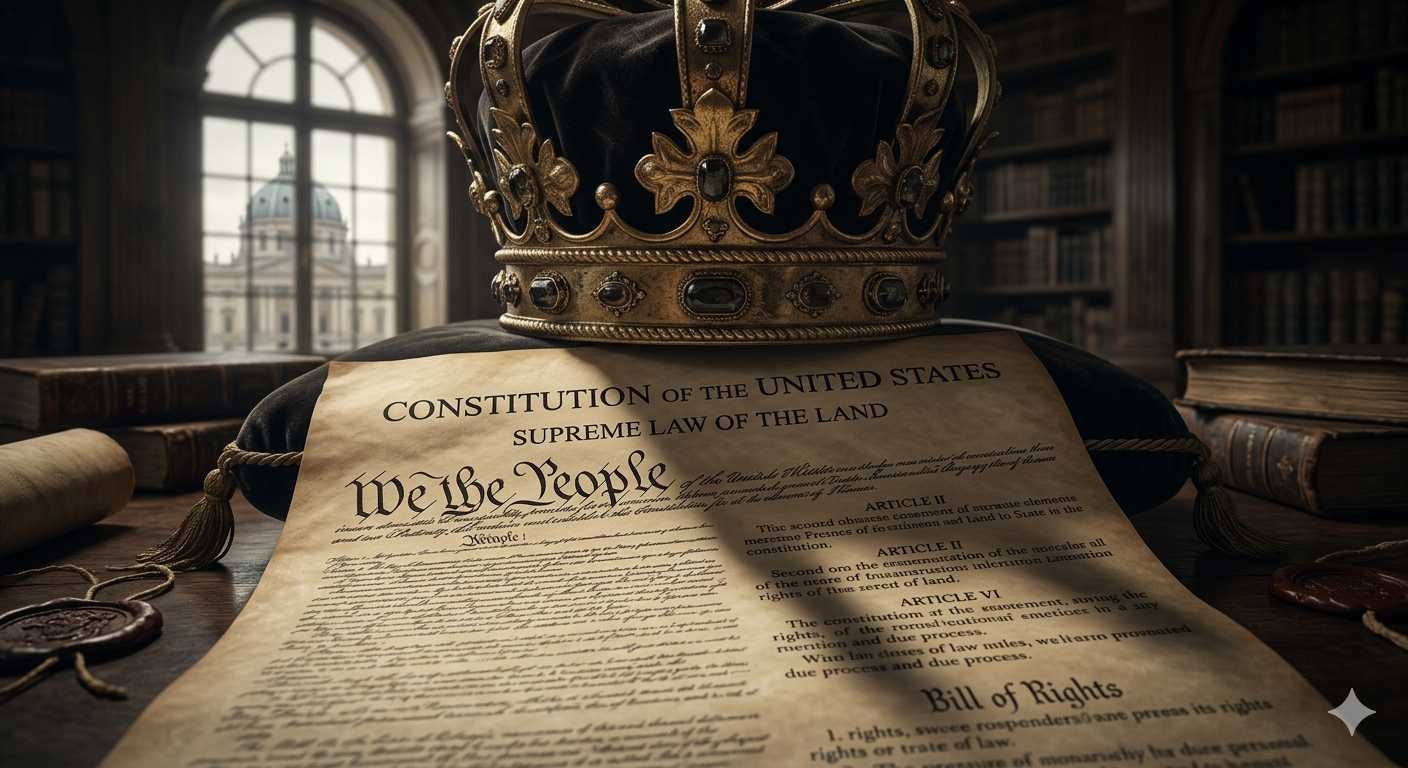
The Executive is insulated by a legal shield that mirrors the powers of a monarch.
This isn’t a sudden collapse of democracy. Elections still occur; courts still sit; laws are still passed. But the function has been hollowed out. When money shapes the narrative, voting is suppressed and power is unreachable by law, the system ceases to be a representative republic.
The “moderate” label is Roberts’ most essential tool in this transformation. By occasionally breaking with the Court’s far-right flank, he maintains a veneer of restraint. This tactical moderation buys him the institutional legitimacy he needs to finalize the most radical outcomes.
The mythology says John Roberts protects our institutions. The record shows he has preserved their form while gutting their purpose.
Democracy doesn’t usually disappear overnight. It tilts. And under Roberts, it has tilted so far that what remains is no longer self-government.
It is oligarchy.
If this work matters to you, you can help by sharing and forwarding emails - including past posts. Most political Substacks offer news commentary or analysis - ours is a record, and records only matter if they reach the people who need to see them.
Notes
Citizens United - https://en.wikipedia.org/wiki/Citizens_United_v._FEC
Anthony Kennedy - https://theintercept.com/2018/06/28/farewell-to-anthony-kennedy-author-of-some-of-the-most-ludicrous-words-in-supreme-court-history/
Billionaire contributions - https://www.brennancenter.org/our-work/research-reports/citizens-united-explained
Shelby County v. Holder - https://naacpldf.org/shelby-county-v-holder-impact/
Trump v. United States
https://nysba.org/trump-v-united-states-the-chilling-effects-of-potential-presidential-immunity/
The portrait of John Roberts as a cautious institutionalist has long been a comforting narrative for those who look for moderation within an increasingly polarized Supreme Court of the United States. It rests on visible moments—most notably his vote to preserve key elements of the Affordable Care Act—that suggest a jurist guided less by ideology than by concern for the Court’s legitimacy. But the durability of that image may obscure a more consequential pattern.
Viewed across decades, Roberts’ jurisprudence does not so much reject conservatism’s project as refine it. His opinions often operate incrementally, avoiding the rhetorical sharpness of some of his colleagues while nonetheless producing structural change. Cases like Citizens United v. FEC and Shelby County v. Holder illustrate this dynamic. In the former, the Court expanded the role of money in political speech; in the latter, it dismantled a key enforcement mechanism of the Voting Rights Act of 1965. Both were framed in constitutional terms—free speech, equal sovereignty of states—but their practical effect was to reshape who holds influence in the democratic process.
Critics argue that these decisions, taken together, tilt the system toward those with resources and institutional access. The logic is not overtly anti-democratic; it is procedural, even technical. Yet outcomes matter. When campaign finance restrictions are loosened and voting protections narrowed, the aggregate effect can be a political environment where wealth carries greater weight and participation becomes more uneven.
Supporters of Roberts would counter that this critique confuses principle with consequence. From their perspective, his rulings reflect a consistent commitment to constitutional interpretation: skepticism of expansive federal power, a robust view of political speech, and a belief in judicial restraint—at least as he defines it. They would point to moments when he has sided against more sweeping conservative ambitions as evidence of an underlying institutional concern.
The tension, then, lies between method and impact. Roberts rarely presents his decisions as transformative; they are couched in narrow reasoning and respect for precedent. But the cumulative effect of those decisions may be anything but narrow. Whether one sees this as the careful stewardship of constitutional limits or a gradual reallocation of power depends largely on how one weighs doctrine against democratic outcomes.
What is clear is that the label “institutionalist” does not settle the question—it frames it. The more revealing inquiry is not whether Roberts seeks to preserve institutions, but which features of those institutions his jurisprudence ultimately strengthens, and for whom……. Yes sneaky and snakes!
The manipulation is so tactical and the results so damming.