

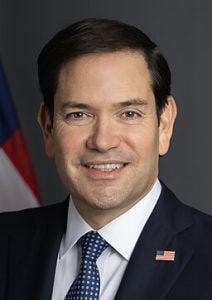
Marco Rubio once called Donald Trump a “con artist” who had “spent his entire career sticking it to the little guy.” This wasn’t a mild policy disagreement. It was a character indictment.
The 2016 primary was ugly. Trump mocked Rubio as “Little Marco” and “The Choker.” Rubio talked about Trump’s “little hands.” The insults were juvenile, personal, and relentless. But beneath the schoolyard taunts was something more serious: Rubio publicly declared Trump fundamentally unfit - a con man.
Fast forward to today. Rubio is now Secretary of State - the chief architect and public face of the administration’s foreign policy. Campaign insults can be dismissed as theater. Calling someone a fraud is not. Working for a man you once branded a con artist requires something deeper than pragmatism.
It requires a wholesale reordering of one’s own moral narrative.
The Policy Reversals: A Structural Recalibration
Rubio hasn’t merely adjusted emphasis. He has reconstructed his worldview. Here are some of the most consequential pivots:
From Moscow’s Moral Foe to “Negotiated Peacemaker”: Rubio once called Vladimir Putin a “gangster” and framed Ukraine as a frontline defense of democracy. But after a February 2025 Oval Office clash in which President Trump rudely rebuked President Zelensky, Rubio chose the “con artist” over the “freedom fighter” he once championed. Instead, he said Zelensky should “apologize” for a “fiasco” of a meeting, arguing that the pressure should now be on Kyiv to accept a “strategic reality.”
The NATO Sentry Becomes the Debt Collector: Rubio once described NATO as a sacred covenant. Now he conditions American support on European “burden-sharing” and ideological alignment, warning allies about “civilizational decline” while pressing MAGA-aligned border and energy priorities.
From Free Trade Evangelist to Globalist Skeptic: The younger Rubio embraced the post-Cold War consensus that free markets spread democratic norms. The current Rubio denounces “globalist institutions,” attacks the “climate cult,” and frames international politics as a blunt contest of sovereignty rather than laws and norms.
From Democracy Advocate to Orbán Endorser: Just days ago, Rubio stood in Budapest and endorsed Viktor Orbán for a fifth term, praising Hungary’s “Golden Era” and confirming a “financial protective shield.” Orbán’s autocratic record - repression of dissent and alignment with Moscow - is not subtle. For a politician who built his brand on pro-democracy rhetoric, Rubio’s endorsement marks a striking inversion.
From Soft Power Advocate to Soft Power Skeptic: As a senator, Rubio repeatedly described foreign aid and democracy promotion as vital tools of U.S. national security, supporting USAID funding and American efforts to counter Chinese and Russian influence abroad. As Secretary of State, however, he has overseen sweeping cuts to USAID, supported the closure of Voice of America and related U.S. international broadcasting entities, and dismantled offices dedicated to countering foreign disinformation. Institutions he once treated as strategic assets of American influence are now recast as wasteful, ideological, or misaligned with “core national interests.”
These are not cosmetic edits. They are structural revisions.
The Final Credential: From Guardian to Gaslighter
Rubio’s most significant “structural revision” isn’t a policy pivot; it’s a surrender of reality itself. To remain at the top of the current administration, he has had to adopt the leader’s version of history.
The 2020 Election: From Certification to “Unfairness”: On January 6, 2021, Rubio voted to certify the results and famously warned that democracy is held together by the “willingness to abide by results.” By late 2024 and through 2025, that principle vanished. He now uses the “Unfairness Loophole,” claiming he only accepts results if the election is “fair” - a subjective standard he populates with debunked claims about Wisconsin drop boxes and Arizona signatures. He hasn’t just changed his mind; he has changed his standards of truth.
January 6: From “Wackos” to “Political Persecution”: In 2021, Rubio called the rioters “wackos” and “nut jobs” who were not part of the conservative movement. As Secretary of State in 2025, he underwent a strategic “numbing out,” refusing to comment on the administration’s mass pardons of those same individuals. He now frames the event as a “partisan scam” by the DOJ, providing a sophisticated diplomatic veneer for what he once correctly identified as a “rogue’s gallery” of criminals.
Why It Happens
Political reversals are common. Total philosophical rewrites are rarer. How does someone reconcile the transformation?
1. The Sunk-Cost Pivot: Once Rubio accepted a seat at the table, his 2016 warnings became psychologically inconvenient. The dissonance between “con artist” and “my president” had to be resolved. The easiest solution? Reinterpret the past. 2016 becomes immaturity; hawkish idealism becomes naiveté; today’s realism becomes wisdom.
2. Ambition as Virtue: There is a familiar rationalization among political insiders: If I’m not in the room, someone worse will be. This “hero in the room” narrative allows ambition to masquerade as sacrifice. Remaining in power becomes a stabilizing act of stewardship.
3. The Civilizational Escape Hatch: When a leader’s character cannot be defended, the argument moves upward. Everything becomes existential: Western Civilization, cultural survival, the fate of the Republic. In that framing, individual flaws are downgraded to tactical inconveniences. The cause eclipses the character of the leader.
The Veneer: The Thinking Man’s Surrender
Rubio is not a bomb-thrower. He is articulate, disciplined, and fluent in the language of order. That makes him a particularly effective enabler. He supplies the intellectual scaffolding for the very phenomenon he once warned against.
But there is a darker possibility underlying this polish: The Machiavellian Core. In political psychology, this is the “empty vessel” theory. It suggests that for some, the moral narrative was never there to begin with. Beliefs aren’t convictions; they are purely tactical tools. If you look at Rubio’s career - from Tea Party darling to “Gang of Eight” immigration reformer, from “Never Trump” hawk to MAGA Secretary of State - you see a man with a near-pathological ability to “mirror” the most powerful person in the room.
He may not experience the “moral injury” of a flip-flop because there is no moral anchor to drag. He isn’t wrestling with his conscience; he may simply be an exceptionally talented actor who has found a more profitable script. He didn’t lose his soul to the con; he simply found the most efficient way to use it.
The most striking transformation is not that he joined the movement. Rubio’s true contribution isn't his loyalty, but his ability to make the fraud look like a plan. He has become the primary salesman for a reality he once correctly identified as a scam. That is the ultimate Quisling move - and the most consequential reversal of all.
Great article, Hawkeye1972 hits the nail on the head. Like all of the Presidents sycophants, blind loyalty has taken over good moral and intellectual judgment. The difference is Rubio is more intelligent than the other clowns in the room.
What a piece of scum, in a sea of scum. Great post.