

The Economist hopes Donald Trump is not a new Caligula. We are less optimistic - and more interested in the people who made him possible.
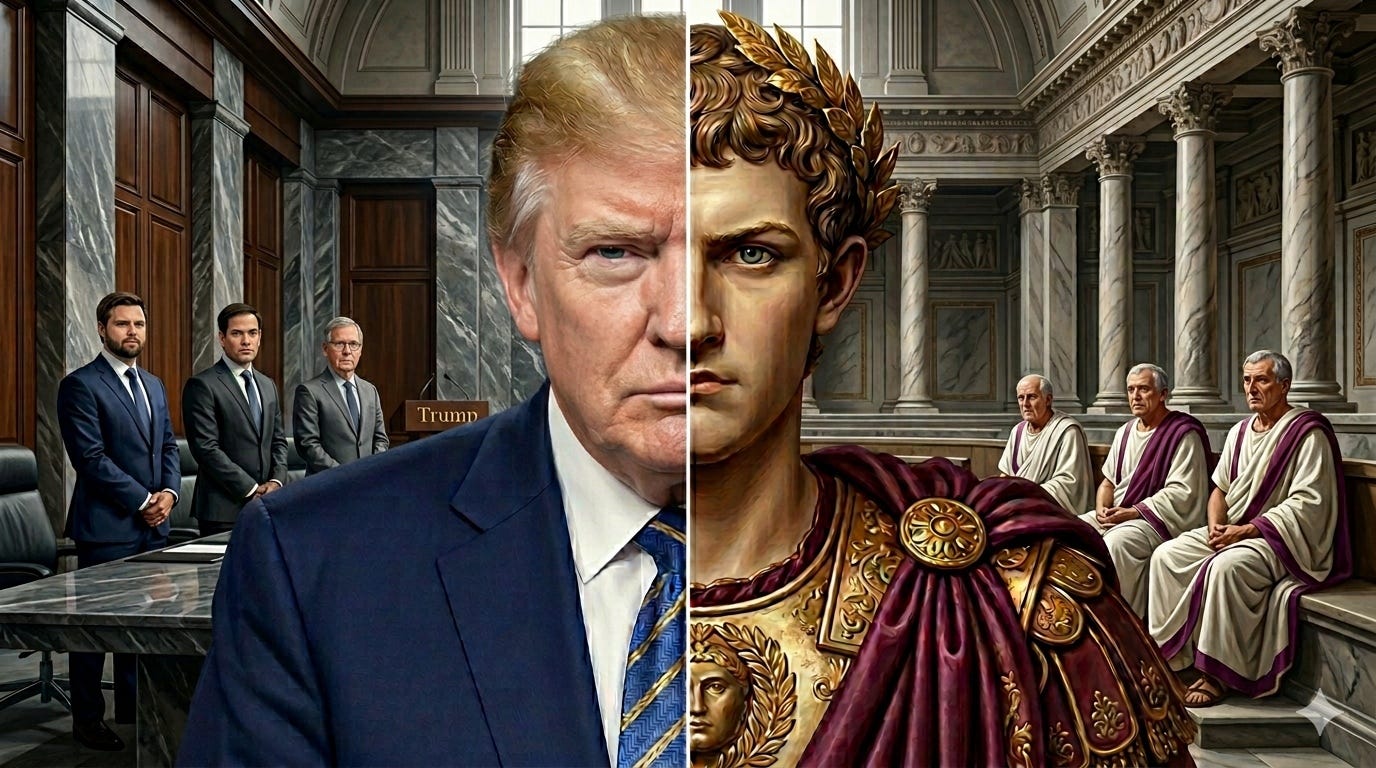
The Economist ran a piece earlier this month - careful, measured, British - that dared to name the comparison serious historians have been circling for years. Its headline: “Hope that Donald Trump is not a new Caligula.”
Hope. That’s the word they chose. Not confidence. Not reassurance. Hope.
The piece leans on Barbara Tuchman’s 1984 masterwork, The March of Folly, which argues that the most dangerous leaders aren’t lone madmen - they’re the ones whose madness gets institutionalized. The Economist’s quiet alarm: Trump’s failures are not his alone. They are “enabled by a much larger group of elected Republicans and voters.” Are his mistakes, the magazine asks, systemic?
We think that’s the right question. And we think the answer, which the Economist is too polite to say plainly, is yes.
That’s why a year ago we created the website quislings.info and now write at “Quislings at Substack.”
What interests us most is not the malefactor at the center of the story, but the people who built the room he stands in. The fixers. The flatterers. The sycophants and the calculating careerists who thought they could control things. The quislings.
They are as old as Rome.
The Emperor and the Showman
Gaius Julius Caesar Augustus Germanicus - known to history as Caligula - became emperor in 37 AD, greeted with wild popular enthusiasm after the grim, paranoid reign of Tiberius. For a few months, the people loved him. Then something shifted, and what emerged was one of the ancient world’s most instructive case studies in what happens when a man of boundless ego is handed boundless authority.
The parallels are not metaphorical. They are structural.
Caligula erected golden statues of himself and renamed temples in his honor. Trump put his name in gold letters on towers, slapped it on steaks, on vodka, on a Bible, and ultimately on a presidency. Both men understood that branding is power.
Caligula’s most famous act of institutional mockery was his reported threat to make his horse, Incitatus, a consul. The message: I can put anyone here, and you will accept it. Trump’s version: Kash Patel at the FBI. Pete Hegseth at Defense. The Economist notes Trump “has appointed unqualified sycophants to positions of high rank, where they vie to show their loyalty while squabbling over trivial perks of office.”
A horse by any other name…
Both men reveled in the public humiliation of elites - Caligula forcing senators to grovel; Trump watching senators who once called him a threat to democracy praise him four years later. Both demanded not competence but devotion, and punished its absence with a speed that kept everyone around them in a permanent state of managed anxiety.
Individual Folly, or Systemic Rot?
Tuchman’s crucial distinction: individual folly versus systemic folly. One bad emperor is a tragedy. A system that produces and sustains bad emperors is a civilizational crisis.
Caligula reigned less than four years before the Praetorian Guard assassinated him. Rome survived because the damage was contained within a single reign.
The question Tuchman would ask about Trump is whether the American system is similarly resilient - whether the follies are personal to one man, or have been absorbed into the structure of a party, a media ecosystem, a court, and a base that will carry them forward regardless of what happens to Trump himself.
We are not optimistic. And the reason has a name. It has many names, actually.
The Quislings: A Study in Self-Justification
Vidkun Quisling collaborated with the Nazi occupation of Norway, and his name entered every major language as shorthand for a particular kind of betrayal: enabling and appeasing the powerful out of ideology, ambition, or the cold calculation that being on the winning side beats being on the right one.
Both Caligula’s Rome and Trump’s Washington are populated by them. The profiles rhyme across two thousand years.
The Praetorian Who Made the Monster. Naevius Sutorius Macro engineered Caligula’s succession, believing he was positioning a manageable young man who would be grateful and compliant. Caligula had Macro killed. McConnell, Ryan, and the Republican donor class made the same calculation in 2016 - they would make Trump, and in making him, control him. He did not need their permission to become what he became. He never did.
The Senate That Handed Over the Keys. The Roman Senate voted Caligula sweeping powers within weeks of his accession, chose relief over caution, and spent four years being publicly humiliated for it. After January 6th, McConnell called Trump “practically and morally responsible” for the assault on the Capitol - then did not vote to convict. He explained the matter was now for the courts. The courts declined.
The Courtiers Who Stayed. In Caligula’s court, men of genuine ability told themselves they were indispensable - that without them, someone worse would have the emperor’s ear. John Kelly. James Mattis. Rex Tillerson. Each entered Trump’s orbit with a reputation and left diminished. Kelly called Trump “the most flawed person” he had ever known. Mattis said he was the first president in his lifetime who “does not try to unite the American people.” They said these things after they left.
The Media That Made the Spectacle Profitable. Fox News did not invent Trump, but it discovered by 2015 that he was extraordinarily good for ratings. What began as coverage became promotion, then symbiosis. By the time the Dominion lawsuit revealed that hosts knew they were broadcasting falsehoods, the infrastructure was too profitable to stop. Roger Ailes. Rupert Murdoch. Tucker Carlson. Amplifiers who made themselves necessary to the spectacle, and the spectacle necessary to them.
The Pattern That Should Keep Us Up at Night
The quislings of Caligula’s Rome and Trump’s Washington did not all tell themselves the same story. Some were true believers, wanting exactly what the emperor wanted. Some were pure opportunists in it for the titles, the access, the reflected glory. Some genuinely convinced themselves they were the adults in the room, managing a dangerous situation, preventing something worse.
Macro thought that. McConnell thought that. Kelly thought that. The Roman Senate thought that. None of them were the exception. They were the rule. They were the system.
Caligula was assassinated in 41 AD, stabbed thirty times on the Palatine Hill. The senators who had enabled his rise celebrated briefly in the Temple of Jupiter, imagining they might restore the Republic. They could not. Claudius was already being acclaimed the new emperor by the Praetorian Guard. The enabling had done its work - not Caligula’s work, but theirs.
The Economist ends with a hope: that Trump’s follies “can be reversed by an election or two.” We share it.
Those Roman senators had a blind spot we do not have to share. The Republic they imagined returning to had not been taken from them by Caligula. It had been handed over, one small capitulation at a time, by the men standing right beside them in that temple.
We have named some of ours. The ones who built him, believing they could control him. The ones who knew what they were serving and stayed, then told the truth only after it stopped costing them anything. The ones in the media who did it for the money. The ones who watched an insurrection unfold in real time and still could not bring themselves to vote for conviction.
The Roman senators had no idea what they were living through. We do. That is not a small thing. The damage they have done is real, and none of it reverses on its own. But systems that can be named can be challenged. The quislings, their choices, their calculations, their legacies - they are visible now. And so is what they built.
That is where accountability begins.
Written in response to “Hope that Donald Trump is not a new Caligula,” The Economist, May 9th, 2026. Barbara Tuchman’s The March of Folly: From Troy to Vietnam (1984) is helpful reading for anyone trying to understand the present moment.
Thank you. Keep talking!
Great comparisons.