

We covered Trump’s tariff obsession back on February 13, 2026 (”The Most Expensive Free Lunch in History“). A week later, on February 20, the Supreme Court struck down his original IEEPA tariffs - and since then the administration has been trying a variety of end-runs around its own defeat.
Good time for a refresher: the logic of tariffs, who actually pays, and the rare cases where they make sense.
The Basics of Trade
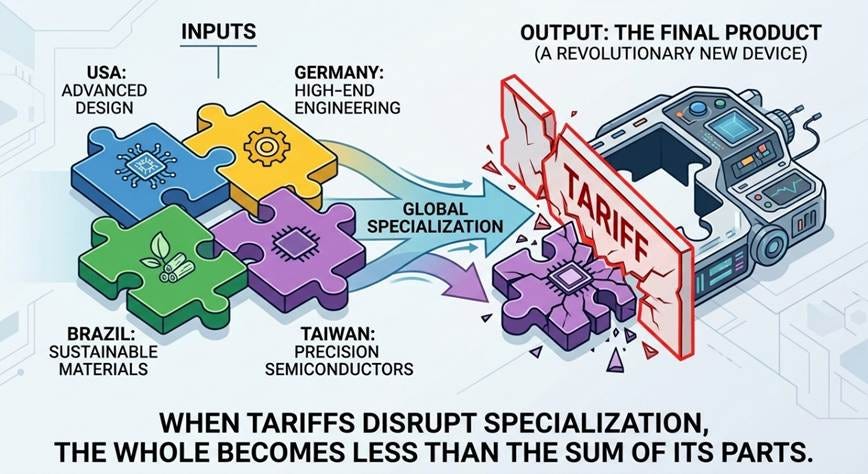
Trade exists because different persons and nations have different resources and different productive capacities. The cobbler doesn’t need to also be a hunter. The wheat farmer doesn’t need to produce lumber. The miner doesn’t need to grow food. Each specializes, each trades the surplus, and everyone ends up better fed, better shod, and better housed than if each had tried to do everything alone. This isn’t an abstraction from an economics textbook - it’s the whole reason towns, nations, and international commerce exist. It is also the first thing a blanket tariff policy gets wrong.
A 15% Tax on Things We Don’t Even Make
In February 2026 the administration announced a baseline tariff of 10%, then upped it to 15%, on imports from virtually every country, on virtually everything. Not a targeted levy on steel dumped below cost. Not a response to a specific unfair practice. A blanket tax on the act of importing itself - which ignores the first lesson of trade: countries don’t produce everything, and they shouldn’t try to.
The administration didn’t have to learn this the hard way - but it did. After the “Liberation Day” tariffs hit on April 2, 2025, grocery prices spiked so badly - ground coffee was on its way to hit a record of over $9 a pound, up 40+% in a year, driven largely by a 50% tariff on Brazilian coffee - that the White House was forced to exempt coffee, bananas, beef, and other tropical foods. Its own stated reason gave away the whole argument: these are “products that are not produced in the United States or cannot be supplied in sufficient quantities domestically.”
A tariff can’t “protect” an industry that doesn’t exist. It can only tax the American who wants a cup of coffee.
Walking it back after the fact, instead of understanding it before imposing the tax, is the tell.
Where Tariffs Actually Make Sense
Not every tariff is irrational. There’s a real, narrow case for barriers on strategic and defense-related goods - semiconductors, rare earths, munitions components - the capacity you don’t want to discover you’re missing mid-crisis because it’s all offshore. Paying a premium to keep that production at home is insurance, not error. But a flat rate applied to everyone and everything doesn’t distinguish a rare-earth magnet from a bag of coffee beans. It isn’t strategy. It’s a tax that happens to also catch the handful of goods where a strategic case exists.
Canada Was Never a Problem
If the blanket tariff shows the administration doesn’t grasp comparative advantage, the treatment of Canada shows it doesn’t grasp what the policy was supposedly protecting against.
The Peace Arch on the Washington–B.C. border carries an inscription - “Children of a Common Mother” on the American side, “Brethren Dwelling Together in Unity” on the Canadian - put there in 1921 to mark the two countries’ unmatched integration.
Whatever “strategic independence” is supposed to mean, it was never a sensible frame for a neighbor that supplies energy, potash, and manufacturing inputs through a border crossed a million times a day and defended for a century by the same alliance.
Since 2025, that relationship has been treated instead as a target: a 25% tariff on most Canadian goods, a 10% levy on energy, and in July 2026 a 50% rate on things like machinery and electrical equipment - among the steepest tariffs applied to any trading partner, allied or not. Canada retaliated, first with tariffs on roughly $30 billion in American goods, then escalating toward $155 billion.
And Canada didn’t just absorb the hit - it started looking elsewhere. Prime Minister Mark Carney has pursued closer ties with Beijing, including a preliminary deal trading lower Canadian EV tariffs for China easing tariffs on Canadian canola.
A close ally with a century of integrated trade and a shared defense alliance has been pushed to hedge toward a strategic rival.
That is not a side effect of a tough negotiating stance. It’s the predictable result of not understanding that trade relationships, once treated as adversarial, don’t stay put waiting to be repaired.
Who Actually Paid for All of This
A tariff, in the end, is not a bill sent to Ottawa, Brasília, or Beijing. Research from the Federal Reserve Bank of New York found Americans paid for close to 90% of 2025’s tariffs; the Kiel Institute put the figure at 96%. Economists across the spectrum have reached the same conclusion for the same reason: tariffs are collected from the importer at the U.S. border, and pass-through to consumer prices runs close to 100% in most studies. Estimates put the added cost to the average American household at roughly $900 in 2026, with the Dallas Fed tying a meaningful share of that year’s core inflation directly to tariff pass-through.
Add it up:
A blanket policy that taxes goods the U.S. doesn’t produce, carved back only after prices spiked and only for the products loud enough to make headlines
A strategic-goods exception that would make sense on its own but gets buried inside a rate applied to everything
A needlessly adversarial turn against the one neighbor whose economy was never a security threat, which has pushed it instead toward a rival superpower
None of it was necessary. All of it was paid for by Americans. And all of it traces back to the same basic gap: not understanding that trade is not a zero-sum contest where one side’s exports are the other side’s loss, but the mechanism by which both sides end up with more than either could produce alone.
And the Quislings? Rubio, Vance, Speaker Mike Johnson, Senate Majority Leader John Thune - plus nearly the entire Republican congressional delegation - have said nothing in public. Thune has reportedly voiced misgivings in private about the damage to his own farm-state economy; Johnson has done the same. Neither has lifted a finger to stop it. Trump may not understand the economics here. They do. November should cost them for enabling it anyway.
If this makes tariffs feel less complicated, send it to someone who still thinks only a “stable genius” can understand them.
Sources
· Tax Foundation - Tariff Tracker: 2026 Trump Tariffs & Trade War by the Numbers
· Axios - Trump raises tariffs to 15% after Supreme Court setback
· NPR - Trump scraps tariffs on beef, coffee, tropical fruit in a push to lower prices
· International Peace Arch Park Association - Peace Arch History
· CNN - Trump’s new 50% tariffs on Canada risk igniting a fresh trade war
· Government of Canada - Canada announces $155B tariff package in response to unjustified U.S. tariffs
· CBC News - Canada reaches tariff-quota deal with China on EVs, canola
· Fortune - 90% of Trump’s tariffs are paid for by American consumers and companies, New York Fed says
· Kiel Institute - America’s own goal: Americans pay almost entirely for Trump’s tariffs
· Yahoo Finance / Tax Foundation - Trump’s Tariffs Will Cost Each American Household $900 in 2026
· Why Mike Johnson and John Thune are sticking with Trump amid tariff turmoil
The Hill - Republicans fear Trump’s trade war could lead to political wipeout
😡this tariff thing is infuriating!
Thank you this primer on tariffs. The republicans in congress need to step up and do their job. They need to read this column.