

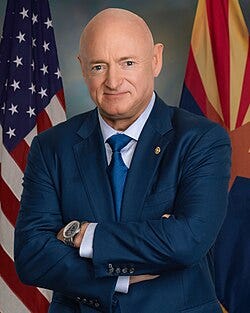
Several weeks ago, six veterans-turned-lawmakers did something that should not be controversial: they quoted the law.
In a brief video, the six vets reminded service members that their oath is to the Constitution - not to any person. They reiterated a principle every military professional understands: service members must refuse unlawful orders.
For that, Sen. Mark Kelly and his colleagues were branded “seditionists” and “traitors,” and President Trump openly suggested their conduct was “punishable by death.”
But now, the legal process has spoken - and resoundingly so.
A Grand Jury Declines to Indict
Last week, a federal grand jury in Washington, D.C., refused to indict Kelly and the other lawmakers over the “illegal orders” video. Prosecutors - operating under a Trump-appointed U.S. attorney - had sought to bring charges under a statute that bars interference with the loyalty, morale, or discipline of the U.S. armed forces.
The grand jury returned what’s called a “no bill” - meaning jurors did not find probable cause to move forward with criminal charges.
That’s not a technicality. Historically, it’s very rare for a federal grand jury to decline to indict once prosecutors present a case. In recent DOJ data from 2016 - the most recently published year - out of nearly 70,000 defendants presented, only six times did a federal grand jury refuse to return an indictment.
In practical terms: even with the prosecutor’s evidence and the government’s legal narrative, citizens serving on a grand jury could not conclude that any criminal charge was appropriate.
This outcome reinforces two core points:
1. The speech at issue was political expression, not criminal conduct.
2. The attempt to treat a restatement of existing military law as a crime had no evidentiary foundation that satisfied jurors.
Kelly and his allies were left without an indictment - even under a system where prosecutors traditionally control what grand juries see and how cases are framed.
The Law Is Clear
Article 92 of the Uniform Code of Military Justice criminalizes failure to obey a lawful order. That word is not ornamental. There is no duty to obey an unlawful one.
The Manual for Courts-Martial recognizes that obedience is required only for lawful orders and that patently illegal orders - such as those directing the commission of a crime - must not be followed.
The Nuremberg Principles removed any doubt after World War II: “just following orders” is not a defense to war crimes.
The Department of Defense Law of War Manual goes further. It explains that service members have an affirmative duty to refuse manifestly unlawful orders. Among the textbook examples discussed in law-of-war doctrine: an order to fire upon shipwrecked persons who are hors de combat (French for “ out of the fight”) and defenseless. Such an order would be clearly illegal.
That is not politics. That is black-letter law.
Who Is Lecturing Whom?
Mark Kelly flew 39 combat missions in Operation Desert Storm. He commanded sailors. He later piloted the Space Shuttle.
The man attacking him received multiple Vietnam-era deferments, including a 4-F medical classification for bone spurs that kept him out of uniform while others served.
Veterans like us are allowed to notice that contrast.
When a combat veteran explains the legal duty to refuse unlawful orders, and a man who avoided military service calls that explanation “sedition,” the moral geometry is difficult to miss.
Why This Matters
The duty to disobey unlawful orders is not an act of rebellion. It’s an act of fidelity - to the Constitution, to the law of armed conflict, and to the moral core of the profession of arms.
If a superior were ever to order troops to shoot detainees, target civilians, fire on shipwrecked survivors, or otherwise violate the law, the UCMJ would not protect the soldier who complied. It would prosecute them.
Kelly and the other veterans were not encouraging insubordination. They were restating settled legal obligations - obligations that jurors, after seeing actual evidence, clearly did not regard as criminal.
An army that obeys only lawful orders is not weakened. It is constitutional.
And that truth is precisely why reminding service members of it should never have been treated as a crime.
Persecuting Mark Kelly for saying "you can refuse illegal orders" is like arresting the driver’s ed teacher for saying "you must stop at red lights."
Excellent summary of the situation. Clear and concise. Thank you