

Two weeks before the midterms, here is where things stand.
On Oct. 16, President Trump waived the new Russia sanctions he had signed into law in September, two days before they were due to take effect. They included a 500% tariff on Russian imports and penalties on the biggest buyers of Russian oil. The same week, he called Ukraine’s strikes on Russian refineries a “disgrace” and said Zelensky “doesn’t want to end this war, and probably never did.” Meanwhile, according to The Washington Post, Patriot interceptors that European allies have already paid for are waiting on Defense Secretary Hegseth’s signature. Zelensky says Ukraine has “almost no Patriot interceptors left.”
Ordinarily that would be our whole post. Instead, we’re going to digress, again.
Part of the reason is selfish: we’ve been editing this one for weeks and need to get it published and behind us. But there’s a better reason. On Nov. 3, voters won’t only be judging what this administration has done. They’ll also be weighing what the other side offers, and the Democrats are still deciding what to call it. Our analysis is incomplete, and we know it. We’re hoping it stirs some thought. Then we’ll get back to hunting quislings.
“LDA or DSA?”, which we published in July, was a thought experiment: “Liberty Democrats of America” or “Democratic Socialists of America.” Could the Democratic Party find a better way to say what it actually believes, and maybe sand down a few of its perceived extremes along the way?
Our suggestion was a single word. “Liberty.”
We should be clear about what we are and aren’t. We’re not strategists, and nobody has asked us to write a platform. We’re readers who spent a weekend with both parties’ platforms and came away thinking one of them had misplaced its best word. Please take what follows in that spirit.
The conversation since July has been lively, and one phrase kept coming up. We had tossed it off almost in passing: fair wages, health care, and housing aren’t handouts. They’re the “floor of freedom.”
Several of you pushed us on what that actually means. Fair question. This is our attempt at an answer.
The timing is interesting. Last month Gallup reported that 43% of Americans now view socialism favorably, the highest it has ever measured. In the same survey, 77% view free enterprise favorably and 95% view small business favorably.
Democrats will probably spend a lot of energy arguing over the first number. We keep looking at the other two.
The Government Portfolio
First, a word about who’s been calling whom a socialist.
The party of free markets now advocates government ownership of companies. The federal government holds nearly 10% of Intel, which makes it the largest shareholder. It holds stakes in MP Materials, Lithium Americas, Trilogy Metals and USA Rare Earth. It has a “golden share” in U.S. Steel with veto power over major decisions, a cut of Westinghouse’s future profits, and equity in nine quantum-computing firms. By August the count had passed 25 companies. The White House also claimed a 25% cut of Nvidia’s advanced-chip sales to China.
Every deal comes with a national-security rationale, and some may even be sound. But it’s worth noticing whom the government chose to back. Not the family facing a medical bill. Not the worker locked in by a non-compete. Shareholders of specific companies, and not their competitors.
Socialism for the connected. Rugged individualism for everyone else.
We’ll leave it to readers to decide whether a party that picks winners in the stock market can still call itself the party of limited government.
Freedom Is the Power to Say “No”
Here is the idea at the center of all this.
Liberty isn’t only the absence of a government boot. It’s also the practical ability to make your own choices, and maybe the most important of those is being able to say no.
No to a boss who wants you working off the clock. No to a landlord who won’t fix the heat. No to a marriage that has turned dangerous. No to a job that’s slowly grinding you down and keeping you from the business you’ve been sketching on napkins for years.
If you’re of a certain age, as we are, you probably remember a stretch of your own working life when saying no simply wasn’t an option.
A person one paycheck from eviction can’t say no to anybody. A parent whose child’s insulin depends on an employer’s health plan isn’t free to quit. Economists have a name for it: “job lock.”
Franklin Roosevelt put it more bluntly in 1944: “Necessitous men are not free men.”
That’s what we mean by the “floor.” It isn’t a hammock, and it isn’t a handout. It’s something solid to stand on, so that when you do say no, you don’t fall through.
Not a New Idea, and Not a Left One
What surprised us most, digging into this, was how conservative the idea’s pedigree turns out to be.
Thomas Paine, the pamphleteer who talked the colonies into revolution, proposed in 1797 that every citizen receive a lump sum at age 21 to get started in life, and a pension at 50. He insisted it was “not charity but a right.”
Abraham Lincoln signed the Homestead Act, which offered 160 acres to anyone willing to work them. It was one of the largest floors any government has ever built, and it settled the Midwest.
The GI Bill sent a generation to college and into their own homes. It produced the most prosperous and entrepreneurial middle class the world had seen.
Friedrich Hayek, patron saint of every free-market think tank in Washington, wrote in The Road to Serfdom that “some minimum of food, shelter, and clothing, sufficient to preserve health and the capacity to work, can be assured to everybody.”
And Milton Friedman, nobody’s idea of a socialist, proposed a negative income tax.
So the argument between left and right was never really about whether there should be a floor. It was about how high, and who builds it.
Building on the Liberty Argument
What might a Liberty Democrat floor look like? Here are five planks we’d put on the table, each argued in the language of freedom rather than redistribution. Reasonable people will disagree with some of them, and we’ve tried to say where we’re less sure.
Health care that belongs to you, not your boss. Coverage tied to employment works like a leash. The enhanced ACA subsidies expired on January 1. KFF found that net premiums for marketplace enrollees rose 58%, deductibles hit record highs, and enrollment is on track to fall by roughly 4.8 million people. Each of those people is now a little less free to change jobs, start a business, or retire early. How to make coverage portable is the hard part, and we don’t pretend to have that answer. But portability is the liberty argument.
Your skills belong to you. An estimated 30 million Americans, about one worker in five, have signed non-compete agreements. Many of them are hairstylists, sandwich makers, and security guards. Employers have real reasons to protect trade secrets, and there are narrower tools for that. But a contract that keeps a sandwich maker from working at the shop across the street is hard to defend as anything other than private control over someone’s life.
A wage that buys independence. A full-time job should keep a person out of poverty. When a worker needs a second job and public assistance to get by, taxpayers end up covering part of the payroll. We’d call that the real handout, though we know economists argue over how high a wage floor can go before it starts costing jobs.
The freedom to build. Much of the housing crisis is made by government: zoning and building codes that dictate lot sizes, parking minimums, and construction minutiae with little safety or environmental benefit. Here, oddly enough, Liberty Democrats and libertarian Republicans might find themselves on the same side of the city council meeting. It’s also a floor that costs the Treasury almost nothing.
A retirement you earned. Social Security and Medicare aren’t handouts. They’re insurance you paid for, and they carry a promise that old age won’t mean depending on your children or on charity. Protecting them protects the right to leave the workforce with dignity.
What’s not on the list says something too: no federal jobs guarantee, no nationalized industries, no government stake in anything. That last one we’ll leave to the current administration.
The Non-economic Planks
To keep this from running longer than it already has, we’ll refer you to our earlier piece, “LDA or DSA?”, for the case for bodily, spiritual and personal liberty.
Floor, Not Ceiling
We said in July that a liberty platform would take discipline. It’s hard to preach freedom from government on Tuesday and propose a new agency for everything on Wednesday.
The floor idea helps with that, because it comes with its own limit. A floor keeps a single bad break, whether a diagnosis, a layoff, or a flood, from ending your liberty for good. That’s all it does. It doesn’t tell you where to walk, and it doesn’t cap how high you climb.
That gives a Liberty Democrat one simple question to ask of any new program: does this keep people from falling through, or does it tell them how to live? The first fits. The second deserves a harder look.
A floor is not what you live on. It’s what you stand on to reach.
The frontier family had its 160 acres. The returning soldier had his GI Bill. The question for 2026 is whether a nurse in Spokane or a welder in Ohio gets something to stand on too, or whether the only Americans with a government-backed floor turn out to be the shareholders of Intel.
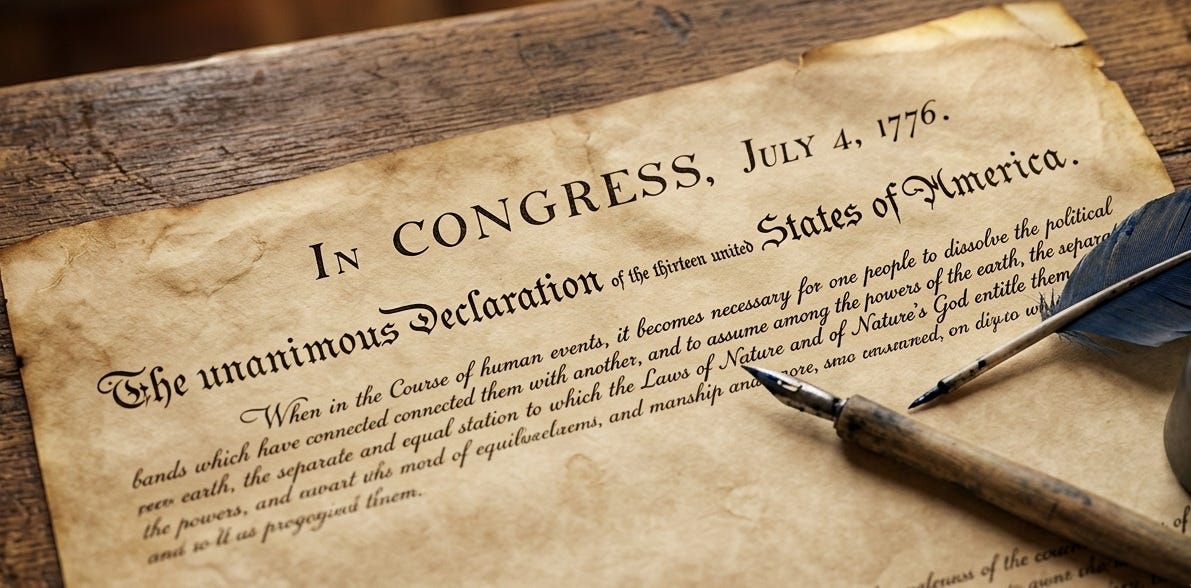
The Declaration promised life, liberty, and the pursuit of happiness. Two hundred and fifty years later, we’d add only this: it’s hard to pursue much of anything when you’re afraid of losing everything.
Over to You
If this has sounded like a lecture, it’s over. So tell us:
Which plank doesn’t work for you, and what did we miss?
Is the “floor of freedom” a useful line between what government should do and what it shouldn’t?
If you’re a Republican or independent reader (we know a few of you are out there), does any of this move you at all?
Comment freely. If this resonates, share it. Vote!
And thanks for indulging the detour. We’ll get back to the quislings now that this is off our chest.
Sources
Kyiv Post – “Trump Halts Sweeping Russia Sanctions Days Before They Take Effect, Citing US National Interest” (the Oct. 16 waiver, the 500% tariff and oil-buyer penalties, the “disgrace” remark): https://www.kyivpost.com/post/87342
OilPrice.com – “Trump Defends Russia Sanctions Waiver as Rift With Ukraine Deepens” (Zelensky “doesn’t want to end this war, and probably never did”): https://oilprice.com/Geopolitics/Europe/Trump-Defends-Russia-Sanctions-Waiver-as-Rift-With-Ukraine-Deepens.html
HNGN – “Pentagon Holds Europe-Paid Patriots for Ukraine; Rubio: ‘Nothing Has Changed’” (Washington Post report on interceptors awaiting Hegseth’s signature; Zelensky quote): https://www.hngn.com/articles/273550/20261020/pentagon-holds-europe-paid-patriots-ukraine-rubio-nothing-has-changed.htm
Gallup – “Socialism’s Positive Rating Tops 40% for First Time” (43% positive on socialism, 77% on free enterprise, 95% on small business; Sept. 23, 2026): https://news.gallup.com/poll/714653/socialism-positive-rating-tops-first-time.aspx
Washington Examiner – “The updated list of Trump ownership stakes in private companies” (25+ companies, Intel’s 9.9% stake, U.S. Steel golden share, Westinghouse profit share): https://www.washingtonexaminer.com/news/business/4673015/updated-list-trump-ownership-stakes-private-enterprises-equity-chip-production/
CNBC – “The Trump administration equity portfolio is growing. These are the investments so far” (MP Materials, Lithium Americas, Trilogy Metals, USA Rare Earth): https://www.cnbc.com/2026/02/07/trump-administration-equity-portfolio-grows-these-are-investments-so-far.html
CNBC – “Trump greenlights Nvidia H200 AI chip sales to China if U.S. gets 25% cut”: https://www.cnbc.com/2025/12/08/trump-nvidia-h200-sales-china.html
FDR Presidential Library – 1944 State of the Union Address (”Necessitous men are not free men”): https://www.fdrlibrary.org/address-text
Social Security Administration History – Thomas Paine, “Agrarian Justice” (1797) (the stake at 21, the pension at 50, “not charity but a right”): https://www.ssa.gov/history/paine4.html
National Archives – Homestead Act (1862): https://www.archives.gov/milestone-documents/homestead-act
National Archives – Servicemen’s Readjustment Act (GI Bill, 1944): https://www.archives.gov/milestone-documents/servicemens-readjustment-act
Five Books – “The Road to Serfdom” by Friedrich Hayek (the “minimum of food, shelter, and clothing” passage, from ch. 9, “Security and Freedom”) quoted here: https://fivebooks.com/book/road-serfdom-by-friedrich-hayek/
KFF – “What We Know So Far About 2026 ACA Marketplace Enrollment, Premiums, and Deductibles” (net premiums up 58%, record deductibles, enrollment down about 4.8 million): https://www.kff.org/affordable-care-act/what-we-know-so-far-about-2026-aca-marketplace-enrollment-premiums-and-deductibles/
ASTHO – “ACA Enhanced Premium Tax Credits: Legislative Developments in 2025 and 2026” (subsidies expired Jan. 1, 2026): https://www.astho.org/communications/blog/2026/aca-enhanced-premium-tax-credits-legislative-developments-2025-2026/
Federal Trade Commission – “FTC Announces Rule Banning Noncompetes” (about 30 million workers, roughly one in five): https://www.ftc.gov/news-events/news/press-releases/2024/04/ftc-announces-rule-banning-noncompetes
Federal Trade Commission – “Federal Trade Commission Files to Accede to Vacatur of Non-Compete Clause Rule” (the ban abandoned, Sept. 2025): https://www.ftc.gov/news-events/news/press-releases/2025/09/federal-trade-commission-files-accede-vacatur-non-compete-clause-rule
Hawkeye,
The original points of Liberty Democrats of America are clear:
● Economic liberty
● Bodily liberty
● Spiritual liberty
● Personal liberty
● Second Amendment liberty
● Economic sovereignty
When you get into floors of liberty, the details can become contentious: a wage that buys independence (the necessary amount of a full time job wage?) or the freedom to build (which building codes are necessary for safety), etc. I know the devil is in the details, but I don't think elections are won with details. Let's wait until we control the House and Senate.