

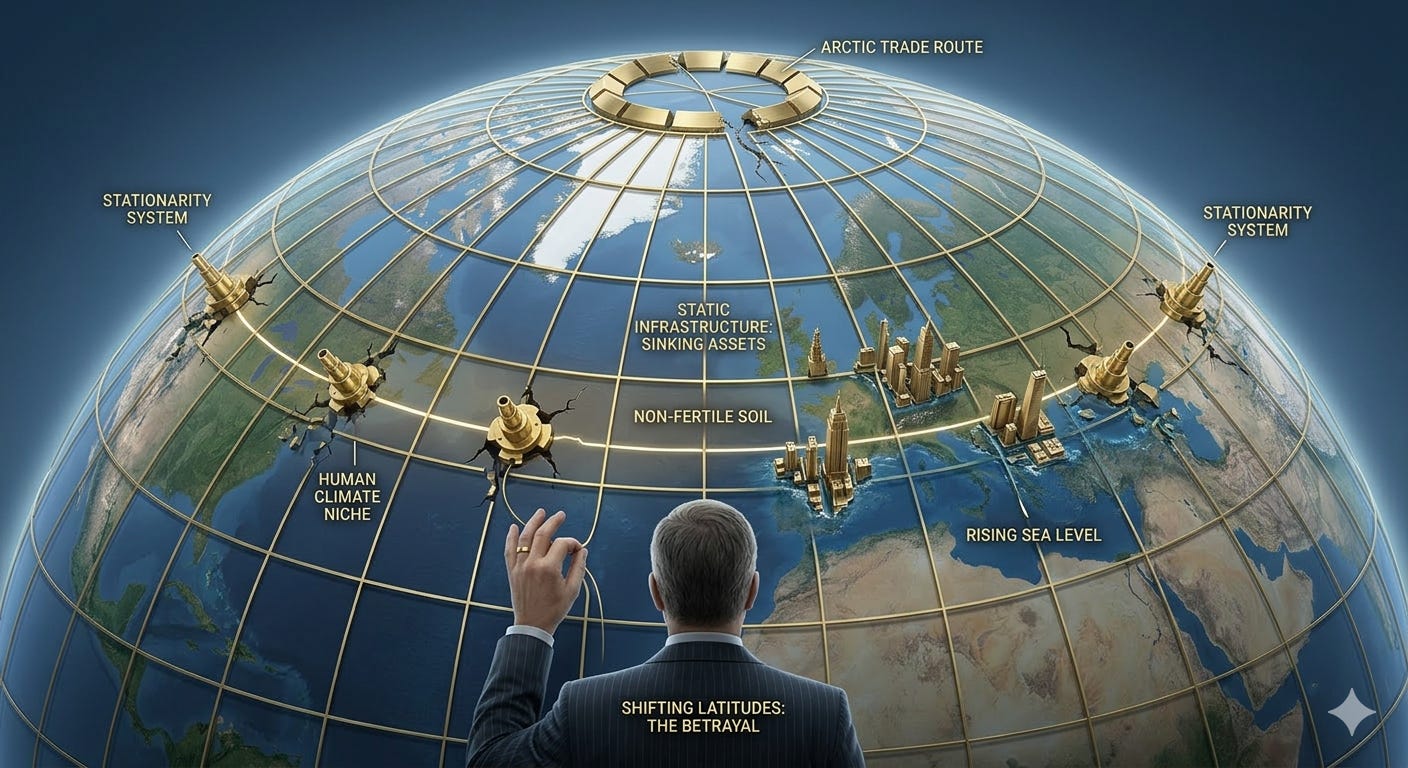
We built a $100 trillion civilization for a climate that is no longer guaranteed. The bill is already arriving.
In our last post, we established the chemistry: burning fossil fuels reverses two billion years of carbon sequestration, raises atmospheric CO2 to levels not seen in at least 800,000 years, and traps heat. That part is not contested by anyone with relevant expertise.
This post is about the consequences. Specifically, about the fact that everything humanity has built - every city, every port, every farm, every piece of infrastructure - was built for a climate that assumed a degree of stability we can no longer guarantee. And about what it costs when that assumption turns out to be wrong.
This is not an abstract cost. It is already on the ledger.
The Holocene Bet
For roughly the last 10,000 years, human civilization has operated during a geological period called the Holocene - an unusually stable interglacial era characterized by relatively consistent temperatures, predictable seasons, and sea levels that changed slowly enough for coastal communities to adapt over generations.
Economists and engineers have a term for the assumption that underlies virtually all long-term infrastructure planning: stationarity. It means that while conditions vary year to year, the boundaries of that variation are fixed and known. Flood plains can be mapped because the hundred-year flood is calculable. Coastal infrastructure can be built at the water’s edge because the water’s edge is known. Crops can be planted in the same fields generation after generation because the seasons that support them are predictable.
Stationarity is the silent assumption behind every subway tunnel, every deep-water port, every levee, every airport built on reclaimed coastal land. It is the assumption that the world your infrastructure was designed for will be recognizably the same world when that infrastructure reaches the end of its design life.
That assumption is no longer safe.
We didn’t build a civilization for a changing planet. We built a $100 trillion monument to a stable one. The climate is changing. The monuments are fixed.
The Coastal Anchor
Eight of the world’s ten largest cities are near a coast. Roughly 40 percent of the global population lives within 60 miles of the ocean. This is not an accident - coastal proximity meant access to trade, to food, to transportation. The wealth of the modern world was largely built at the water’s edge.
Global average sea level has risen 8 to 9 inches since 1880. The rate has more than doubled - from 1.4 millimeters per year through most of the twentieth century to 3.6 millimeters per year since 2006. High-tide flooding events - the kind that didn’t used to happen without a storm - are now 300 to 900 percent more frequent than they were 50 years ago, depending on location.
This is already happening. Miami floods on sunny days. Parts of coastal Louisiana are disappearing into the Gulf at a rate of a football field every 100 minutes. Jakarta - a city of 10 million - has been sinking into the Java Sea fast enough that Indonesia began relocating its capital. In New York City, real estate valued at $129 billion sits within the official flood plain. Hurricane Sandy, in 2012, gave a preview of what happens when the water moves: 90,000 buildings flooded, 2 million people lost power, and the city absorbed more than $19 billion in damage from a single storm.
The problem is not just damage. It is the nature of the asset.
You cannot move a subway system. You cannot relocate a deep-water port 20 miles inland. The accumulated infrastructure of coastal cities represents generations of public investment - the labor and capital of prior generations, embedded in fixed locations chosen for a world of stable seas. When the water moves, that wealth does not migrate. It is simply destroyed. It transfers to no one. It benefits no one. It is gone.
When a coastal city floods permanently, the wealth doesn’t move. It disappears. That is not an economic transition. It is the permanent destruction of accumulated capital.
The Agricultural Shift
Civilization is not just built at the coast. It is fed from specific latitudes.
The American Corn Belt - the stretch of deep, fertile soil running from Ohio through Iowa and into the Dakotas - is one of the most productive agricultural regions in human history. It exists at its current location because of a specific combination of latitude, rainfall, temperature, and soil - soil that took thousands of years of prairie ecology to build and that is, in places, ten feet deep. It is not just land. It is accumulated biological capital.
Climate change is moving the conditions that make that land productive northward. Research published in peer-reviewed journals projects that growing conditions for corn, soy, alfalfa, and wheat will shift strongly north as temperatures rise - with the upper Midwest potentially becoming unsuitable for corn cultivation by 2100 under moderate emissions scenarios. Growing conditions for all major commodity crops are projected to shift northward under every emissions scenario modeled - with more severe emissions accelerating the timeline. The crops may eventually follow. The soil cannot.
Here is the problem the Latitude Trap identifies: you can move a tractor. You cannot move a million years of topsoil.
The thin, acidic soils of the Canadian Shield - the rocky terrain that sits above the current Corn Belt - cannot support the same agricultural productivity as the deep glacial soils of Iowa and Illinois. A third of the Corn Belt’s farmland has already lost its topsoil entirely due to erosion, costing farmers an estimated $3 billion annually before the full climate shift has even occurred. The crops may move north. The fertility does not move with them.
This is, again, the permanent destruction of accumulated capital. Not a business cycle. Not a recession. The irreversible loss of the biological inheritance that took millennia to build and that no amount of money can recreate on a human timescale.
The Capital That Cannot Be Moved
There is an old economic argument - associated most famously with Marx but accepted well beyond his tradition - that capital is not simply money. It is the accumulated product of prior labor: the roads built by previous generations, the ports dredged over decades, the soil cultivated across centuries, the institutions constructed over lifetimes. Money can be transferred and reinvested. Accumulated physical and biological capital, once destroyed, is simply gone.
The Latitude Trap is the climate expression of that distinction. The question is not whether wealthy individuals and corporations can adapt to a shifting climate - many of them can, and some will profit from the transition. The question is what happens to the accumulated public capital that cannot be picked up and moved: the coastal cities, the deep-water ports, the fertile soils, the freshwater aquifers that are already being contaminated by saltwater intrusion.
That capital was built by everyone. Its loss will be borne by everyone. But not equally.
The people who live in Miami’s flood plain are not, by and large, the people who own stock in fossil fuel companies. The farmers who will watch the Corn Belt shift off their land are not the people who set energy policy in Washington. The residents of coastal Louisiana whose communities are disappearing are not the people whose portfolios include Arctic shipping rights that become more valuable as the ice recedes.
The people who built the capital that is being destroyed are not the people who benefit from the process destroying it. That is not a market outcome. It is a policy choice.
The Quisling Angle
We are not, in this series, arguing that climate change can be stopped entirely. The physics and chemistry are already in motion. We are arguing about the scale and speed of the damage - which is still, to a significant degree, within human control - and about who bears the cost of the damage that is already locked in.
The quisling behavior in this context is specific. It is not ignorance of the science - the fossil fuel industry’s own scientists understood the greenhouse mechanism by the 1970s. It is the deliberate manufacture of delay: the funded campaigns to create the appearance of scientific controversy, the lobbying to prevent the pricing of carbon, the political pressure to defund the measurement infrastructure we documented in Post 1, and the ongoing effort to ensure that the public conversation remains focused on whether the problem is real rather than on who will pay for it and who already is.
Every decade of delay increases the amount of capital that will be permanently destroyed. Every decade of delay shifts more of the cost from those who have profited from the burning onto those who have not. Every decade of delay makes the infrastructure mismatch - cities built for a stable climate, seas that are no longer stable - more expensive to correct and less possible to avoid.
Our generation inherited a stable world built by those before us. And that inheritance is being deliberately spent down by people who know what they are doing - and have calculated that the returns are worth someone else’s cost.
The latitude trap is not a future problem. It is a present one.
The water is already moving. The cities are not.
Next in this series: Disaster Capitalism - why some of the most powerful people in the world are not trying to stop climate change, and what they are positioning themselves to gain from it.
If this matters to you, send it to someone who is still on the fence.
NOTES AND SOURCES
On sea level rise rates: NOAA, “Is Sea Level Rising?” https://oceanservice.noaa.gov/facts/sealevel.html (8-9 inches since 1880; rate doubled from 1.4mm/year to 3.6mm/year since 2006)
On coastal population and infrastructure: NOAA, “How Many People Live in Coastal Areas?” https://oceanservice.noaa.gov/facts/population.html
On Hurricane Sandy damage: NOAA National Centers for Environmental Information www.ncei.noaa.gov/access/billions/events/US/1980-2023
On corn and soybean yield impacts from warming temperatures in the Corn Belt: Schlenker & Roberts, “Nonlinear temperature effects indicate severe damages to U.S. crop yields under climate change,” Proceedings of the National Academy of Sciences, 2009 www.pnas.org/doi/10.1073/pnas.0906865106
On planting zones shifting northward (USDA data): http://www.climatecentral.org/climate-matters/warming-planting-zones-2025- 97% of 243 U.S. locations analyzed have seen their coldest annual temperatures warm, with 67% already shifting to warmer planting zones compared to 1951-1980 baselines.
Burchfield, Emily K., “Shifting cultivation geographies in the Central and Eastern US,” Environmental Research Letters, May 2022 https://iopscience.iop.org/article/10.1088/1748-9326/ac6c3d
On Corn Belt topsoil loss: Borrelli et al., “An assessment of the global impact of 21st century land use change on soil erosion,” An assessment of the global impact of 21st century land use change on soil erosion | Nature Communications
On the concept of stationarity in infrastructure planning: Milly et al., “Stationarity Is Dead: Whither Water Management?” Science, 2008 www.science.org/doi/10.1126/science.1151915