

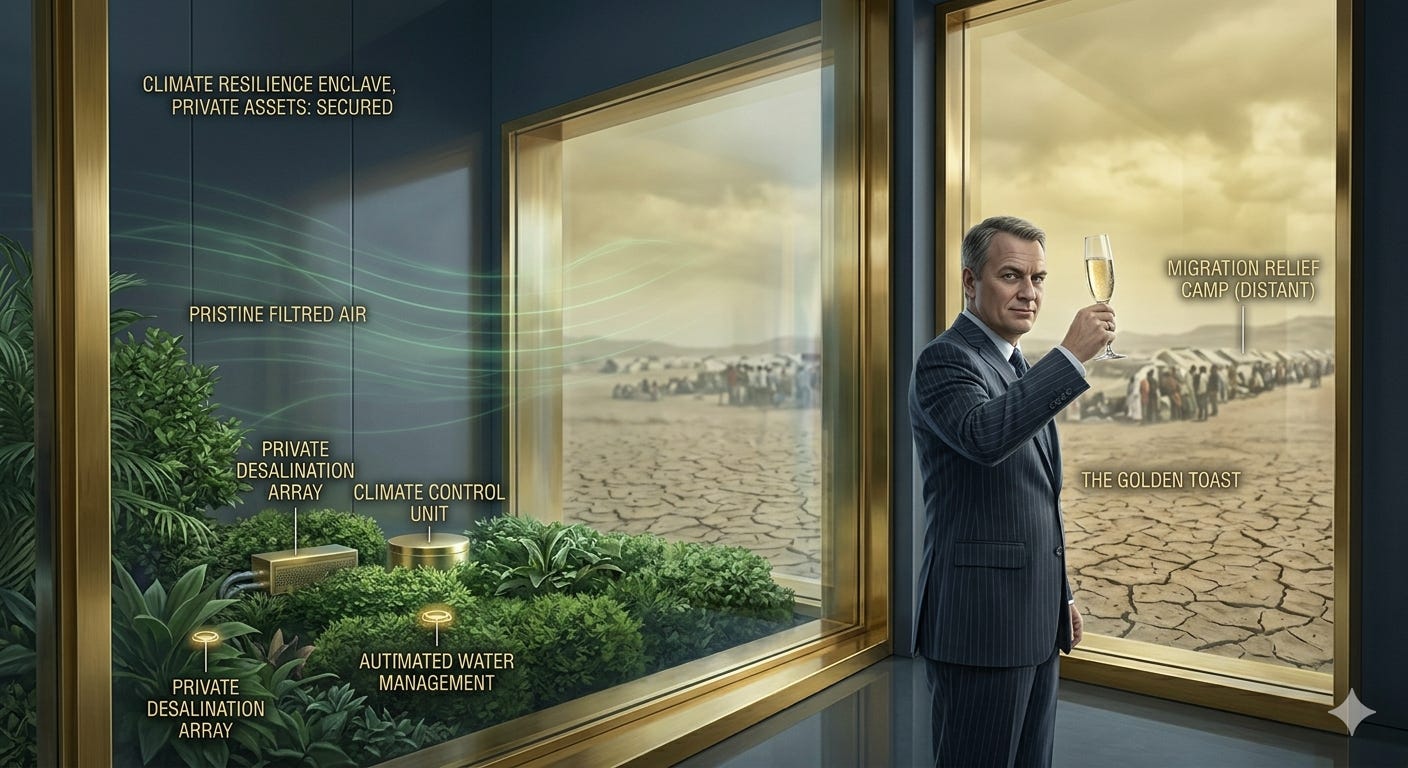
Some people are not trying to stop climate change. They are positioning to profit from it.
In the first two posts in this series, we established the chemistry and the cost. The burning of fossil fuels is reversing two billion years of carbon sequestration. The civilization we built - its cities, its ports, its farms, its freshwater systems - was designed for a stable climate that is no longer guaranteed. The capital being destroyed by that instability is public capital, built over generations, that cannot be moved or replaced on any human timescale.
This post asks the question that follows from those two: if the consequences are this large and this foreseeable, why has the response been so slow? Why have the people with the most power to act spent decades funding the appearance of scientific controversy instead?
The answer is not complicated. For some of the most powerful actors in this story, a destabilized climate is not a crisis to be prevented. It is an opportunity to be positioned for.
What Exxon Knew - and When
The starting point for understanding the denial campaign is a documented fact: the fossil fuel industry did not deny climate science because it did not know the science. It denied it because it did.
In July 1977, Exxon’s senior scientist James Black delivered a presentation to the company’s management committee concluding that there was “general scientific agreement” that burning fossil fuels was the most likely cause of human influence on global climate. A year later he warned that doubling CO2 concentrations would raise average global temperatures by two to three degrees Celsius - a projection consistent with current scientific consensus. He added that humanity had a “time window of five to ten years before the need for hard decisions regarding changes in energy strategies might become critical.”
That was 1978.
Harvard researchers published a systematic analysis in the journal Science in 2023 comparing Exxon’s internal climate projections from 1977 to 2003 against what has actually happened. Between 63 and 83 percent of those projections accurately predicted subsequent global warming. The researchers concluded:
“Whereas academic and government scientists worked to communicate what they knew to the public, ExxonMobil worked to deny it.”
Exxon was not alone. The American Petroleum Institute ran a task force of senior scientists from the nation’s largest oil companies between 1979 and 1983, monitoring and sharing climate research. Internal documents from that period show the industry understood the mechanism and the likely consequences. By the 1990s, the same companies had joined the Global Climate Coalition, a lobbying group whose explicit objective was to derail international efforts to limit emissions. One internal coalition document stated the goal plainly:
“Victory will be achieved when average citizens ‘understand’ uncertainties in climate science - and when recognition of uncertainty becomes part of the ‘conventional wisdom.’”
They knew. They had known since the 1970s. The campaign to manufacture doubt came after - and it was deliberate.
Exxon has since spent more than $30 million funding think tanks and organizations promoting climate denial, according to Greenpeace. The strategy was modeled explicitly on the tobacco industry’s decades-long campaign to manufacture uncertainty about the link between smoking and cancer - same consultants, same tactics, same goal: delay.
Every decade of delay protected revenue from assets that would become harder to sell if the public fully understood what burning them was doing. The industry’s own term for those assets - the reserves that might have to stay in the ground if climate policy succeeded - is “stranded assets.” The denial campaign was, among other things, insurance against stranding.
The Arctic Prize
While the denial campaign protected existing assets, climate change itself was opening new ones.
The Arctic is estimated to contain roughly 13 percent of the world’s undiscovered oil and 30 percent of its undiscovered natural gas. For most of human history, those deposits were inaccessible - locked under ice too thick and too persistent for commercial extraction. As the Arctic warms at roughly four times the global average rate, that is changing.
Arctic sea ice extent has declined by 43 percent from 1971 to 2019. Russia has invested heavily in infrastructure to develop its Northern Sea Route along Siberia’s coast, which has seen growing commercial traffic. In 2025, icebreaking vessels navigated the Central Arctic Route for the first time. China has launched what it calls the “world’s first China-Europe Arctic Express container route,” cutting transit time from over 40 days via the Suez Canal to just 18.
The connection to the current administration is not incidental. The repeated statements about acquiring Greenland - an autonomous Danish territory that sits astride the Northwest Passage and above significant mineral deposits - make most sense as a resource and strategic positioning play. Greenland’s rare earth mineral deposits include some of the largest known reserves of materials critical for batteries and defense technology. A warming Arctic makes those deposits increasingly accessible.
The Arctic is melting. The shipping lanes and mineral deposits it reveals are worth trillions. The people positioning to access them are not the same people losing their homes to the rising seas.
The Privatization of Survival
The Arctic is the most dramatic example of climate-driven opportunity. The more pervasive one is closer to home, and it is already happening.
As climate change strains public infrastructure - water systems under drought, power grids under heat stress, flood protection systems under increased storm intensity - a pattern is emerging. Cash-strapped municipalities, unable to fund the upgrades their aging systems require, are selling those systems to private operators. Nearly 73 million Americans now rely on private companies for drinking water and wastewater services - a substantial increase over the past five years.
The model is straightforward. Public systems, underfunded for decades and now under additional stress from climate-driven events, become too expensive for local governments to maintain. Private equity firms with access to capital step in, acquire the systems, and then recoup their investment through rate increases on the people who depend on the water. Investment firms including Blackstone, Brookfield Asset Management, and KKR have assembled water infrastructure portfolios worth hundreds of billions of dollars across multiple continents.
Michael Burry - the investor who predicted the 2008 housing collapse and made a fortune shorting subprime mortgages - has publicly discussed his shift toward water as an investment theme, acquiring farmland with water rights in drought-prone regions. BlackRock has listed water sustainability as a top investment priority. The pattern is not speculative. It is a documented and accelerating trend.
The mechanism is the same in each case: public infrastructure, built over generations at public expense to serve a public need, is transferred to private ownership at the moment of maximum stress - often with minimal public debate about long-term consequences. The new owners do not bear the cost of the climate damage that made the system unaffordable. They acquire the asset after that damage has already been done, at a price that reflects the distress, and then charge the same public for access to what was previously theirs.
“Climate change provides additional justification for water privatization, as governments struggle to maintain aging infrastructure during extreme weather events. Private companies offer immediate capital for system upgrades while securing long-term operational control. This crisis-driven privatization often occurs without adequate public debate.” - analysis of water infrastructure investment trends, 2025
Who Has Already Bought Their Seat
The billionaire land acquisition trend is also documented and public. In drought-prone regions from the American Southwest to Australia and Africa, investment firms and ultra-high-net-worth individuals are quietly acquiring land with water rights - not for agriculture, but for the water itself. In New Zealand, Patagonia, and the Pacific Northwest, wealthy individuals have acquired large properties in areas that combine political stability, freshwater access, and distance from the geographies most exposed to climate disruption.
This is rational behavior for someone who has concluded that the public systems designed to ensure equitable access to survival resources will not hold. It is also, in aggregate, a bet against those systems - a wager that the failure of public infrastructure is more likely than its repair, and that private control of essential resources will prove more valuable than public provision of them.
The quislings who have spent decades funding climate denial and delaying climate policy did not do so because they were ignorant of the consequences. They did so because some of them had already concluded where those consequences were leading - and had begun positioning accordingly.
The Quisling Connection
We return to the question we started with: why has the response been so slow, given what was known and when?
Part of the answer is the denial campaign - the manufactured uncertainty that delayed public understanding and political will. Part of it is the structural power of industries whose revenues depended on the delay. And part of it, documented in the investment patterns of the very wealthy, is that some of the most powerful actors in the system had concluded that managing their own exposure to the consequences was more achievable than preventing them.
The current administration’s systematic dismantling of climate measurement infrastructure - the satellite sensors, the NOAA databases, the agency staffing we documented in Post 1 - fits this pattern exactly. Breaking the thermometer does not change the temperature. It changes who knows what the temperature is, and when. In a world where information is an asset, being the last to know that the basement is flooding is not a neutral outcome. It is a transfer of value from the uninformed to the informed.
The people defunding the measurement infrastructure are not doing so because they doubt the science. The science of their own industry told them the truth fifty years ago. They are doing it because informed public response would change the conditions under which those positioning decisions play out.
The three posts in this series may appear to have been a digression from our usual coverage - but not really. The pattern is the same. People with information, authority, and a constitutional or corporate obligation to act honestly, choosing instead to protect their position while others bear the cost. The scale is simply larger.
The inheritance being stolen is not just a nation’s institutions. It is the stable world that made those institutions possible.
Denial was never really about the science. It was about the clock.
The clock is running out. We return next to the people running it down.
This concludes our three-part climate series. Posts 1 and 2 are in the archive at “Quislings At Substack” and quislings.info.
If this matters to you, send this series of three articles to someone who is still on the fence or someone who can help us spread the word. That is the whole ask.
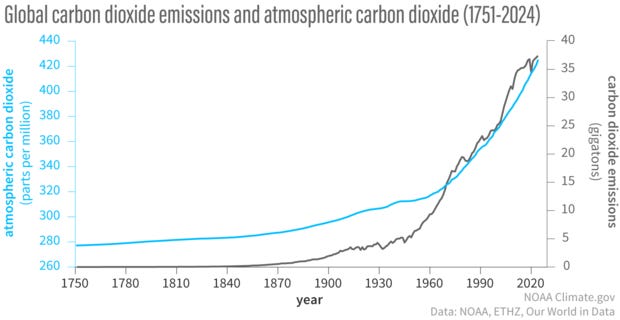
For a dynamic and entertaining look at CO2 over time, view the “Pumphandle” graph animation which still exists at NOAA. It is a 3-minute graphic compilation of multiple sensor readings from 1979 forward and ice core data going back 800,000 years. https://gml.noaa.gov/ccgg/trends/history.html
NOTES AND SOURCES
On Exxon’s 1977 internal climate research: InsideClimate News, “Exxon’s Own Research Confirmed Fossil Fuels’ Role in Global Warming Decades Ago,” September 2015 https://insideclimatenews.org/news/16092015/exxons-own-research-confirmed-fossil-fuels-role-in-global-warming/
On the Harvard/Potsdam Science journal study: Supran, Rahmstorf & Oreskes, “Assessing ExxonMobil’s Global Warming Projections,” Science, January 2023 www.science.org/doi/10.1126/science.abk0063
SourceWatch, “Global Climate Science Communications Plan (1998)” — the original leaked API memo www.sourcewatch.org/index.php/Global_Climate_Science_Communications_Plan_(1998)
InsideClimate News, “Exxon Sowed Doubt About Climate Science for Decades by Stressing Uncertainty,” October 2015 https://insideclimatenews.org/news/22102015/exxon-sowed-doubt-about-climate-science-for-decades-by-stressing-uncertainty/
On Exxon’s $30 million in denial funding: Scientific American, “Exxon Knew about Climate Change Almost 40 Years Ago,” October 2015 www.scientificamerican.com/article/exxon-knew-about-climate-change-almost-40-years-ago/
On Arctic sea ice decline and shipping routes: National Snow and Ice Data Center, “Arctic Sea Ice News and Analysis” https://nsidc.org/sea-ice-today
“China launches first Arctic Express container route,” https://thedailycpec.com/china-launches-first-arctic-container-express-route/
On water privatization and private equity: Food and Water Watch, “The State of Public Water in the United States,” 2024 www.foodandwaterwatch.org/2024/02/22/the-state-of-public-water-in-the-united-states/
On Michael Burry and others’ water investment: https://www.farmlandgrab.org/post/32449-corporations-plunder-us-west-s-water-amid-worst-drought-in-1-200-years
On billionaire land acquisition for climate resilience:https://www.bbc.com/news/articles/cly17834524o