

Republicans discovered the deficit on January 20, 2009. They lost track of it on January 20, 2017. They found it again on January 20, 2021. And they lost it again on January 20, 2025.
The pattern is not random.
In an earlier series we used the term “The Inheritance Thieves” to refer to those who are squandering an atmospheric legacy built over two billion years.
This series is about a different kind of inheritance, and a different kind of theft.
It is about the federal balance sheet - what was borrowed, by whom, for whose benefit, and who is going to pay it back. It’s a complex subject, so this piece will be a little longer - bear with us.
The U.S. national debt now exceeds 100 percent of GDP for the first time since the immediate aftermath of World War II. Net interest on that debt surpassed $970 billion in fiscal year 2025. Interest is now larger than the entire defense budget.
Those facts are not in dispute. What is in dispute - and what we want on the record - is the political theater that surrounds them.
The deficit is treated as a national emergency only when a Democrat is in the White House. Under Republican presidents it becomes, in Dick Cheney’s words, “our due.”
“Reagan Proved That Deficits Don’t Matter”
The cleanest statement of the modern Republican position on debt was made in private by the sitting Vice President in a White House meeting after the 2002 midterms.
Treasury Secretary Paul O’Neill - a lifelong Republican, formerly CEO of Alcoa - was warning the Bush 43 administration that a second round of tax cuts would tip the country toward fiscal crisis. According to O’Neill’s account in Ron Suskind’s The Price of Loyalty, Vice President Cheney cut him off:
“You know, Paul, Reagan proved that deficits don’t matter. We won the midterms. This is our due.”
Six months later, O’Neill was fired. The tax cuts passed.
That became an operating principle. It has not changed. What changes is whether it is said out loud - and that depends entirely on which party holds the presidency.
The Ledger Itself
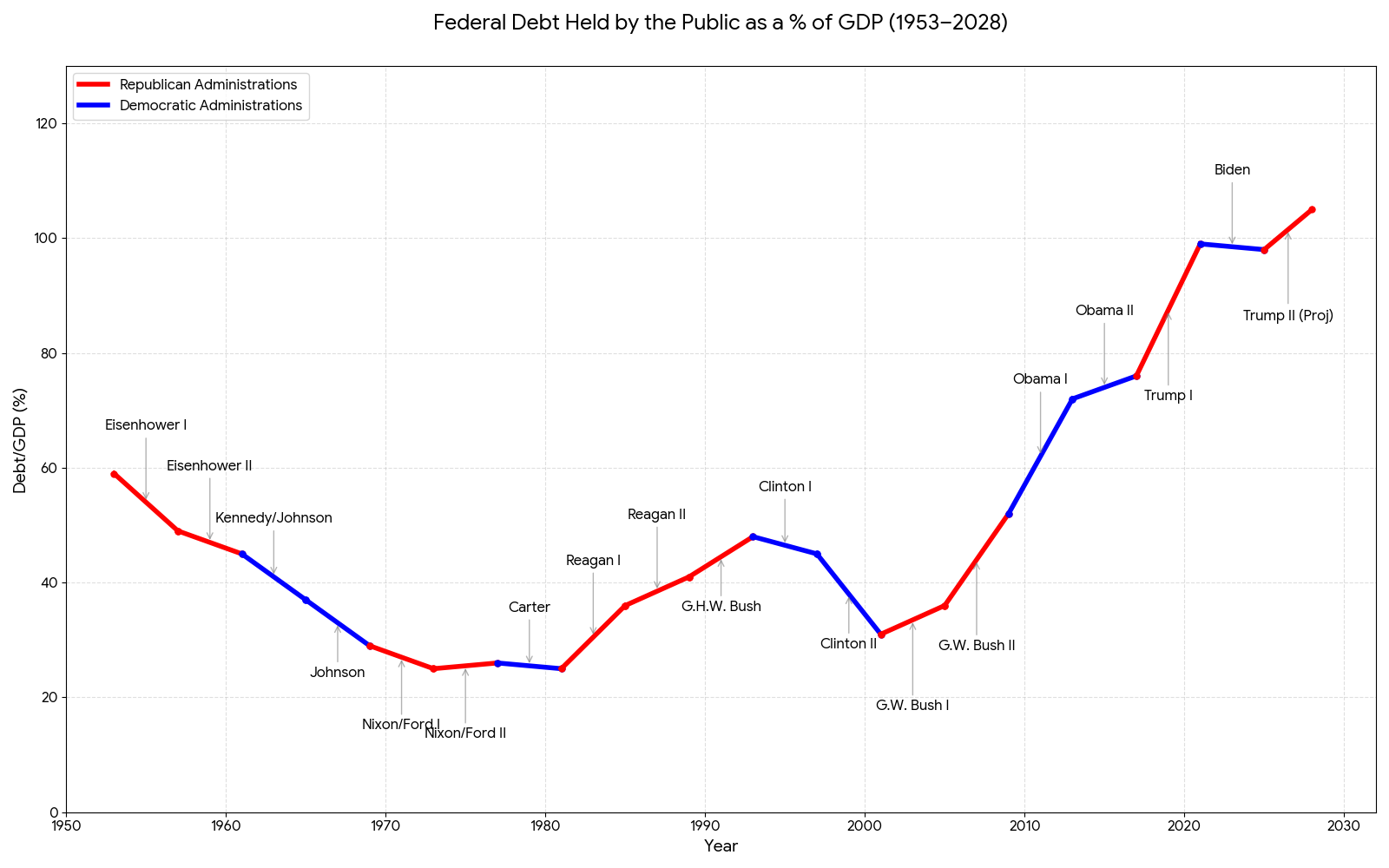
What follows is the change in federal debt held by the public, as a percentage of GDP, by four-year presidential term, since the end of the Korean War. Debt-to-GDP is an honest measure: it accounts for inflation and growth, and tells you whether the country is growing into or out of its obligations.
The figures are end-of-fiscal-year, drawn from the Congressional Budget Office’s historical series and the Office of Management and Budget’s Historical Tables.
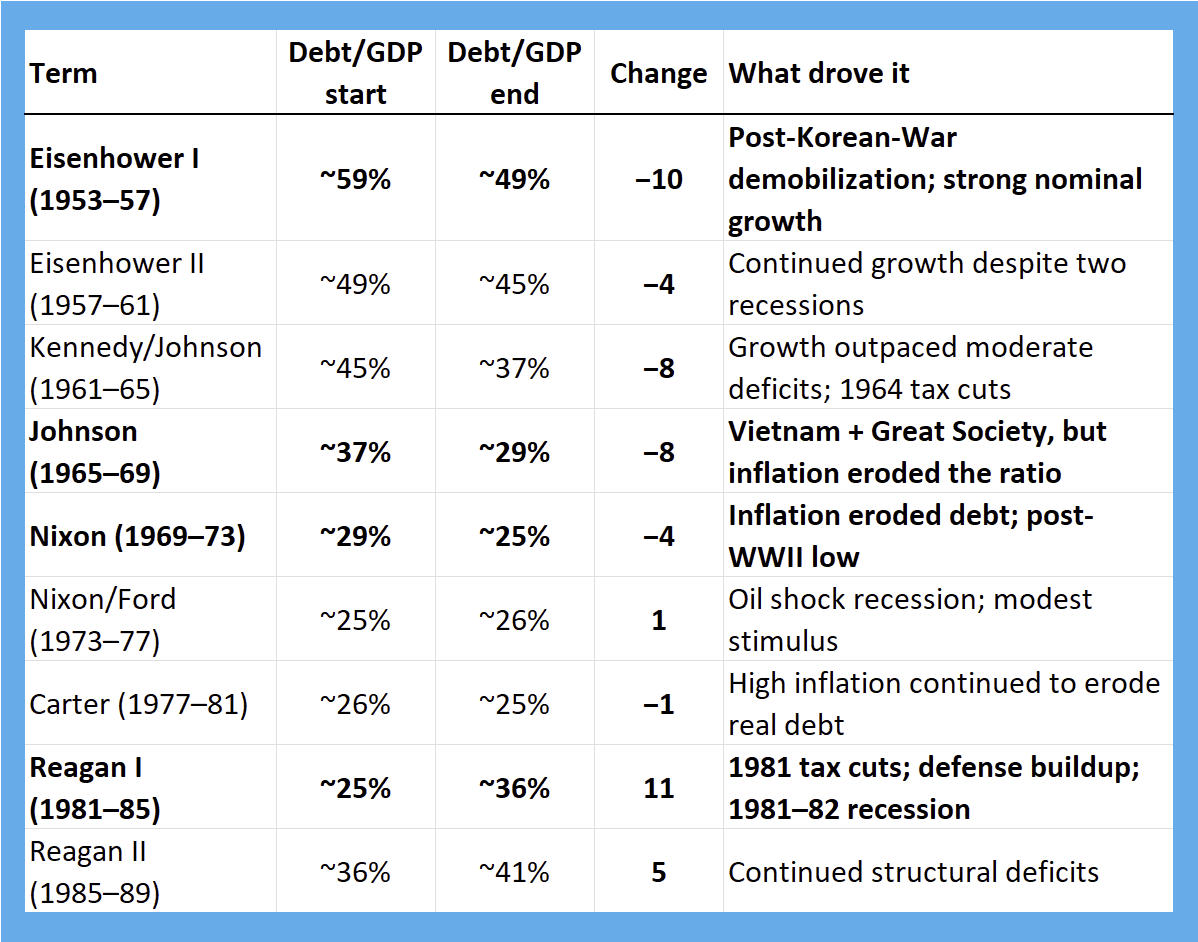
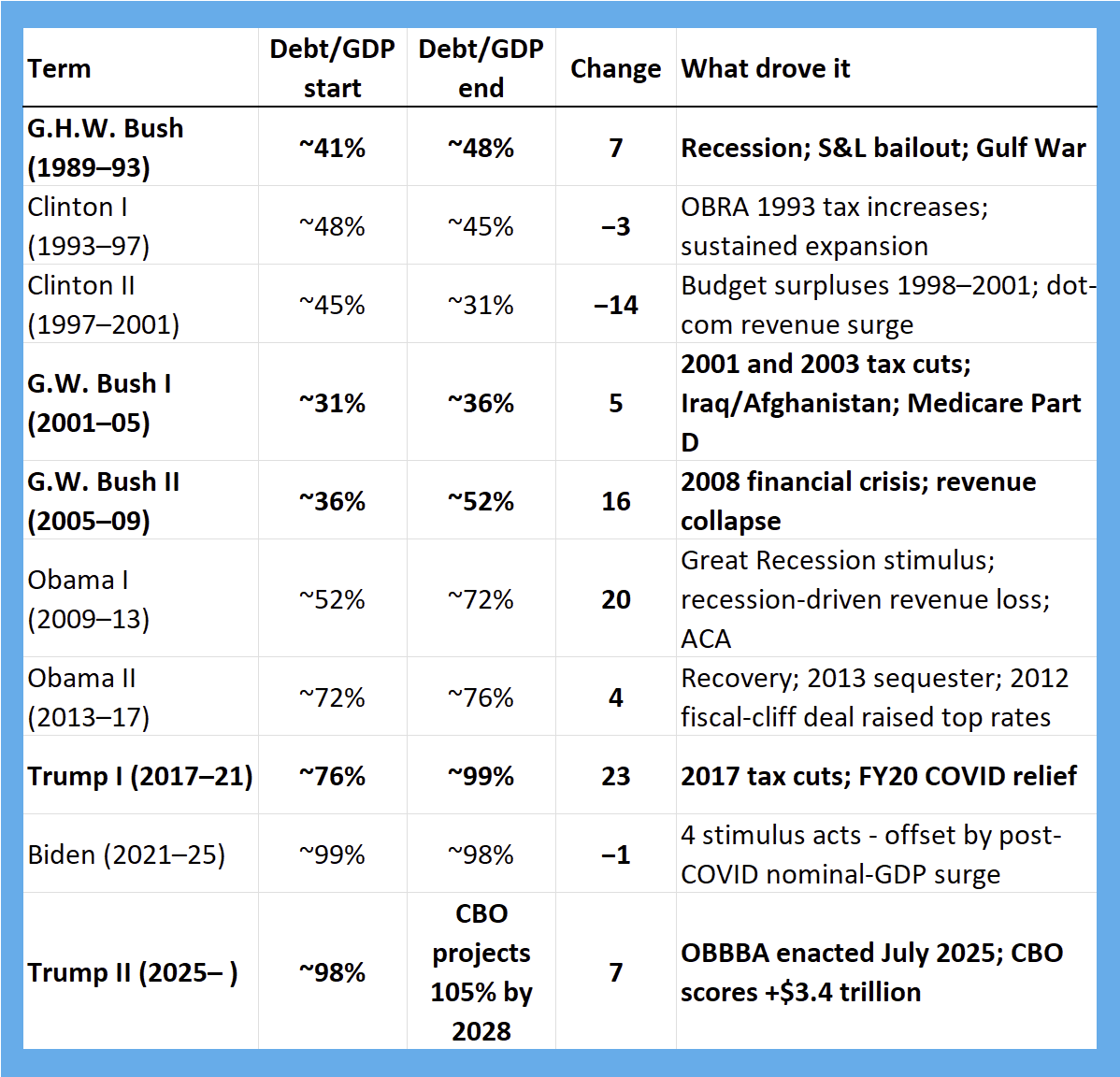
Look at the bolded rows. Every completed Republican presidential term since 1981 has increased the debt-to-GDP ratio. Every one. The only unbolded Republican rows are the Eisenhower-era declines, before the modern Republican fiscal program existed.
Look at the unbolded Democratic rows. Clinton II ran four straight surpluses. Biden - coming in with debt at 99 percent of GDP, with COVID still on the books - left it roughly where he found it.
The party that talks the loudest about deficits has, for forty-four years, been the party that creates them.
The Cycle
The pattern is now documented enough to predict.
Reagan tax cuts (1981) raise the deficit. Bush 41 is left to deal with the bill, breaks his “no new taxes” pledge in 1990, and is punished electorally. Clinton raises taxes on the top bracket in 1993 - every Republican in Congress votes against it - and runs surpluses by 1998.
Bush 43 tax cuts (2001, 2003) raise the deficit. The financial crisis explodes it. Obama inherits a $1.4 trillion deficit and 10 percent unemployment. The Tea Party - which did not exist after Bush’s two unfunded wars or Medicare Part D - emerges within weeks of Obama’s inauguration. Republicans take the country to within forty-eight hours of default in 2011, demanding spending cuts in exchange for raising the debt ceiling. S&P downgrades U.S. sovereign debt from AAA to AA+ for the first time in history.
Trump tax cuts (TCJA, 2017) raise the deficit by an estimated $1.9 trillion before COVID adds another wave. Biden inherits the bill. Republicans rediscover their concern - even as the IRA scores as deficit-reducing by the CBO.
Trump II (2025) signs the One Big Beautiful Bill Act on July 4. The CBO scores it at $3.4 trillion in added deficits over ten years. The same Republicans who spent fourteen years calling Democratic deficits “immoral” and “generational theft” vote for it.
This is not commentary. This is roll call.
The Three Paths Ahead
When debt-to-GDP exceeds 100 percent and net interest exceeds defense spending, the country has three options. None is comfortable. The choice among them is who pays.
Path One: Carry the debt. Accept that an ever-larger fraction of every tax dollar - currently 14 percent of all federal spending - goes to bondholders rather than to roads, research, or seniors. CBO projects that share rises to 19 percent by 2036. This is the path of slow erosion. It is the path the country is currently on.
Path Two: Pay it down. Run primary surpluses - revenue exceeds non-interest spending - for a sustained period, the way the U.S. did from 1946 to 1974 and Clinton did from 1998 to 2001. This requires tax increases, spending cuts, or both. Republicans block the tax side. Democrats block entitlements. The math is not impossible. The politics, currently, is.
Path Three: Inflate or default. A country that issues debt in its own currency can let inflation run hot enough to shrink the real value of the principal - a slow-motion default on bondholders, savers, and people on fixed incomes. The dollar’s reserve-currency status gives the U.S. more rope than other countries. But rope is not infinite. The bond vigilantes are not a fairy tale. They are simply patient.
The first path is a tax on the future. The second is a tax on the present. The third is a tax on everyone who holds dollars.
The current Republican fiscal program has chosen Path One by default and is positioning the country, slowly and without public consent, toward Path Three.
The Morality Question
Sovereign debt is not, in itself, immoral. Countries borrow to fight wars, weather crises, build the infrastructure that future citizens will use.
Borrowed dollars become problematic when they are used to buy something the borrower will consume and the lender will pay for.
Consider what Democratic deficits, at scale, have purchased: the 2009 Recovery Act prevented a depression; the ACA extended coverage to twenty million Americans; the 2021 Infrastructure Act underwrote bridges, ports, and rural broadband; the CHIPS Act brought semiconductor manufacturing onshore; the IRA funded the energy transition and, per CBO, reduced projected deficits. These were borrowed against. They are also things the future inherits. A bridge built today is used by your grandchildren.
Now consider what the major Republican fiscal bills since 2001 have purchased: the 2001 and 2003 Bush tax cuts, the 2017 TCJA, the 2025 OBBBA. Three rounds of tax reductions whose benefits flowed disproportionately to the highest income deciles. Three rounds of borrowing whose proceeds were consumed in the present by people best positioned to absorb the loss had the cuts not occurred.
The future does not inherit a tax cut. It inherits the bill for one.
A Democratic deficit, at its best, builds something. A Republican deficit, at its worst, transfers something - from the future to the present, and from the bottom of the income distribution to the top.
This is not a slogan. It is a description of the cash flows.
Who Pays
The federal debt will be paid back. The only question is how, and by whom.
If it is serviced indefinitely (Path One), it is paid by every future taxpayer through interest that crowds out other spending. Those future taxpayers are, on average, less wealthy than the present-day recipients of the tax cuts that swelled the principal. The transfer is upward in time, downward in income.
If it is paid down (Path Two), the fairer version concentrates higher taxes at the top - where the borrowed money largely went. The Republican version concentrates spending cuts at the bottom: Medicaid, SNAP, ACA premiums. We will document the OBBBA version of that math in Part 2.
If it is inflated away (Path Three), it is paid by everyone on a fixed schedule - wage earners, retirees, small savers. The wealthy, holding assets in real estate and equities, are most insulated.
There is no version of this story in which the people who lobbied for, voted for, and benefited from the borrowing are the same people who pay it back.
That is the inheritance theft.
What This Series Is About
In Part 2 - “The Quislings” - we will lay out the One Big Beautiful Bill Act in detail: what it cost, who got the money, who lost coverage, and what the CBO’s distributional analysis shows. Then we will do something simpler. We will pull transcript and press release from Republican senators and representatives who spent the Obama and Biden years calling federal borrowing “unsustainable,” “immoral,” and a threat to “future generations” - and set those statements next to their roll-call vote.
The exercise is not subtle. It is not meant to be.
Cheney was right about one thing. Reagan proved something in 1981: that deficits - for Republicans - are a campaign theme, not a principle. The principle is whichever party holds the presidency.
The debt is real. The interest is real. The bill is going to come due.
The only open question is who is going to pay it.
Next in this series: Part 2 - The Quislings. The OBBBA distributional autopsy, and the gallery of Republicans who voted for it after a decade and a half of warning that this exact bill would destroy the country.
If this matters to you, send it to someone who is still on the fence.
NOTES AND SOURCES
On federal debt held by the public as % of GDP, historical: Congressional Budget Office, “Historical Data on Federal Debt Held by the Public, 1790 to Present” - https://www.cbo.gov/publication/21728
Office of Management and Budget, Historical Tables (Table 7.1) - https://www.whitehouse.gov/omb/budget/historical-tables/
Federal Reserve Bank of St. Louis, FRED series FYGFGDQ188S - https://fred.stlouisfed.org/series/FYGFGDQ188S
On debt approaching 100% of GDP and FY2025 deficits: Committee for a Responsible Federal Budget, “12-Month Deficit Totals $1.7 Trillion, Debt Approaches 100% of GDP” (November 2025) - https://www.crfb.org/blogs/12-month-deficit-totals-17-trillion-debt-approaches-100-gdp
On net interest exceeding defense spending: Congressional Budget Office, “Monthly Budget Review: Summary for Fiscal Year 2025” - https://www.cbo.gov/publication/61307
Peter G. Peterson Foundation, “Monthly Interest Tracker: National Debt” - https://www.pgpf.org/programs-and-projects/fiscal-policy/monthly-interest-tracker-national-debt/
House Budget Committee, “Interest Costs Surpass National Defense and Medicare Spending” - https://budget.house.gov/press-release/interest-costs-surpass-national-defense-and-medicare-spending
On the Cheney “deficits don’t matter” quote: Ron Suskind, The Price of Loyalty: George W. Bush, the White House, and the Education of Paul O’Neill (Simon & Schuster, 2004).
TIME, excerpt of Suskind, “Confessions of a White House Insider” - https://time.com/archive/6737485/confessions-of-a-white-house-insider/
The Nation, “Gotta Sequester? Or Was Cheney Right That ‘Deficits Don’t Matter’?” - https://www.thenation.com/article/archive/gotta-sequester-or-was-cheney-right-deficits-dont-matter/
On the One Big Beautiful Bill Act cost score: Congressional Budget Office, “Estimated Budgetary Effects of H.R. 1, the One Big Beautiful Bill Act” - https://www.cbo.gov/publication/61570
CBO dynamic estimate - https://www.cbo.gov/publication/61486
CBO debt-service effects - https://www.cbo.gov/publication/61459
CRFB summary, “OBBBA Dynamic Score Comes In At $4.7 Trillion” - https://www.crfb.org/blogs/obbba-dynamic-score-comes-47-trillion
On the 2017 TCJA cost: Joint Committee on Taxation and CBO scoring summarized at - https://www.crfb.org/blogs/tcja-extension-could-add-37-trillion-deficits
On the 2011 debt-ceiling crisis and S&P downgrade: “2011 United States debt-ceiling crisis” - https://en.wikipedia.org/wiki/2011_United_States_debt-ceiling_crisis
S&P credit-rating downgrade - https://en.wikipedia.org/wiki/United_States_federal_government_credit-rating_downgrades
CNN, “S&P downgrades U.S. credit rating” (August 5, 2011) - https://money.cnn.com/2011/08/05/news/economy/downgrade_rumors/
On the IRA scoring as deficit-reducing: Congressional Budget Office, “Estimated Budgetary Effects of H.R. 5376, the Inflation Reduction Act of 2022” - https://www.cbo.gov/publication/58455
Visit us at https://quislings.info/ for our archive. Part 2 - The Quislings - will follow within the week.
Hawkeye this is so well written and packed with information even I can understand. Thank you for all your hard work pulling these together and informing us of the good, the bad, and the ugly truths.