

A roll-call exercise. The deficit hawks of the Obama and Biden years vote on a $3.4 trillion bill of their own.
In Part 1 we laid out the ledger: every Republican presidential term since 1981 has increased federal debt as a share of GDP. The party that talks loudest about deficits is, in office, the party that creates them. This post documents it at the level of the individual.
The vehicle is the One Big Beautiful Bill Act of 2025 - signed by President Trump on July 4, after passing the Senate 51 to 50 (Vice President Vance casting the tiebreaker) and the House 218 to 214.
We will do two things: the autopsy - what the bill cost, what it did, and who got the money - and the gallery - on-record statements from senators and representatives who voted for it, set against what those same people said about deficits when a Democrat held the White House.
The Bill
The OBBBA is, in CBO scoring, a $4.5 trillion tax cut paired with $1.4 trillion in spending cuts - most falling on Medicaid, SNAP, and federal student aid. Net deficit effect: $3.4 trillion over ten years on a static basis, $4.2 trillion on a dynamic basis with added interest payments included.
The bill permanently extends the 2017 individual income tax cuts, expands business expensing, raises the estate tax exemption, and introduces deductions on tips and overtime - the politically photogenic provisions. To partially offset the cost, it imposes work requirements on Medicaid recipients, tightens SNAP eligibility, and allows the enhanced ACA premium tax credits to expire.
In raw dollars, it is the largest deficit-financed tax reduction in American history.
Who Got the Money
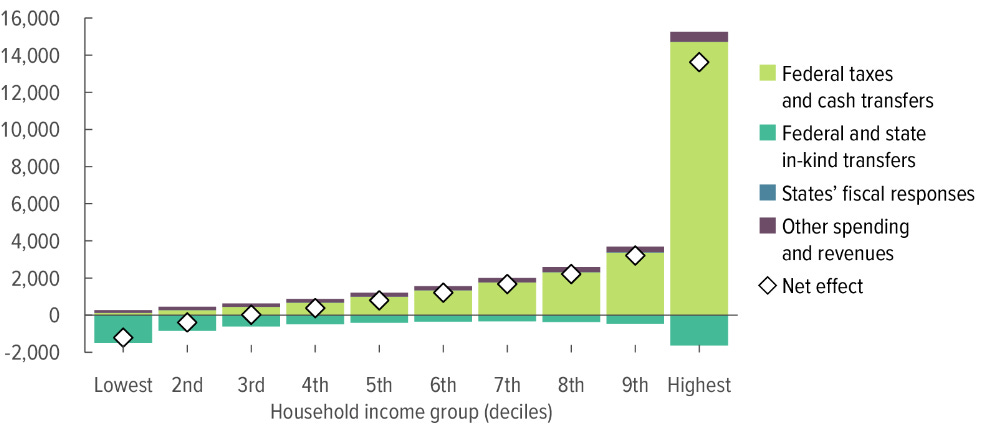
The CBO’s distributional analysis found the following:
The lowest-income decile sees its average household resources fall by approximately $1,600 per year by 2034 - a 3.1 percent reduction, driven primarily by the Medicaid and SNAP cuts.
The highest-income decile sees its average resources rise by approximately $12,000 per year - a 2.7 percent increase.
The Tax Policy Center finds the bottom quintile receives an average tax cut of about $40 per year; the top quintile receives over 70 percent of the total tax benefits. ITEP estimates the top 1 percent receives an average annual reduction of approximately $66,000.
The poorest tenth of the country loses $1,600 a year. The richest tenth gains $12,000. The top one percent gains $61,000. This is the bill the deficit hawks voted for.
CBO projects approximately 7.5 million Americans will lose Medicaid by 2034. Allowing the enhanced ACA credits to expire adds another 5 million to the uninsured. Total projected coverage losses: approximately 16.9 million.
That is the bill. Now let us look at the votes.
The Gallery
What follows is, for each senator or representative: an on-record statement from the Obama or Biden years warning of fiscal catastrophe - and their roll-call vote on the One Big Beautiful Bill Act.
Senator Mike Lee, Utah
After the 2011 S&P downgrade of U.S. sovereign debt:
“The true threat to our country, our economy and our way of life is our debt and the continued deficit spending Washington and the Obama administration are pursuing.”
Introducing a Balanced Budget Amendment in 2013:
“Washington’s insatiable need to borrow and spend has put off difficult decisions and threatened the prosperity of future generations. It is unconscionable and immoral.”
Senator Lee’s vote on OBBBA: YES.
Senator Ted Cruz, Texas
Opposing a debt-ceiling increase in 2013:
“This is about mortgaging the future of unborn generations of Americans. It’s a form of taxation without representation.”
Senator Cruz’s vote on OBBBA: YES, accompanied by a celebratory press release from his office.
Senator John Thune, South Dakota - now Majority Leader
In a 2009 op-ed titled “Skyrocketing National Debt Is Dangerous,” Thune wrote that federal borrowing was “unsustainable” and compared America to a family borrowing forty-three cents of every dollar it spent.
Senator Thune’s vote on OBBBA: YES.
He did not merely vote for it. As Majority Leader, he managed the floor, whipped the votes, and cast the deciding procedural ballots. Of every senator on this list, Thune most directly translated the Obama-era warning into the Trump-era result.
Senator Ron Johnson, Wisconsin
On President Obama’s FY2012 budget, February 2011:
“The American people clearly recognize that our spending, deficit, and debt are at unsustainable levels.”
Senator Johnson’s vote on OBBBA: YES. He had publicly threatened to oppose the bill on cost grounds. The threat did not survive the final vote.
Senator Lindsey Graham, South Carolina
In 2011, Graham was among twenty-three Republican signatories to a letter warning Obama that “future generations will drown in debt forced onto them.” In December 2012, he went on national television and demanded that Obama “man up” on the debt.
Senator Graham’s vote on OBBBA: YES. As chair of the Senate Budget Committee, he managed the bill through committee and onto the floor.
Speaker Mike Johnson, Louisiana
In his acceptance speech as Speaker on October 25, 2023:
“The greatest threat to our national security is our nation’s debt.”
He added that “in the time it’s going to take me to deliver this speech, we’ll go up another $20 million in debt.”
Speaker Johnson’s vote on OBBBA: YES. He shepherded the bill through the House and signed the enrollment.
By his own October 2023 standard, he just signed the largest single increase in the greatest threat to American national security in modern history.
Senator John Cornyn, Texas
Throughout the Obama years, Cornyn characterized the federal debt as both an economic and a national-security risk - echoing the framing that debt itself was the country’s foremost strategic danger.
Senator Cornyn’s vote on OBBBA: YES.
Senator John Barrasso, Wyoming - Majority Whip
On the 2009 Recovery Act: the stimulus had “shoveled billions of dollars of more debt on the backs of hard-working Americans.”
Senator Barrasso’s vote on OBBBA: YES. As Majority Whip, he was responsible for delivering Republican Senate votes for a bill that - by his 2009 standard - shovels trillions in additional debt onto those same hard-working Americans.
The One Who Held
One Republican senator on this list voted against OBBBA on cost grounds.
Senator Rand Paul of Kentucky voted no. He had spent the Obama years arguing that trillion-dollar deficits were a moral failing of his own party as much as the opposition’s. When the test came, he applied the standard he had set in 2018:
“I can’t in all good honesty, in all good faith, just look the other way.” - Senator Rand Paul, Senate floor, 2018
We may not agree with Senator Paul on much. We note him here because he is the exception that demonstrates the rule. One senator displayed integrity and principle. Fifty did not.
What This Tells Us
The point is not that politicians are inconsistent. That is not, by itself, a story.
The point is that the inconsistency is structural. It does not track new evidence about the macroeconomics of debt, or revised CBO projections. It appears precisely when a Democrat is sworn in as President. It disappears precisely when a Republican is.
That is not a statement of belief about deficits. It is a statement of strategic posture. The deficit, for the Republican Party in its current form, is a rhetorical asset deployed against Democratic legislation. It is not a constraint on Republican legislation.
If it were a constraint, the senators in this gallery would have voted differently.
The next time a Republican senator says federal borrowing is unsustainable, immoral, or a threat to future generations, guess which party holds the White House?
The Inheritance
The structure across both volumes of this series is the same: people with information, authority, and a public obligation choose instead to protect their position while others bear the cost - future citizens whose accumulated public capital is being spent down without their consent.
The OBBBA borrowed $3.4 trillion. The future will repay it. Those footing the bill are not, on average, in the top decile of the income distribution. The recipients of the borrowed money largely are.
That is not a market outcome. That is a transfer. From later to earlier, and from below to above.
The debt is real. The interest is real. The bill is going to come due. It will be paid by people who had no vote on the One Big Beautiful Bill Act - by people not yet of voting age when it passed, and by people who both voted for and against the senators in this gallery.
The senators in this gallery are not going to pay it.
This concludes the second volume of The Inheritance Thieves. The first volume - three posts on climate – can be found via links in the Substack index page at quislings.info, along with prior coverage of the individual senators and representatives named above.
If this matters to you, send it to someone who is still on the fence - or someone who is not yet old enough to vote, but who will be paying the bill.
NOTES AND SOURCES
On OBBBA cost scoring: Congressional Budget Office, “Estimated Budgetary Effects of Public Law 119-21” - https://www.cbo.gov/publication/61570 CBO dynamic estimate - https://www.cbo.gov/publication/61486 CBO debt-service effects - https://www.cbo.gov/publication/61459 CRFB summary - https://www.crfb.org/blogs/obbba-dynamic-score-comes-47-trillion
On OBBBA distributional effects: Congressional Budget Office, “Distributional Effects of Public Law 119-21” - https://www.cbo.gov/publication/61367 (interactive: https://www.cbo.gov/interactive/2025-reconciliation-act) Tax Policy Center, “Distributional Effects of the Tax Provisions in the 2025 Budget Reconciliation Act” - https://taxpolicycenter.org/tax-model-analysis/distributional-effects-tax-provisions-2025-budget-reconciliation-act Institute on Taxation and Economic Policy, “How Much Do the Top 1% in Each State Get from the Senate Tax Bill?” - https://itep.org/tax-provisions-in-trump-megabill-national-and-state-level-estimates/ Yale Budget Lab, combined OBBBA + tariff distributional effects - https://budgetlab.yale.edu/research/combined-distributional-effects-one-big-beautiful-bill-act-and-tariffs
On Medicaid, SNAP, and ACA coverage losses: Center on Budget and Policy Priorities, “By the Numbers: Harmful Republican Megabill Will Take Health Coverage Away from Millions” - https://www.cbpp.org/research/health/by-the-numbers-harmful-republican-megabill-will-take-health-coverage-away-from Kaiser Family Foundation, “A Closer Look at the Work Requirement Provisions in the 2025 Federal Budget Reconciliation Law” - https://www.kff.org/medicaid/a-closer-look-at-the-work-requirement-provisions-in-the-2025-federal-budget-reconciliation-law/
On final OBBBA roll-call votes: U.S. Senate roll call vote, July 1, 2025 - https://www.senate.gov/legislative/LIS/roll_call_votes/vote1191/vote_119_1_00372.htm U.S. House roll call vote, July 3, 2025 - https://clerk.house.gov/Votes/2025190
On individual senators’ Obama- and Biden-era statements:
Senator Mike Lee (S&P downgrade response, August 2011) - https://www.lee.senate.gov/2011/8/u-s-senator-mike-lee-responds-to-s-p-downgrade-of-united-states Senator Mike Lee (Balanced Budget Amendment, January 2013) - https://www.lee.senate.gov/2013/1/lee-introduces-balanced-budget-amendment
Senator Ted Cruz (debt-ceiling opposition, 2013) - Cruz Senate office press releases at https://www.cruz.senate.gov/newsroom/press-releases/
Senator John Thune (“Skyrocketing National Debt Is Dangerous,” August 2009 op-ed) - https://www.thune.senate.gov/public/index.cfm/2009/8/oped-c77be52d-3cc1-4287-a180-f4b283b71925
Senator Ron Johnson (statement on Obama FY2012 budget, February 2011) - https://www.ronjohnson.senate.gov/2011/2/johnson-statement-on-president-obama-s-budget
Senator Lindsey Graham (signatory, 23 Republican senators’ letter to Obama, 2011) - CRFB summary at https://www.crfb.org/blogs/23-senate-republicans-urge-obama-address-deficit Senator Lindsey Graham (“manning up” remark, December 2012) - https://www.washingtonpost.com/news/post-politics/wp/2012/12/10/lindsey-graham-to-obama-how-about-manning-up-on-debt/
Speaker Mike Johnson (acceptance speech, October 25, 2023) - PolitiFact transcript and fact-check at https://www.politifact.com/factchecks/2023/oct/26/mike-johnson/fact-checking-new-house-speaker-mike-johnson-on-th/
Senator John Barrasso (stimulus debt remark) - https://www.barrasso.senate.gov/
On individual senators’ OBBBA votes and post-passage statements:
Senator Mike Lee - Salt Lake Tribune coverage at https://www.sltrib.com/news/politics/2025/07/05/why-mike-lee-voted-megabill-after/ Senator Ted Cruz - https://www.cruz.senate.gov/newsroom/press-releases/sen-cruz-statement-on-senate-passage-of-one-big-beautiful-bill Senator John Thune - https://www.thune.senate.gov/public/index.cfm/2025/7/thune-the-one-big-beautiful-bill-makes-life-better-for-hardworking-americans Senator Ron Johnson - https://www.ronjohnson.senate.gov/2025/7/sen-johnson-releases-statement-on-passage-of-the-one-big-beautiful-bill-act Senator Lindsey Graham - https://www.lgraham.senate.gov/public/index.cfm/2025/7/chairman-graham-statement-on-senate-passage-of-the-one-big-beautiful-bill-act Senator John Cornyn - https://www.cornyn.senate.gov/news/cornyn-statement-on-vote-to-advance-president-trumps-one-big-beautiful-bill/ Speaker Mike Johnson - https://mikejohnson.house.gov/
On Senator Rand Paul’s NO vote and prior statements: CBS News interview, June 1, 2025 - https://www.cbsnews.com/news/rand-paul-trump-one-big-beautiful-bill-math-face-the-nation-06-01-2025/ Axios coverage - https://www.axios.com/2025/07/01/republican-senators-vote-big-beautiful-bill-trump Senator Paul’s 2018 floor speech on the Bipartisan Budget Act - https://www.paul.senate.gov/news-floor-speech-sen-rand-paul-speaks-out-against-budget-agreement/
Visit us at https://quislings.info/ for an index to the full archive, including individual Quisling Spotlight posts on John Thune, Mike Johnson, and Scott Bessent.