

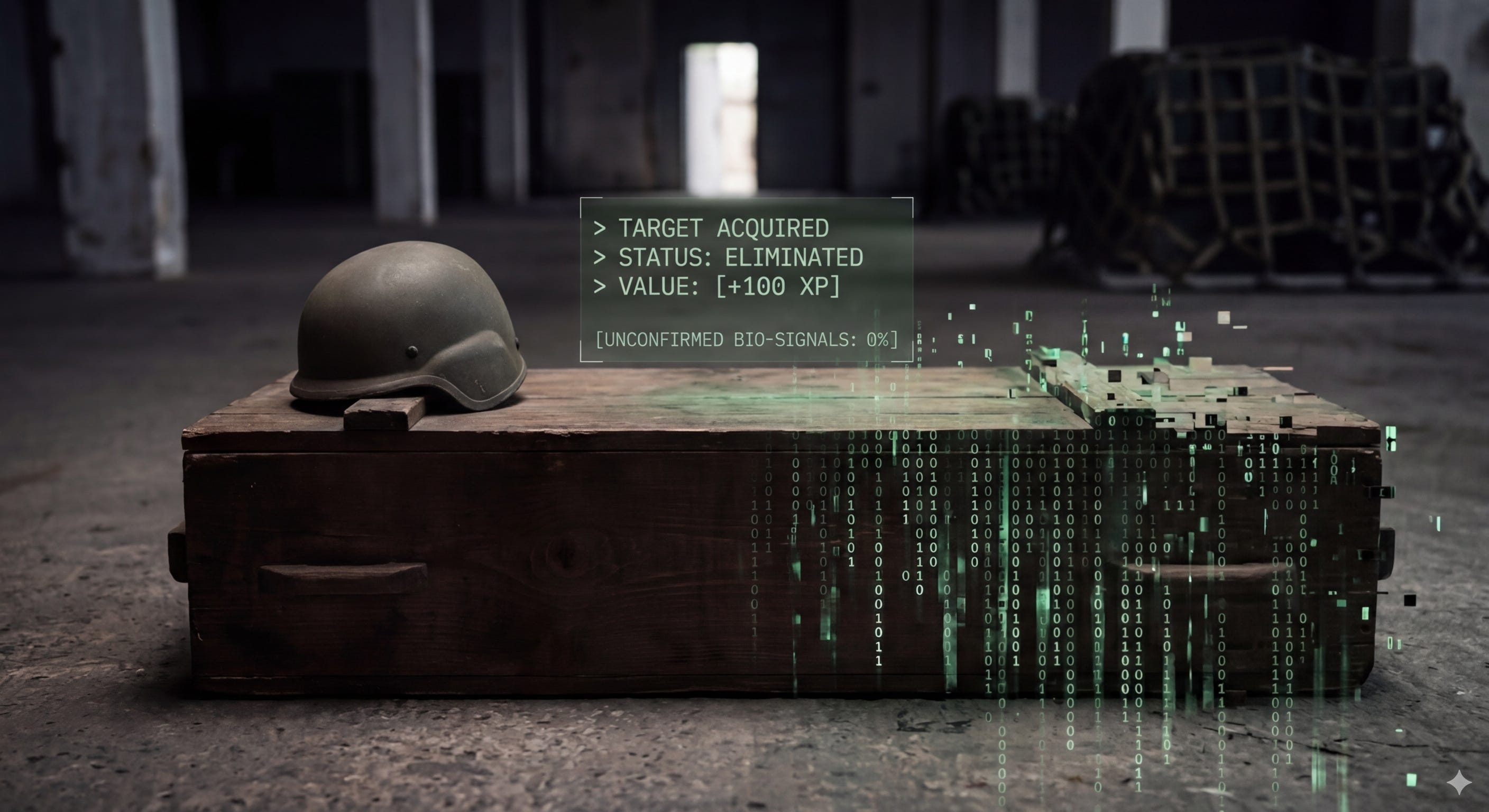
You’ve likely seen the clips by now: slick, high-definition “hype edits” shared by the White House and the Secretary of Defense. In these digital simulations, lethal strikes on Iran are rebranded with the aesthetics of a video game. Real explosions are spliced with “perfect victory” graphics, football hit sound effects, and captions like “WASTED.”
You don’t have to be a veteran to recognize what’s wrong with that.
This isn’t just content. It’s an effort to create distance - to turn the reality of war into something abstract, consumable, and easy to cheer.
The Mathematics of the Trenches
In the U.S. military, decision-making authority is concentrated at the top, but execution is not. The overwhelming majority of service members are young, junior-ranked, and tasked with carrying out orders rather than shaping them.
One of war’s oldest imbalances remains unchanged: it is typically initiated by older leaders and executed by younger people.
The average age of Republicans in the Senate - now avoiding public debate and a binding vote on continued military action against Iran - is 64. Few have immediate family in uniform. They sit in what Pete Hegseth dismissively calls “mahogany rooms,” but they’re enabling him as Secretary of Defense as he treats the deaths of young recruits - ours and theirs - as clickable social media fodder.
The Conscript’s Burden
Every one of those stylized explosions represents the death of human beings.
In Iran, military service is compulsory at age 18. Their draft law allows exemptions for the only son in a family, or for university students - but not for the rural poor, who make up the bulk of the ranks. The person on the receiving end of those strikes is not always an ideologue and rarely a decision-maker. Often, it’s just a 19-year-old kid who was told to show up for duty or face prison.
These young men are grist in a mill set in motion by older men in Tehran, just as our recruits are moved across the board by older men in D.C.
Strip away the flags and the language, and the resemblance becomes harder to ignore. Which is precisely why it must be obscured.
When someone cheers a cartoonish “football hit” that is actually a missile strike, they aren’t just mocking an enemy government - they are mocking the extinction of a human being who likely has more in common with a kid from Ohio than he does with the Ayatollah.
From “Kill Company” to the Pentagon
The title of this piece is not accidental.
Pete Hegseth served in a unit informally known as “Kill Company,” later associated with a war-crimes investigation involving the killing of detainees. While he was not charged, reporting from that period described a culture in which body counts were informally tracked - an environment that blurred the line between combatant and target.
In the years since, Hegseth has built a public persona that treats the legal and ethical constraints of warfare less as safeguards and more as obstacles.
Placed in charge of the Pentagon, that worldview does not remain rhetorical. It scales.
And it does so with the quiet consent of a Senate majority that has chosen to avoid formal authorization and oversight - preferring not to interrupt the performance with inconvenient questions about objectives, limits, or consequences.
The Lessons of 1914
There’s a famous ballad – “Christmas in the Trenches” – recounting an event that happened during World War One. In the winter of 1914, on Christmas Eve and Christmas Day, there were a number of unofficial truces, spontaneous recognitions of commonality. German and British soldiers stepped into No Man’s Land to share tobacco and photos and sing Christmas carols. They realized that the person in the opposite trench was just a mirror image of themselves, trapped in a nightmare precipitated by prime ministers and kings and designed by generals miles behind the lines.
For a brief moment, the illusion collapsed. The “enemy” looked familiar.
Senior officers were alarmed. They moved quickly to ensure such truces would not happen again. Because war depends on distance - psychological as much as physical. It is much harder to kill someone once you’ve seen their face, heard their voice, or recognized yourself in them.
Modern warfare has found new ways to preserve that distance.
The aesthetic of the “hype edit,” the language of the highlight reel - these are not accidental choices. They serve the same purpose as those long-ago orders: to prevent recognition, to suppress empathy, to keep the reality of war safely out of view. And to ensure no one is thinking in line with the final lyrics of the song:
“That the ones who call the shots won’t be among the dead and lame; And on each end of the rifle we’re the same.
The Bottom Line
For someone who so publicly invokes faith - through imagery, language, and symbolism - Hegseth seems ignorant of the most basic demands of Christianity. Love of neighbor does not stop at the border, and it does not disappear in wartime. And, while there are wars which are necessary and justified, glorifying the death of individual opponents is morally wrong.
War is not a branding exercise. It is not a clip, or a caption, or a moment engineered for reaction. It is the irreversible end of human lives.
To present it otherwise is not just distasteful. It is dehumanizing by design. Silence in the face of that dehumanization is its own form of collaboration.
At some point, the question is no longer what is being done.
It is why so many have decided to accept it.
So true and well said. Thank you!