

The presidential pardon was designed as a check on injustice - a constitutional safety valve for the wrongly convicted, the over-sentenced, or the repentant.
In the second term of Donald Trump, the pardon has ceased to be a rare act of mercy and has become a centerpiece of the “loyalty economy.” While his first-day blanket pardon for 1,500 January 6 defendants signaled a political shift, it is the individual clemency grants for white-collar titans and “rogues” that reveal the true price of justice in 2026. Across industries - finance, crypto, nursing homes, politics, even international narcotics trafficking - clemency has flowed toward figures connected by money, loyalty, or political utility.
Different crimes. Different sectors. Same structure: resources and allegiance move toward Trump-world; pardons move back.
Here are a few of the cases that define the new clemency economy.
The Repeat Customer: Adriana Camberos
In January 2026, Trump pardoned Adriana Camberos for a $10 million grocery fraud scheme. It was not her first act of presidential forgiveness. In 2021, Trump had already pardoned her for a counterfeit energy drink operation.
Two separate fraud convictions. Two separate pardons. Same president. We couldn’t find another example of such a thing.
Campaign finance records show tens of thousands of dollars in donations to MAGA-aligned political committees tied to her network. Whether coincidence or correlation, the outcome is undeniable: a serial fraudster received not just a second chance, but a second erasure.
The Crypto Convergence: Changpeng Zhao
Binance founder Changpeng Zhao pleaded guilty to federal charges related to money laundering violations tied to terrorist financing and illicit networks.
In October 2025, he was pardoned.
The timing raised eyebrows. The pardon coincided with the launch of the Trump family’s crypto venture, World Liberty Financial. Investigative reporting noted Binance-linked infrastructure connected to Trump-affiliated crypto initiatives, and a UAE-based fund soon purchased $2 billion in Trump-linked stablecoins while expanding ties to Binance.
No formal quid pro quo has been proven. But the alignment of clemency, crypto partnerships, and large-scale capital flows illustrates how porous the line between public authority and private venture has become.
The $1 Million Ticket: Paul Walczak
Nursing home executive Paul Walczak admitted to stealing $10 million in employee payroll taxes - funds diverted to finance a $2 million yacht and luxury purchases.
In early 2025, his mother attended a $1-million-per-head fundraiser at Mar-a-Lago. Three weeks later, Walczak received a full pardon. The $4.4 million owed in restitution to the IRS was wiped away.
The Lobbyist’s Payday: Joseph Schwartz
Joseph Schwartz oversaw a $38 million tax fraud while his nursing home chain deteriorated, leaving elderly residents in distressing conditions.
Reports indicate that Schwartz paid nearly $1 million to politically connected intermediaries in pursuit of clemency.
In November 2025, after serving only a fraction of his sentence, he received a “full and unconditional” pardon.
The Narco-Paradox: Juan Orlando Hernández
Trump’s 2024 campaign rhetoric promised uncompromising punishment for drug traffickers.
Yet in December 2025, he pardoned former Honduran president Juan Orlando Hernández, who had been sentenced to 45 years for facilitating the movement of hundreds of tons of cocaine into the United States.
Trump described Hernández as the victim of political targeting.
At the same time, federal drug enforcement policy toward low-level traffickers remained aggressive and lethal. The contrast is stark: severity at the margins, leniency at the top.
The Libertarian Symbol: Ross Ulbricht
Ross Ulbricht, founder of the “Silk Road” dark web market, who was serving a life sentence, became a political symbol for the Libertarian wing of the MAGA coalition. While supporters framed Silk Road as a “free market” experiment, the reality was a global narcotics bazaar. Under Ulbricht’s watch, Silk Road facilitated over $200 million in sales of heroin, cocaine, and LSD. Most critically, the DOJ unsealed evidence that Ulbricht solicited murders-for-hire to protect his empire.
His case became a rallying cause among libertarian activists, and his release fulfilled a campaign promise.
The pardon eliminated not only his sentence but also approximately $184 million in restitution and financial penalties connected to the case.
The Reality-TV Redemption: Todd and Julie Chrisley
Reality TV stars Todd and Julie Chrisley were convicted of a $30 million bank fraud scheme involving falsified documents and systemic deception of community banks.
Their daughter became an outspoken defender at Trump rallies, framing the prosecution as political persecution. In May 2025, Trump personally called her to announce their release.
The Loyalty Commutation: George Santos
Expelled from the House of Representatives in a bipartisan vote for fabrications and fraud, George Santos later pleaded guilty to wire fraud and aggravated identity theft - including stealing donor credit card information.
In October 2025, Trump commuted his seven-year sentence, praising Santos for having the “Intelligence to ALWAYS VOTE REPUBLICAN,” effectively a slap in the face of House GOP leaders showing that their ethics standards don’t apply to his allies.
The Constitutional Cost
By early 2026, these pardons and commutations had erased an estimated $1.3 billion in restitution, fines, and financial penalties.
The pardon power was designed as a check on injustice.
Used this way, it becomes a check on nothing.
In this new economy, prison is for the unconnected. Accountability is optional. And the constitutional power of mercy has been converted into a private asset - controlled by one man. The message is clear:
Justice is flexible.
And mercy has a market price.
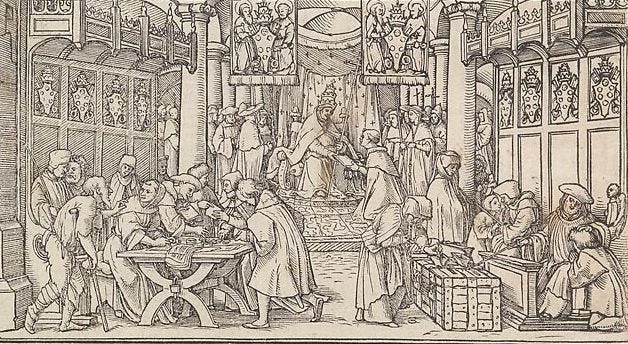
The image at the top is a section of a 16th century woodcut by Hans Holbein the Younger called "The Selling of Indulgences."
Thank you for exposing these shameful actions by the trump administration.