

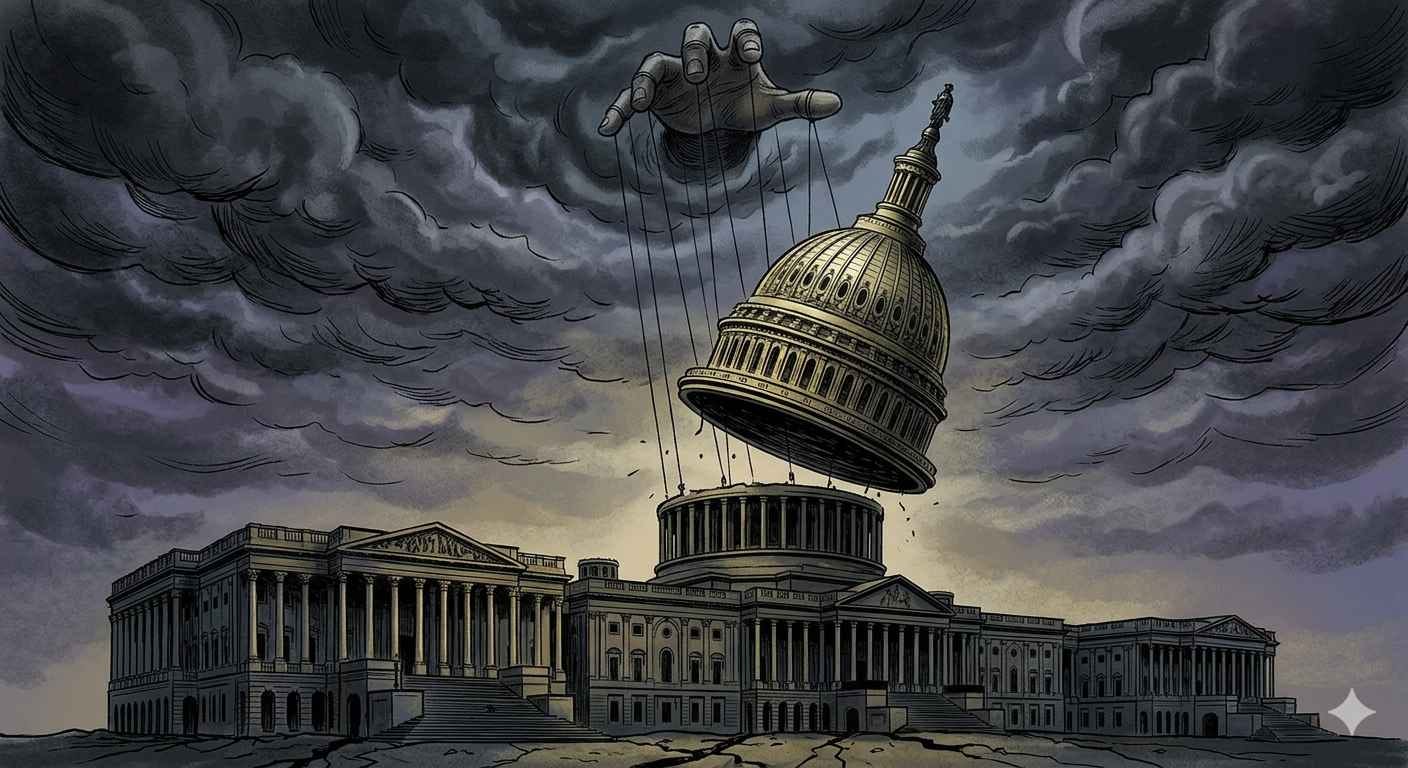
The Constitution gives Congress alone the power of the purse. Congress has been handing it back.
Article I is unambiguous: “No Money shall be drawn from the Treasury, but in Consequence of Appropriations made by Law.” The power of the purse belongs to Congress. Not to the president. Not to an unelected billionaire running a cost-cutting operation out of a government office with no statutory authority. To Congress.
This was not an oversight or a minor procedural detail. The founders gave Congress the purse specifically because they understood that the power to spend is the power to govern. A legislature that cannot control the money cannot control anything else. James Madison wrote in Federalist 58 that the power of the purse was “the most complete and effectual weapon” available to the people’s representatives for obtaining redress of grievances and checking executive overreach.
The current Republican majority in Congress has that weapon. It has largely chosen not to use it.
What the Constitution Requires
The system was designed with a specific sequence:
The executive branch proposes a budget.
Congress debates, amends, and passes appropriations.
The president signs or vetoes.
Once appropriations are enacted into law, the executive branch is constitutionally required to spend the money as directed - not less, not differently, and not withheld pending presidential approval.
This is not a technicality; it is the foundational mechanism by which a democratic legislature maintains control over the executive. Without it, appropriations become mere suggestions. Without it, the president can effectively amend any law by simply declining to fund it.
The Supreme Court settled this definitively in Train v. City of New York (1975), holding that a president cannot “impound” - refuse to spend - funds that Congress has appropriated. Congress reinforced this with the Impoundment Control Act of 1974, passed specifically in response to President Nixon’s systematic refusal to spend funds.
For fifty years, that framework held. Presidents of both parties worked within it, sometimes unhappily. The current administration has decided it no longer applies.
The DOGE Doctrine
Beginning on the first day of the second Trump administration, the Department of Government Efficiency (DOGE) - an entity with no statutory authority and no congressional authorization - began systematically cutting programs that Congress had funded, firing employees that Congress had authorized, and shuttering agencies that Congress had created.
DOGE has made less news since Musk’s departure, but it is still operating. The DOGE executive order actually created two entities: the permanent U.S. DOGE Service and the temporary “U.S. DOGE Service Temporary Organization,” which expires July 4, 2026 - timed, with characteristic self-congratulation, to coincide with America’s 250th birthday. But that deadline applies only to the temporary organization - the permanent U.S. DOGE Service has no expiration date. Whether or not the nameplate comes down on July 4th, the apparatus remains.
DOGE is not a government agency in any legal sense. It has no appropriation. Its staffing and budget are, as one legal analysis noted, “largely a mystery.” It has nonetheless claimed the power to override decisions made by the branch of government assigned that authority by the Constitution.
While Congress refuses to fund DOGE directly, it stands by as the executive branch uses the 1932 Economy Act to siphon millions from agency budgets - effectively allowing the executive to appropriate its own enforcement arm without a single vote.
The legal argument advanced to justify this is “impoundment” - the claim that the president has inherent authority to spend less than appropriated. OMB Director Russell Vought has been explicit:
"We have executive tools; we have impoundment." — Russell Vought, CNN State of the Union with Dana Bash, June 1, 2025
The legal consensus against this position is not close. Georgetown Law professor David Super told NPR that the constitutional answer is “very clear.” A Stanford Law Review analysis published in summer 2025 concluded that “all the conventional considerations in constitutional interpretation cut against” a presidential impoundment power. Stanford Law’s Michael McConnell, a former federal appellate judge, was direct:
“The president has the constitutional obligation to take care that the laws be faithfully executed, and that includes spending. I don’t know where Mr. Vought gets the view that somehow the president has the right to decide what the government is going to spend money on.”
The administration is not claiming a legal gray area. It is claiming a power that courts have rejected, that Congress explicitly legislated against after Nixon, and that the legal consensus across the political spectrum says does not exist.
What Congress Is Doing About It
Here is where the quisling analysis becomes precise. The Quislings here don’t just fail to defend the gate; they explain to the citizens why the gate wasn’t necessary in the first place.
Congress has tools. It controls the appropriations process. It can attach conditions to funding, refuse to pass continuing resolutions, hold oversight hearings, and refuse to confirm nominees until the law is followed.
It has not done any of these things.
Speaker Mike Johnson, asked about the administration’s $9.4 billion rescissions package - a request to ratify DOGE cuts already made without approval - said he was “anxiously awaiting” it. The Speaker of the House, whose role is to guard that chamber’s authority, described his function as eagerly processing the executive branch’s retroactive spending decisions.
Senator Thom Tillis of North Carolina offered perhaps the most candid Republican assessment, acknowledging that some of DOGE’s actions “run afoul of the Constitution in the strictest sense.” He then told the news outlet NOTUS:
“Nobody should bellyache about that.”
Nobody should bellyache... About the Constitution being violated “in the strictest sense” by a senator who took an oath to defend it. This is the quisling pattern applied to the most fundamental power the legislature possesses: the explicit statement that a violation is occurring and that the appropriate response is silence.
The Rescissions Gambit
The $9.4 billion rescissions package sent to Congress in June 2025 illustrates the mechanism precisely. DOGE had already cut the funding. The programs were defunded; the employees were fired.
The rescissions package was not a request for permission; it was a request for retroactive ratification of illegal acts.
By passing that package, the Republican majority did not restore order; they validated the process by which the order was bypassed. They established a precedent: the executive acts, and Congress follows. The sequence the founders designed has been reversed. The executive now spends or withholds as it sees fit, and Congress ratifies afterward.
Madison’s Weapon, Surrendered
The Republican majority in Congress has not been stripped of its “most complete and effectual weapon.” It has handed it back - through inaction, through statements like Senator Tillis’s, and through a Speaker who has traded his constitutional role for a clerical one.
The question our series keeps returning to is: Who had the power to object, and what did they do with it?
The Senate Majority Leader controls the floor. The Speaker controls the House calendar. Every one of them had the procedural tools to reassert control. They know the Constitution is being violated. They have simply been told not to bellyache about it.
The purse has no strings because the people holding it cut them.

If this matters to you, send it to someone who needs to read it.