

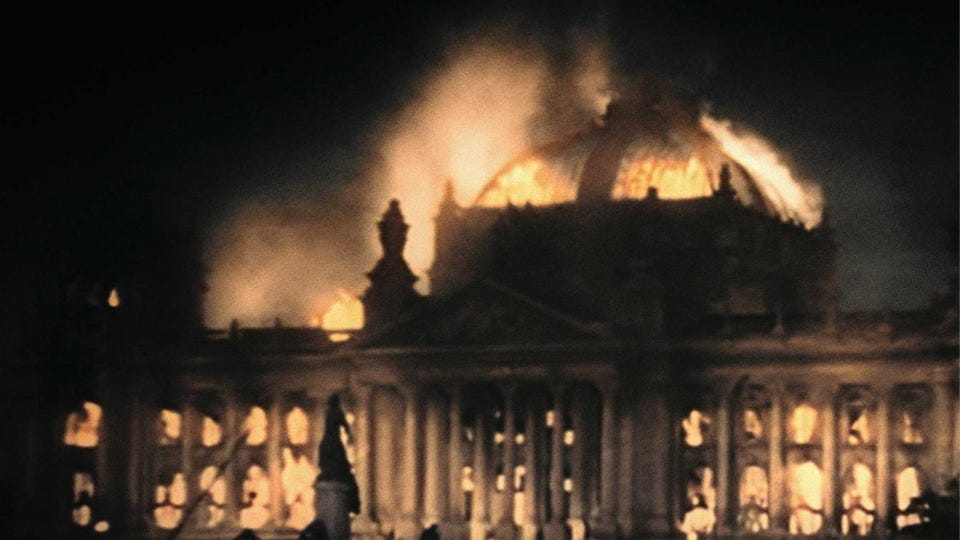
Our last post discussed the German Enabling Act of 1933 - the legislation by which the German Reichstag voted its own power away. What we didn’t cover was what came first.
Less than a month before the Enabling Act passed, the Reichstag itself was set on fire.
On the night of February 27, 1933, the German parliament building burned. The great Plenary Chamber - ornate timber, decades of debate - became a furnace. The glass and metal cupola shattered under the heat, creating a chimney effect that turned a crime scene into a national trauma. Whether the arsonist acted alone or was manipulated by the Nazis themselves has never been conclusively established. What happened next, however, was not improvised.
To the public, it was chaos. To the Nazi Party, it was the opening.
The Shield and the Sword
The mechanism of the Nazi takeover was not that they ignored the law. It was that they used the law to kill the law. The Reichstag fire provided the vacuum. Two pre-planned instruments filled it.
The first was the Reichstag Fire Decree - issued the very next morning, before the smoke had cleared. Framed as a temporary security measure “for the Protection of People and State,” it effectively suspended the German Bill of Rights overnight. The state gained the legal authority to intercept mail, monitor phone calls, and search homes without warrants. Within hours, 4,000 political opponents had been arrested under its provisions. The opposition did not need to be defeated. It needed to be silenced long enough for the second instrument to work.
The second was the Enabling Act three weeks later. With the opposition imprisoned or intimidated, Hitler asked the remaining parliament to hand executive power to the government - temporarily, just until the crisis passed. The chamber was surrounded by armed guards. The vote was held anyway. Democracy did not die in a dark alley. It voted itself out of existence in a well-lit room.
Watching for the Blueprint
History rarely repeats exactly. It reuses the architecture.
In our current US climate, where the press and political opposition have been branded as enemies and there were 8 emergency decrees in the first month of this presidential term - plus an undeclared war - Germany in 1933 is a lesson worth studying.
The Reichstag playbook has three recognizable moves. None of them require a burning building. All of them require a crisis - real, exaggerated, or manufactured.
The pre-drafted response. Comprehensive legislation or sweeping executive orders that appear within hours of a crisis were not written in response to it. Real emergency responses take time. Pre-positioned ones are waiting for a spark. When the solution arrives faster than the problem can be understood, ask who had it ready.
The suspension of process. The argument that the stakes are too high for normal constitutional procedures - that this election, this moment, this emergency is too important for the usual rules - is the oldest move in the playbook. Emergency powers were designed for crises. They were not designed to become the new normal.
The criminalization of dissent. In 1933, the Nazis did not simply blame the arsonist. They used the fire to label everyone who disagreed with them an enemy of the state. When a crisis is used to justify the silencing of political opposition, the emergency is no longer about safety. It is about monopoly.
The Final Word
The Reichstag didn’t just burn; it was used to incinerate the very idea of a government bound by law.
As we approach the mid-terms, we must refuse to be distracted by the glare of any “emergency” flames. History’s most dangerous arsonists don’t always start the fire; they simply ensure that when the smoke clears, the only thing left standing is their own unchecked authority.
We need to look past the event and look instead at the hands of those offering “emergency” solutions. If their response to a crisis is a pre-drafted assault on civil liberties or the electoral process, then the event itself isn’t the emergency - the response is.
We cannot protect our house by allowing its foundations to be cleared away “just this once.” If we are told that the only way to save the country is to surrender the rules that define it, then the “salvage operation” is actually a heist.
By now, our mission at Quislings should be clear: we are less preoccupied with the figure at the podium than with the enablers in the pews. The ‘Reichstag playbook’ works only when representatives trade their constitutional integrity for a seat at the table of power. If you share our concern for the survival of a functional Congress, don’t just watch the erosion happen - act. Forward this piece to your elected representatives as a reminder of their oath, and share it with those who have yet to realize how precarious the ‘well-lit room’ has become.
Very educational! I wonder what will happen to the Quislings when the page turns? Will a resistance movement form under Vance (or someone else), or will they all crawl into the woodwork and somehow try to excuse their conduct or minimize their complicity? Will MAGA dissolve into an Eastern and Western block?
It amazes me that so many in the country are so lackadaisical about what is going on. Saturday is another No Kings demonstration. Make our voices be heard.