
The Same Room
The THAAD story was not an exception. It was an illustration.

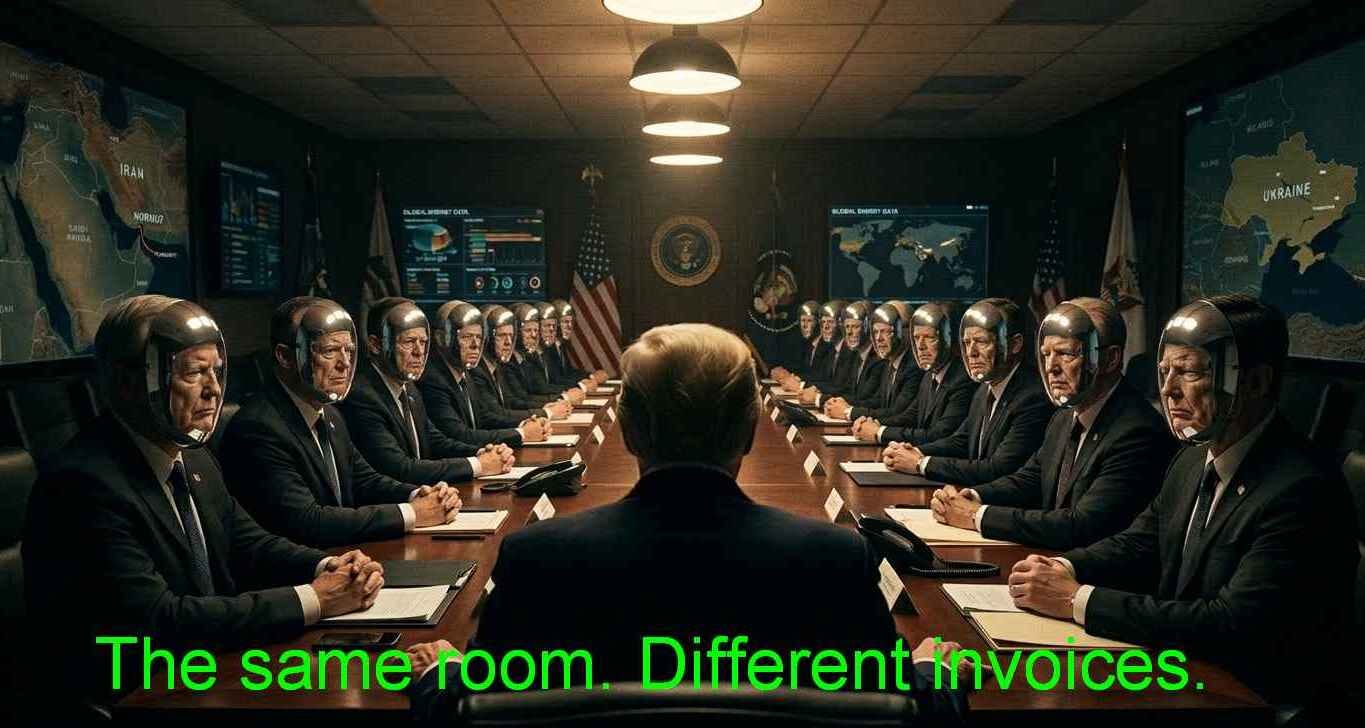
In our last post: a $500 million radar destroyed by a $40,000 drone, a Ukrainian solution rejected and then begged for months later, seven Americans dead. That was one case study. The same dynamic - expertise sidelined, questions not asked, bad assumptions unchallenged - is running across every major policy domain simultaneously.
Here is the ledger outside Jordan.
The War Nobody Seemed to have War-Gamed
The Strait of Hormuz is 21 miles wide and the shipping lanes are two miles across. Twenty percent of the world’s liquid petroleum supply passes through it daily.
Iran does not need a functioning navy to close it - mines, fast boats, and shore-launched missiles are enough. The Revolutionary Guard has every incentive to fight to the end. The regime’s survival depends on it.
Someone should have asked: what happens to oil prices if the strait closes? What happens to our European allies? What does a prolonged Iranian conflict do to Russian oil revenues - which rise as global supply tightens - at the precise moment Russia needs hard currency for Ukraine?
From the outside, it doesn’t appear that a serious decision tree was run. But war-gaming actually had been done. It’s just that the officers who ran it were fired or sidelined before the decisions were made. The administration’s own intelligence community assessed that a full military confrontation carried significant escalation risks. Those assessments appear not to have been heeded and were not prominent in the public case for action.
An armed minority regime with nothing left to lose is not a country you go to war with on a timeline. Someone should have said that out loud.
The strait has been effectively blocked since the war began. Whether or not the administration anticipated this, it is the outcome.
The Reserve: So What?
When gas prices jumped, the administration announced it was opening the Strategic Petroleum Reserve. Here is what that actually means:
Global consumption runs at 100 million barrels per day. The entire reserve holds 400 million barrels - less than four days of global supply. The price impact is modest and temporary.
More to the point: the United States is the world’s largest oil producer and a net exporter. The strategic vulnerability that the SPR was created to address in 1975 - after the Arab oil embargo - no longer applies. We are not going to run short of oil. We are just going to pay more for it.
That is the reality of modern energy economics. Domestic producers sell at international market prices, not at the cost of production. When global supply tightens, American gas prices rise regardless of how much oil sits under American soil.
If the SPR release helps anyone materially, it is Europe, which genuinely depends on Persian Gulf supply in a way we no longer do.
American consumers get the announcement. Europe gets the barrels.
The structural problem - domestic producers capturing windfall profits from global price shocks unrelated to their own costs - has a known policy response. Congress enacted a windfall profits tax in 1980 to address exactly this situation after the Iranian revolution spiked oil prices. It was repealed in 1988. No one in this administration has mentioned it. No one in the room appears to have raised it. You can guess why not.
Plus there is the fact that the reserve that was opened wasn’t even full. Trump inherited an SPR depleted during the Ukraine war price spikes, criticized Biden for it, promised to refill it, and did not. It sat at 58 percent capacity when the war started.
The SPR was opened. It was half empty and more useful to Europe than to the family at the pump. Nobody in the room said any of that.
The Tax That Wasn’t an Emergency
On February 20, 2026, the Supreme Court ruled 6-3 in Learning Resources, Inc. v. Trump. The holding: the International Emergency Economic Powers Act does not authorize the President to impose tariffs. Chief Justice Roberts noted it was “telling” that in IEEPA’s 48-year history, no president had ever used it to impose tariffs - until 2025. The Constitution gives Congress alone the power “to lay and collect Taxes, Duties, Imposts and Excises.” The Court said no.
The damage done in the meantime: the largest U.S. tax increase as a percentage of GDP in more than 30 years - averaging $1,000 per household in 2025 and $1,300 in 2026. At least $160 billion collected from American importers, who passed most or all of the cost to consumers. These were not taxes paid by foreign countries. It is how tariffs work. Someone in the room knew that.
“When Congress has delegated its tariff powers, it has done so in explicit terms, and subject to strict limits.” - Chief Justice John Roberts, February 20, 2026
Scott Bessent called the situation “unsustainable” in private. In public he called it “strategic uncertainty.” The Supreme Court called it unconstitutional.
The Return Address
Three domains. Three categories of failure. Three versions of the same dynamic: information available, expertise present, questions not asked or not heard, consequences absorbed by people who were not in the room.
The Iran war was not war-gamed seriously before it started.
The strategic petroleum reserve was not refilled before a Persian Gulf conflict began. And its “opening” is largely irrelevant to American consumers.
The tariffs were not constitutional, everyone with relevant expertise knew it, and $160 billion was collected from American companies and consumers anyway.
These are not complicated findings. They do not require classified access or insider sources. They are visible in the public record, in court filings, in intelligence assessments, in the gap between what the administration promised and what it did.
What they share is a return address: a government in which the cost of honest counsel has been made higher than the cost of silence. In which the first question in the room is not “what does the analysis say” but “what does he want to hear.”
The THAAD radar was the most visible invoice. But it was not the only one.
They are all arriving at the same address. Yours.
If this matters to you, send it to someone who needs to read it.
Great research and commentary. Thanks