

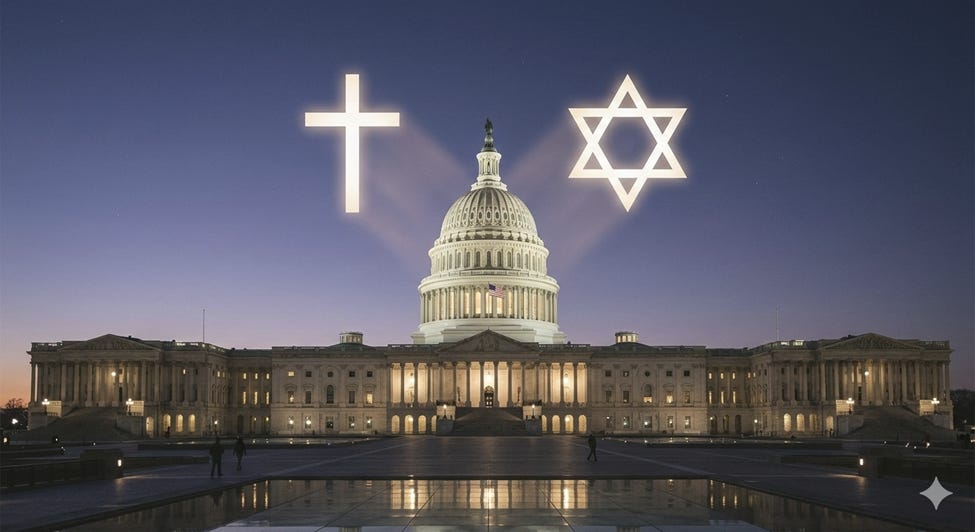
In recent months, we’ve watched Christian Nationalism move from the periphery of the political world to the very heart of the state. We see Secretary Hegseth leading prayers at the Pentagon and hear troubling reports of military commanders citing “religious destiny” in their Iran war briefings.
Is this a concern for anyone else? It should be - regardless of whether you spend your Sunday mornings in a pew or on a hiking trail.
One of the most succinct descriptions of this danger comes from the late science fiction master Ben Bova. In his novel Mars Life, he lays out a historical blueprint that is as chilling as it is consistent:
“The history of civilization is the history of the struggle between the power of the state and the liberty of the individual. History is full of examples. It happened in the Middle Ages in Europe. It happened in the Islamic world after its golden age of science. Whenever a religious movement has gained the reins of governmental power, individual liberties are strangled.”
The “It” in the Room
Bova’s point about the Islamic world is a sobering lesson in “The Great Stagnation.” During its Golden Age, the Islamic world led the planet in medicine, optics, and the algebra we use today. But when the state decided that religious orthodoxy was a more effective tool for control than scientific inquiry, the lights went out.
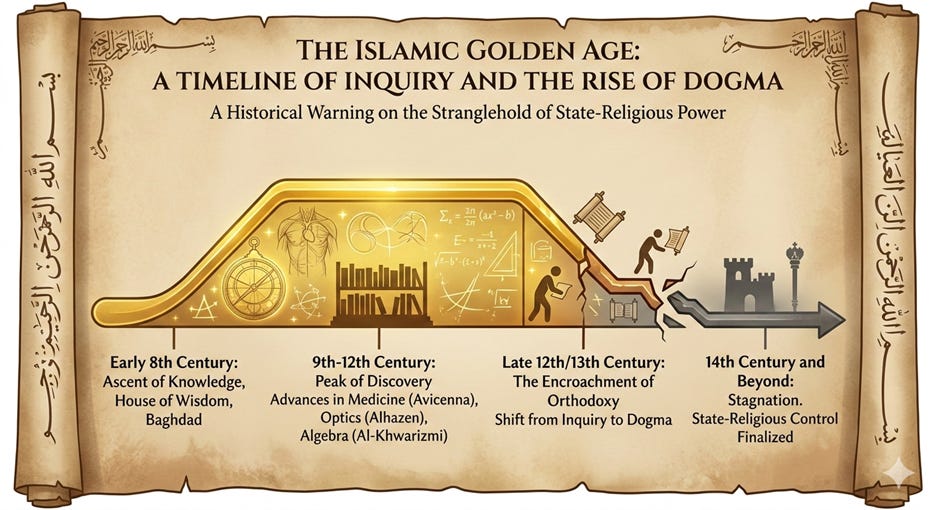
A conceptual timeline showing the decline of scientific inquiry during the historical transition from the Islamic Golden Age to centralized state-religious control.
The same “It” happened in Europe’s Middle Ages. When the state claims a monopoly on God’s will, it no longer needs to debate, compromise, or even prove it is right. It simply is right. And at that point, the “tension” between the state and the individual isn’t just resolved - it’s flattened.
The Magistrate’s Utility
The historian Edward Gibbon, in his sweeping Decline and Fall of the Roman Empire (published in 1776), observed a similar phenomenon in the ancient world. He noted that the various modes of worship were:
“...all considered by the people, as equally true; by the philosopher, as equally false; and by the magistrate, as equally useful.”
We don’t need to debate the “true” or “false” part of that statement to see the danger in the useful. For a magistrate - or a modern politician - a religious movement is the ultimate “force multiplier.” It provides a low-cost way to assemble an army of voters and soldiers who believe that political dissent is synonymous with sin.
This is the perfect “Quisling” move: taking a faith like Christianity that teaches humility and “rendering unto Caesar” and turning it into a tool for Caesar to demand what belongs to the soul.
The Betrayal of the Sacred
We see this “useful” religion in the televangelists with private jets and the politicians who use the Bible as a stage prop while ignoring its most basic tenets. It is a performative masculinity wrapped in a prayer shawl.
For our highly religious friends, the concern here isn’t just about secular liberty - it’s about the corruption of faith itself. There is a deep irony in politicians who wear their faith on their sleeves in direct disobedience to Christ’s warnings against performative piety.

When scripture is used as a low-cost way of “assembling an army,” the scripture itself becomes a casualty. It is stripped of its nuance and mercy and sharpened into a weapon for the culture war. This isn’t a revival; it is the institutional capture of the sacred by the secular. It is the “useful” religion Gibbon warned about - a faith that serves the throne before it serves the truth.
The Cost of Certainty
For those of us who served, we know that leadership is built on competence, strategy, and the weight of responsibility for the lives in one’s command, whether you’re a platoon leader or the commander-in-chief. Replacing that foundation with “religious destiny” doesn’t make a country or military stronger; it makes it brittle. It replaces the earthly accountability of the chain of command with the ‘certainty’ of the divine.
Liberty requires tension. It requires the state to be constantly checked by the individual. When the state and the church become one, the tension snaps. And as those of us who have seen misguided wars can attest: when “certainty” takes over, it is always the individual - the sailor, the scientist, the citizen - who ends up being strangled by it.
NOTES
The first two illustrations above are our first experiments with AI-generated images. Please share your thoughts on their effectiveness / appropriateness.
Lawmakers Want DOD, Hegseth Investigated For Biblical 'Armageddon' Claims | Military.com
We can recommend the Mars triad by Ben Bova; one of the dominant themes is the power of the “New Morality” – a religious movement that is turning the US into a theocracy and impacting scientific exploration.
The Gibbon quote is often misattributed to the Roman philosopher Seneca in this form: “Religion is regarded by the common people as true, by the wise as false, and by the rulers as useful.” It’s become a “zombie” quote - attributed to Seneca for so long (likely because it sounds like something a Stoic would say) that it’s become a standard “fact” on the internet.
Christ’s warnings about performative piety are perhaps most succinct in Matthew 6:1-18.
It does feel like our country is being strangled by ignorance of the powerful.