

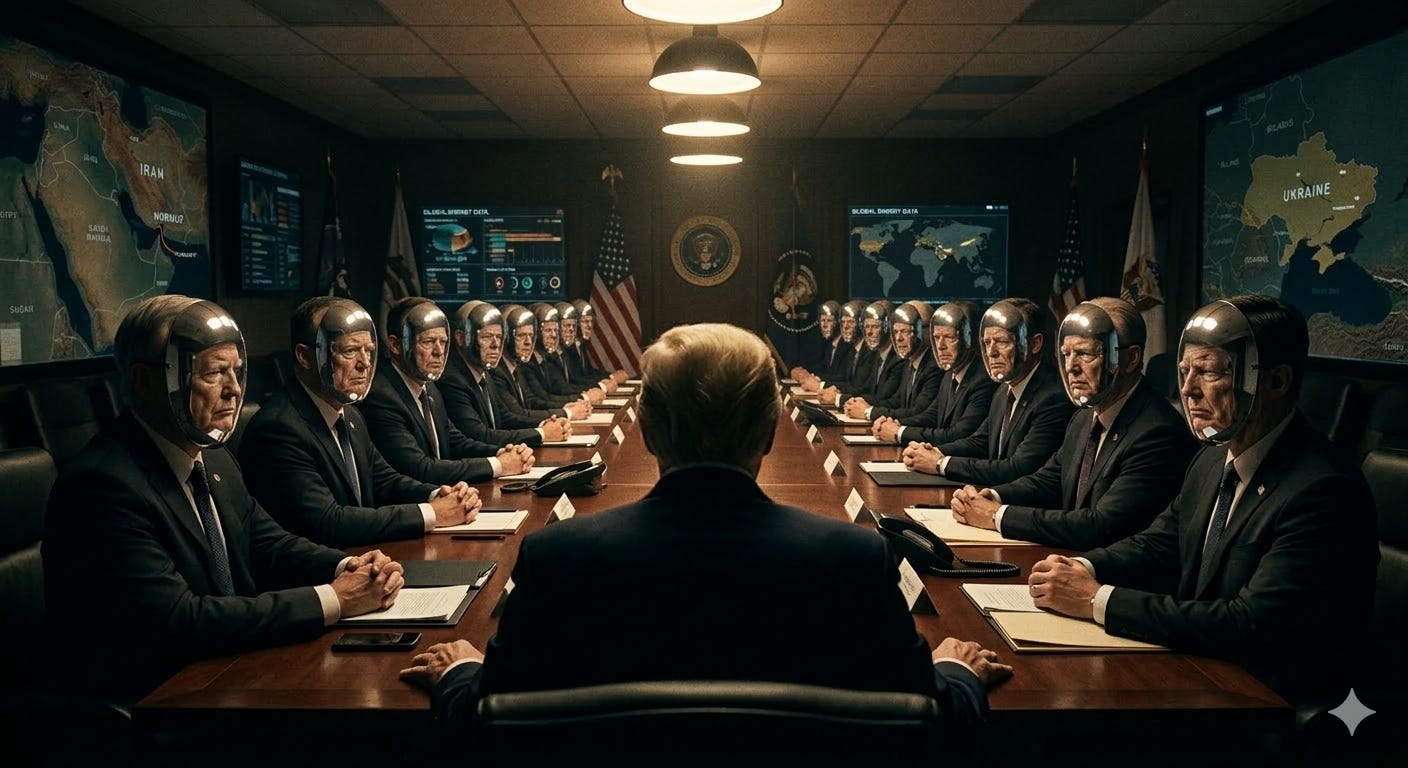
Great powers rarely collapse because enemies defeat them.
More often, they collapse because no one in the room is willing to say no.
What follows is not a policy disagreement. It is a case study in what happens when the people with the knowledge decide it is safer to stay quiet - and the people in power stop being told the truth.
We are watching it happen in real time. The evidence is sitting in the desert in Jordan.
The Radar
On or around March 1–2, 2026, an Iranian drone - a single-use kamikaze weapon costing somewhere between $20,000 and $60,000 depending on the model - destroyed a U.S. Army AN/TPY-2 radar at Muwaffaq Salti Air Base in Jordan. Satellite images confirmed it. The Pentagon declined to comment.
The AN/TPY-2 is the eyes of a THAAD battery - Terminal High Altitude Area Defense, the U.S. Army’s premier system for intercepting ballistic missiles in the final seconds before impact. Destroy the radar, and the battery is blind. The missiles it was there to stop are now uncontested. It is, according to the Missile Defense Agency’s own 2025 budget, worth approaching half a billion dollars. The United States operates approximately eight THAAD systems worldwide. There are no spares.
Similar strikes damaged THAAD radar infrastructure in the UAE, Qatar, Saudi Arabia, and Bahrain in the opening days of the war. By one estimate, Iran destroyed $2.7 billion worth of high-value U.S. radar systems in the first week of hostilities.
A $40,000 drone destroyed a $500 million radar. There are no replacement radars in storage. Someone decided this was an acceptable risk.
The vulnerability was not a secret. Military analysts had been writing about it for years. THAAD batteries are large, largely static, and detectable by commercial satellite. The AN/TPY-2 emits a powerful radar signature that can be homed in on autonomously. Layered drone protection - the kind Ukraine had been building and refining for two years against the same Iranian Shahed drones now being used against us - was the obvious answer.
No one required it to be in place before deployment.
The Offer That Sat on a Shelf
On August 18, 2025, President Zelenskyy walked into the White House and made an offer.
Ukraine had spent two years developing battle-tested technology to detect, intercept, and defeat Iranian Shahed drones - the same weapons now killing American service members and destroying infrastructure. Zelenskyy’s team presented a detailed proposal: drone defense hubs in Turkey, Jordan, and the Gulf states, positioned near American bases, using Ukrainian interceptor technology that had already proven effective in combat. The presentation included maps, cost projections, and a warning that Iran was actively improving its drone capabilities.
Trump told his team to look into it.
“They didn’t do anything.” - Ukrainian official, as reported by Axios
The administration’s explanation, offered months later by officials who preferred not to be named: they were skeptical of “the proposal and its presentation.” In other words, they thought Ukraine was selling something.
Seven American service members are now dead. The United States last week formally asked Zelenskyy for the help it had already been offered and declined. Two U.S. officials told Axios that passing on Ukraine’s proposal was, in their words, “one of the administration’s biggest tactical mistakes” before the war began.
Ukraine offered the solution in August. American soldiers came home in coffins in March. The administration then asked Ukraine for the help it had already refused.
The Math No One Did
There is a third problem, and it compounds the first two.
The United States is now firing $15 million interceptor missiles to knock down drones that cost tens of thousands of dollars. The exchange ratio is not sustainable. Iran has an industrial base for Shahed production. We do not have an equivalent base for the interceptors being expended to stop them. At the rate reported in the opening weeks of hostilities, the U.S. has burned through a significant fraction of its global interceptor stockpile.
This is precisely the war of attrition our adversaries design for. The strategy is not to defeat American air power. It is to exhaust it - to trade mass-produced expendable weapons for silver bullets until the United States is strategically bankrupt and politically exhausted.
Ukraine understood this. They had lived it. They came to Washington with a cheaper answer.
No one in the room said: we need to think carefully about this exchange ratio. No one said: we have eight THAAD batteries in the world and no replacements. No one required drone protection for the most expensive radar systems in the U.S. Army inventory before deploying them into a conflict zone.
Or if someone said it, no one listened.
The Collapse of Counsel
These are not failures of intelligence. The information was available. The warnings were on record. The offer was made in person, by the head of state of a country that had been fighting these exact weapons for two years.
This is a failure of counsel - what happens when the people around power have learned that the cost of honesty is higher than the cost of silence. When the first instinct in the room is to protect access rather than provide analysis. When skepticism about a briefer’s motives becomes an excuse to ignore the substance of what they’re saying.
A government built on loyalty rather than competence does not correct bad ideas. It amplifies them.
The quislings in this story are not the ones who gave the wrong answer. They are the ones who made sure the right answer never got a hearing.
The room was full. No one said no.
The bill so far: seven dead Americans and $2.7 billion in destroyed radar systems in the first week alone - equipment with no replacements in storage, protecting bases that had been warned, against weapons that a foreign president had offered to counter eight months earlier.
That is what a government built on obedience costs.
The invoices come in two forms. One is denominated in dollars. The other comes home in flag-draped coffins.
The 19-year-olds don’t get to say no either.
If this matters to you, send it to someone who needs to read it.
I didn’t know about this. Thanks for keeping us informed!
Thank you Hawkeye 1972 for this insightful article about the incompetence of the current administration to fight war in this new era. It is disheartening to know that we are being led in the war by incompetent leaders that are costing human lives as well as taxpayers dollars.