

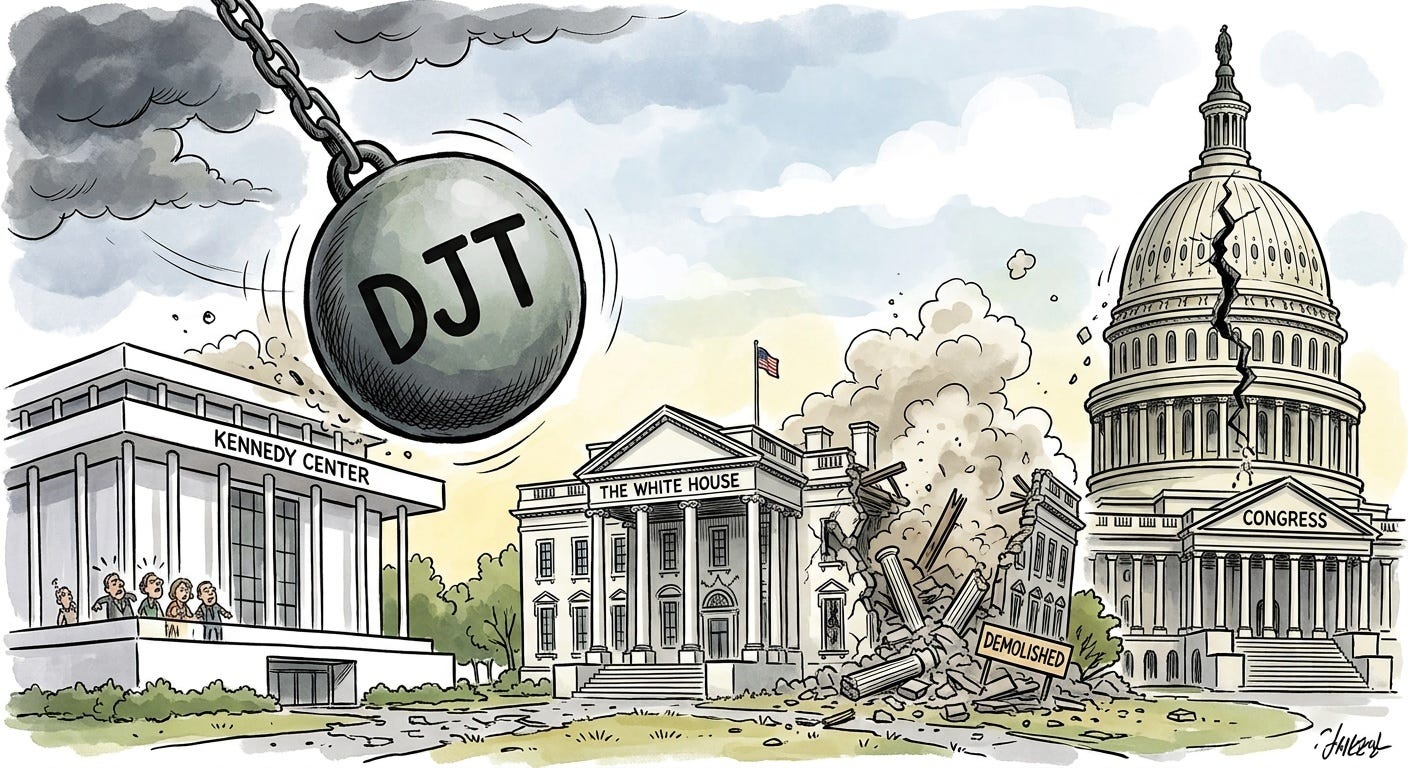
A digression from our usual quisling hunting. After the demolition of the East Wing of the White House, the threats to the Kennedy Center raised a question we could not resist: what becomes of the buildings Donald Trump touches?
On September 16, Donald Trump was photographed aboard Air Force One studying a large printout of the Kennedy Center. One of the markups he examined was labeled “Kennedy Center DEMOLISHED.”
The same day he told reporters the building would be “ripped down” if his name did not go on it: “If we don’t do that, it’s going to close, it will end up being ripped down.”
The day before, the board he chairs had voted to close the center. On the 17th, Judge Christopher Cooper ordered the administration to give 30 days’ written notice before any demolition.
The Justice Department had already told the court, on August 25, that the building was “decrepit,” faced a “death spiral,” and could be torn down if a judge blocked the renovation plan.
Some of the trouble is real. Plaster fell from the Grand Foyer ceiling in a storm this month. The center blames decades of deferred maintenance by previous leadership, but critics suggest it is the lack of maintenance in the last year. The center reported a $6 million surplus in 2023, before Mr. Trump took over. This year it was on track for about $124 million in revenue against a $220 million budget, and the board’s own packet warned of “certain fiscal collapse” within weeks. It suggested that putting his name on the building might be the only way to avert it.
We take no position on the building’s engineering. We ask a narrower question. What happens to buildings in this man’s care? He has a record, and it is worth reading.
Atlantic City
Trump Plaza opened in 1984, the first of three Trump casinos in Atlantic City. Trump Castle opened in 1985. The Taj Mahal followed in April 1990, at a cost of nearly $1 billion, and was in bankruptcy court the next year.
The casino companies would return to bankruptcy court in 2004, 2009 and 2014, four trips in all. Trump Castle, by then renamed Trump Marina, was sold in 2011. It is now a Golden Nugget.
Trump Plaza closed on September 16, 2014. About 6,100 people had worked there. It then stood empty for six years while pieces of its facade kept falling, until the building was declared an “imminent hazard.” On February 17, 2021, about 3,000 sticks of dynamite brought it down. A nearby lot reportedly charged $10 to watch.
The Taj Mahal closed on October 10, 2016. By then Mr. Trump held only the name. Carl Icahn controlled the casino and said it had lost almost $350 million in a few years. About 3,000 people worked there, roughly 1,000 of them on strike since July 1.
A 2016 New York Times report found contractors and local businesses left unpaid by the bankruptcies. A former state legislator said many would never recover what they were owed. A USA Today analysis that year counted about 60 lawsuits and more than 200 liens from plumbers, painters, contractors and others who said Trump businesses had not paid them in full.
Mr. Trump took credit for reviving Atlantic City. Those who worked and lived there may have a different opinion.
The rest of the ledger
Buildings are only the visible part. The same decades produced a long list of ventures that ended the same way:
• Trump Shuttle. Bought for $365 million. It never turned a profit, loans went into default, and was gone in about three years.
• Trump Vodka (2006). Production ceased in 2011.
• GoTrump.com (2006). The travel service shut down about a year later.
• Trump Mortgage (2006). Folded in less than 18 months, as the mortgage crisis arrived.
• Trump Magazine (2007). Ceased publication in 2009, with bills unpaid.
• Trump Steaks (2007). Sold only through Sharper Image and QVC, and pulled from both after about two months of negligible sales.
• New Jersey Generals. Bought in 1983. The league folded, and took the franchise with it.
• Trump University (2005-2010). Students called the courses extended infomercials. A $25 million settlement was announced in November 2016, within weeks of his election.
• The Trump Foundation. In a settlement it admitted that Mr. Trump had diverted its money toward his 2016 campaign, his legal fights, and purchases of self-portraits and sports memorabilia. It agreed in 2018 to dissolve, and a court later ordered him to pay $2 million to charities.
Not every item on that list is a scandal. Businesses fail. What the list shares is who was left holding the bill: workers, contractors, students, charities.
Then the White House
The East Wing was demolished in October 2025, even though Mr. Trump had said ballroom construction would not affect the building.
The National Trust for Historic Preservation sued on December 12, 2025. Its complaint says: “No president is legally allowed to tear down portions of the White House without any review whatsoever.”
On August 21, 2026, Chief Justice John Roberts, whose expansive view of presidential power we have covered before (see our index), signed a brief order temporarily lifting the lower court’s bar on above-ground construction. The case has not been decided on the merits.
The Reflecting Pool
In April, Mr. Trump announced he would resurface the Reflecting Pool in “American Flag Blue.” He had called it “absolutely filthy” on March 31 and said the work “was supposed to be done by the Biden Administration.” The job went to Atlantic Industrial Coatings of Virginia under a no-bid contract that has grown to about $14.7 million. By June 19, the new coating was peeling.
Mr. Trump blamed vandals. On June 21 he wrote that work would begin immediately on “fixing the seriously vandalized Reflecting Pool,” and he claimed a 250-foot gash in the liner. Four people were charged, including former Olympic canoeist David Hearn, who said he touched the peeling material out of curiosity. Prosecutors later dropped the cases. U.S. Attorney Jeanine Pirro’s filing blamed a “botched installation,” and Mr. Trump said she had “folded like an umbrella.”
The Washington Post has now obtained a 75-page failure analysis that an inspection firm prepared for the contractor. It found 85 failure points, including about 40 blisters and buckling along eight of the pool’s ten expansion joints. It blamed an inflexible coating, poor application and too little drying time – basically improper materials and a rushed job. Vandalism was not mentioned as a cause.
Mr. Trump has conceded “some contractor error” but still blames others, saying vandals did the major damage. Trump continues to follow his rule of “Never accept blame” (see the OSS psych eval of Hitler on our “Voices” page at quislings.info).
Back to the Kennedy Center
Mr. Trump first tried to put his own name on the building. When Judge Cooper blocked that, they came up with new signage. On August 13, the center’s Trump-appointed board voted for a $257 million renovation that would close the main building to the public for two years. The sign would read “Restored and Renovated by President Donald J. Trump.”
Judge Cooper has ruled twice that only Congress can put Mr. Trump’s name on the building. Lawyers for Rep. Joyce Beatty, who brought the suit, called the Justice Department’s demolition talk a “not-so-subtle threat.”
The Pattern
Look back over this ledger and a pattern emerges. Buildings fell, ventures folded, and the bills often went to someone else. Mr. Trump’s genuine moneymakers have been The Apprentice and the enterprises that have grown up around him since 2016, most recently crypto. His own memecoin is down more than 90 percent from its peak. By May 2025, Chainalysis had counted about 764,000 wallets that lost money on it, against 58 that each made more than $10 million.
Mitt Romney saw it coming. In a March 2016 speech at the University of Utah, he said: “A business genius he is not.”
But he is persistent, and he has proved effective at talking people out of their money and their votes. We only hope there is something left of Washington, DC, and of the country, by the time we are shut of him.
Sources
• Axios: Kennedy Center demolition requires 30-day notice, judge rules (Sept. 17, 2026)
• ABC News: Lawyers hit back after Trump admin suggests Kennedy Center could be demolished
• Law News: Kennedy Center demolition threat looms as judge blocks Trump naming bid
• HNGN: Kennedy Center faces bankruptcy; board ties rescue to Trump name (Sept. 14, 2026)
• American Almanac: Kennedy Center ceiling collapse blamed on years of neglect
• Rolling Stone: Watch the Trump Plaza Hotel and Casino in Atlantic City implode
• CNN Money: Trump Taj Mahal closes its doors in Atlantic City
• Wikipedia: Trump Entertainment Resorts
• NBC News: Hundreds claim Donald Trump doesn’t pay his bills in full (USA Today analysis)
• NBC News: Donald Trump’s failed business ventures are back in the spotlight
• WION: From Trump Airlines to Trump Vodka, biggest business flops
• The Takeout: Why Trump Steaks failed after just 2 months
• NBC News: Federal court approves $25 million Trump University settlement
• NBC News: Trump pays $2 million judgment for misusing his charity
• Bloomberg Law: Trump, administration heads sued over East Wing demolition
• States Newsroom: Supreme Court allows $400 million Trump ballroom project to proceed
• NPR (WAMC): Supreme Court allows Trump’s ballroom construction to continue for now (Aug. 21, 2026)
• Fast Company: Complete timeline of the Trump Reflecting Pool drama
• The Daily Beast: Jaw-dropping scale of Trump’s Reflecting Pool fiasco exposed (Oct. 14, 2026)
• NPR: Three more people have Reflecting Pool charges dropped after Hearn request (Aug. 3, 2026)
• NewsOne: “A Business Genius He Is Not,” Romney says about Trump (March 3, 2016)
• Cointelegraph: Trump crypto empire reaps $1B (citing the Financial Times, Oct. 2025)
As always - great article, however you neglected one major failure: The Plaza Hotel in NYC. Trump purchased in 1988 for between $395M and $406 - the delta is the difference between public records of $395M and Trump's contention at $406M. He was able to acquire in an auction with a substantial amount of debt which he ultimately could not service, the property went into Chapter 11 in 1992 and Trump lost control in 1995 when the property reverted to lenders and a Saudia investor. Today it operates successfully as a Fairmont Hotel