
The Salamander’s Long Shadow
How Gerrymandering Ate American Democracy

From a Boston newspaper in 1812 to the Supreme Court in 2026, the story of a political monster we named, tolerated, and finally unleashed.
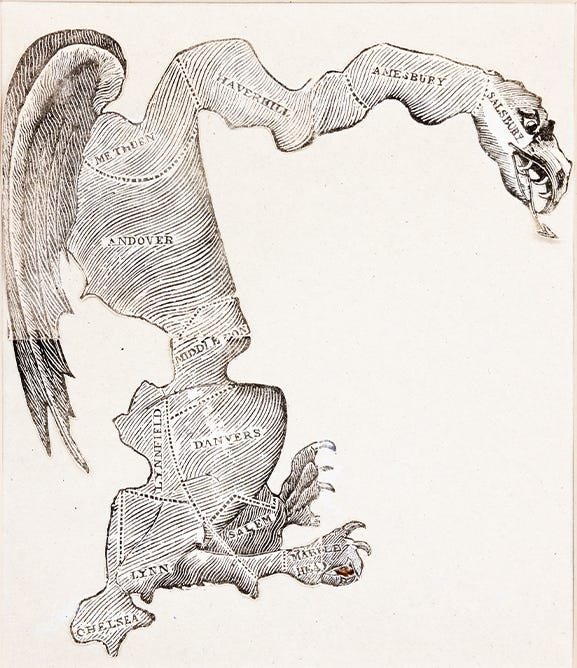
The word is gerrymander. Half a person's name, half the word salamander. It sounds like it escaped from somewhere strange - and it did. It also describes one of the most corrosive forces in American democracy. It was coined as mockery, then became policy. And over the last decade, the Supreme Court has transformed it into something very close to a constitutional right.
A Monster Is Born: Boston, 1812
In 1812, Governor Elbridge Gerry of Massachusetts signed a bill redrawing the state’s senate districts so grotesquely that one district in Essex County looked, on a map, like a serpentine creature. The Boston Gazette ran a cartoon of it with wings, claws, and a dragon’s head. Someone combined the governor’s name with the Greek for fire lizard - salamander - and the word gerrymander entered the language permanently.
Gerry himself didn’t much like the bill. He signed it anyway, lost his governorship that same year partly because of the outrage, and died in office as US Vice President in 1814, his name forever attached to the practice.
That irony - a man punished at the polls for a practice designed to prevent punishment at the polls - has never quite repeated itself. Incumbents who gerrymander tend to stay incumbents. That’s the whole idea.
The Ten-Year Clock
The Constitution requires a census every ten years to apportion congressional seats. But the census also triggers redistricting - the redrawing of district lines to account for population shifts. This is legitimate and necessary. People move. Lines need to follow.
The problem is who draws them. In most states, that job belongs to the legislature - the very politicians whose electoral futures depend on where the lines fall.
Two legal guardrails mattered most:
The first was racial. The Fourteenth and Fifteenth Amendments, and later the Voting Rights Act of 1965, prohibited drawing lines to dilute the voting power of Black, Latino, and other minority communities. Packing them into one district, or cracking a community across five districts so it was a minority in all of them - that was illegal.
The second was partisan. Whether purely partisan gerrymandering violated the federal Constitution remained genuinely contested for decades. In 2019, the Supreme Court settled it. Or rather, it unsettled it.
Rucho v. Common Cause (2019): The Court That Walked Away
The cases before the Court were egregious. North Carolina’s Republican legislature drew a map explicitly designed to produce a 10–3 Republican congressional delegation regardless of the statewide vote.
A North Carolina legislator said on the record that he aimed for 10–3 because he didn’t think an 11–2 advantage was “possible.”
Maryland’s Democratic legislature had targeted a specific Republican incumbent, redrawing his district to flip it. Internal communications left nothing to the imagination.
Two federal district courts found both maps unconstitutional. On June 27, 2019, the Supreme Court reversed them, 5–4, in an opinion written by Chief Justice John Roberts.
Roberts’ majority is, in a strange way, a study in candor about its own conclusions. He did not pretend partisan gerrymandering was anything other than what it is:
“Excessive partisanship in districting leads to results that reasonably seem unjust.” - Chief Justice John Roberts, Rucho v. Common Cause (2019)
He acknowledged the practice “debilitates representative democracy.” And then he said federal courts could do nothing about it.
“Federal courts are not equipped to apportion political power as a matter of fairness.” - Roberts, Rucho
Partisan gerrymandering claims, he held, are “political questions beyond the reach of the federal courts” - there are no “judicially manageable standards” by which a court could determine how much partisan advantage is too much.
“Federal judges have no license to reallocate political power between the two major political parties, with no plausible grant of authority in the Constitution, and no legal standards to limit and direct their decisions.” - Roberts, Rucho
What is illogical about this argument: Roberts argued there is no manageable standard - but courts have invented standards for politically charged questions throughout history. The Warren Court’s “one person, one vote” doctrine was itself a judicially crafted standard applied to the same redistricting process.
Roberts was not describing an impossibility; he was making a choice. Worse, by declaring the question non-justiciable, the Court ratified the status quo - maps already drawn by self-interested politicians - while offering no viable remedy.
Justice Elena Kagan’s dissent was withering:
“Of all times to abandon the Court’s duty to declare the law, this was not the one. The practices challenged in these cases imperil our system of government… None is more important than free and fair elections. The majority’s abdication comes just when it is needed most.” - Justice Elena Kagan, dissenting in Rucho
Rucho did not create partisan gerrymandering. But it federally sanctioned it - telling every state legislature that the Constitution poses no obstacle to drawing maps as nakedly partisan as technology allows. And by 2019, the technology allowed a great deal.
As we wrote in a previous article, "Quisling Spotlight: John Roberts" - Roberts has single-handedly undermined democracy and set the stage for American oligarchy: money without limits, voting without guardrails, and a presidency with sweeping immunity. This decision in Rucho fits a pattern…
The VRA’s Last Line - and Its Demolition
If Rucho surrendered on partisan gerrymandering, one protection remained: the Voting Rights Act of 1965. Section 2 prohibited any voting practice - including redistricting - that resulted in the dilution of minority voting power. You didn’t have to prove intent. If the map diminished minority representation, it was illegal. The Congressional Black Caucus owes much of its existence to Section 2 litigation.
Then came Louisiana. After the Supreme Court’s 2023 ruling in Allen v. Milligan ordered Louisiana to draw a second majority-Black congressional district, the legislature complied - passing Senate Bill 8, a new redistricting law that created two majority-Black districts out of the state’s six, roughly matching its population. Plaintiffs then challenged that very map as an unconstitutional racial gerrymander.
On April 29, 2026, in Louisiana v. Callais, the Supreme Court agreed. 6–3. Written by Justice Samuel Alito.
Alito held that because the VRA did not, in the Court’s reworked analysis, actually require Louisiana to draw a second majority-minority district, using race to draw it was unconstitutional. The opinion significantly rewrote the 40-year-old Thornburg v. Gingles framework - the bedrock standard for Section 2 claims - making it far harder for minority voters to prevail.
What the ruling effectively established: unless legislators explicitly state they are drawing maps to harm minority voters, those maps will stand. No modern gerrymanderer documents their discriminatory intent. This standard is not a guardrail. It is an open door.
“The majority’s changes eviscerate the law, so that it will not remedy even classic cases of vote dilution.” Section 2 is rendered “all but a dead letter.” - Justice Elena Kagan, dissenting in Louisiana v. Callais (2026)
The Shape of What We’ve Lost
In seven years, the Supreme Court dismantled the two most powerful federal checks on redistricting abuse. Rucho removed the constitutional guardrail against partisan manipulation. Callais gutted the statutory guardrail against racial manipulation.
The combined result: a state legislature in power can draw essentially whatever map it wants - partisan or racial - with near-total federal impunity. And they can do it at any time - the census is irrelevant.
Roberts suggested in Rucho that states could fix the problem themselves through independent redistricting commissions. Some have - California, Michigan, Arizona, and Colorado among them. But it is a patchwork, uneven and fragile, dependent on the political will of the very people who benefit from the status quo. Plus, as we’ve seen this year with Louisiana and others, unilateral surrender is unappealing while other states are aggressively manipulating their districts.
The salamander Gerry lent his name to is now, for practical purposes, federally protected wildlife.
★★★
All case quotes drawn from published majority and dissent opinions.
Great article!